Your Amazon Brand Store Should Not Be Just a Homepage, It Should Be a Decision Hub
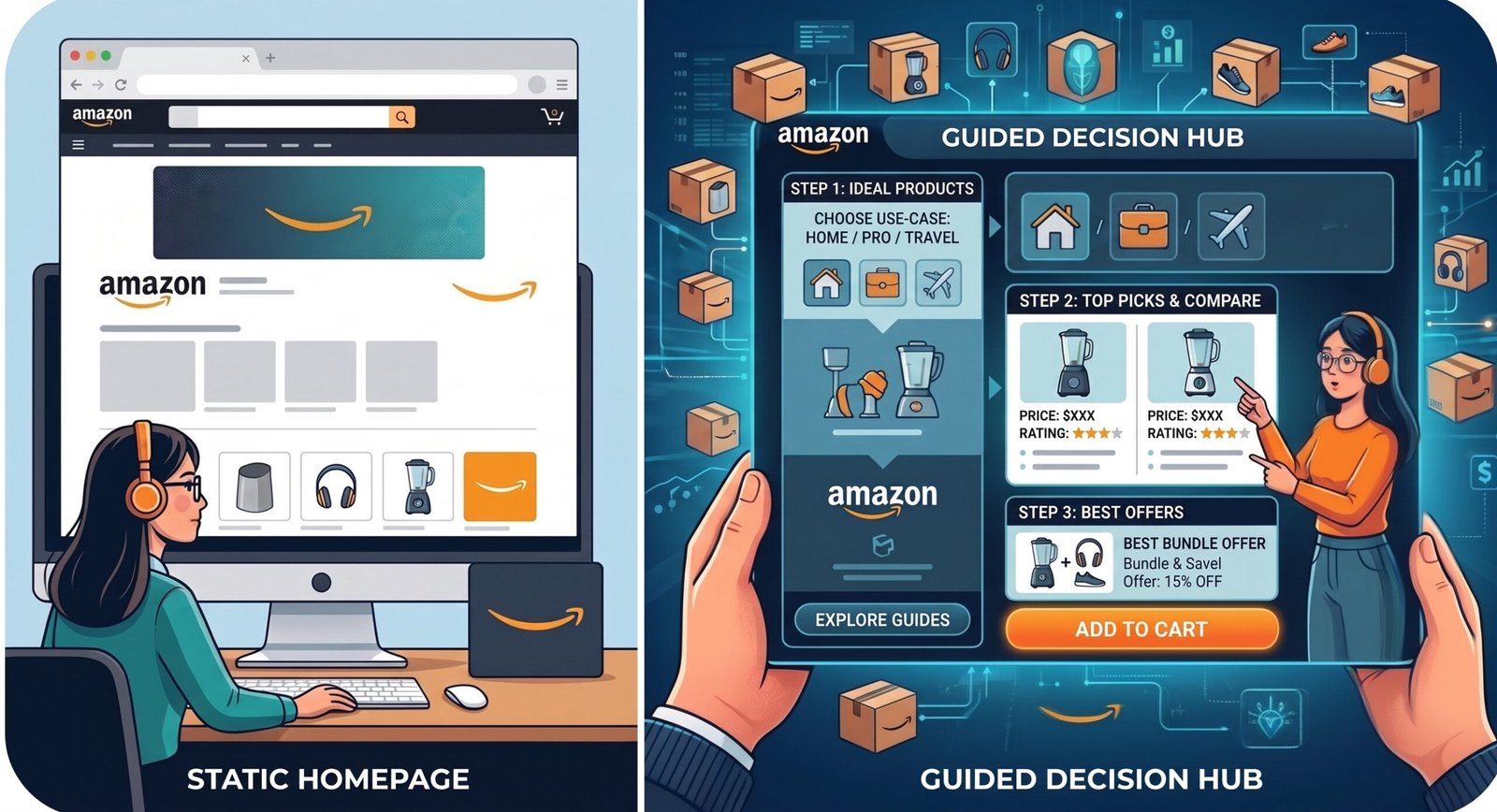
Many sellers have an Amazon Brand Store, but far fewer use it as a serious selling tool.
That is a missed opportunity.
For eligible brands, Amazon Brand Stores provide a free, self-service branded destination on Amazon where sellers can create a multi-page experience without coding. Amazon also notes that Brand Stores can be used as landing pages for Sponsored Brands or display campaigns, which means they can support both organic brand discovery and paid traffic.
But many sellers still treat the Brand Store like a simple digital brochure.
They add a logo, a banner, a few lifestyle images, and a grid of products. It may look nice, but it does not necessarily help the customer make a buying decision.
The stronger approach is this:
Use the Brand Store homepage as a decision hub.
Not just a brand showcase.
Not just a product catalogue.
A decision hub.
What Is a Decision Hub?
A decision hub helps customers answer the questions they naturally have before buying.
For many product categories, especially appliances, home goods, electronics, beauty tools, kitchen items, and specialty products, shoppers are not only asking:
“What products does this brand sell?”
They are asking:
“Which one is right for me?”
“What is the difference between these models?”
“Is the premium option worth it?”
“What should I buy first?”
“Do I need accessories?”
“What fits my space, budget, or usage?”
A standard product grid does not answer those questions well.
It forces the customer to click multiple products, compare details manually, read scattered reviews, and guess which option makes sense.
A decision hub reduces that friction.
It organizes the Brand Store around buying decisions, not just product categories.
Why Many Brand Stores Are Underused
Many Amazon sellers focus heavily on individual product listings because that is where conversion happens. That makes sense. Product detail pages still matter enormously.
But when a brand has multiple related products, variations, accessories, or use cases, individual listings may not explain the full picture.
For example, a small appliance seller may have:
- entry-level model
- premium model
- compact model
- heavy-use model
- accessories
- replacement parts
- bundles
- seasonal offers
If all of those appear as a flat product grid, the shopper has to do the thinking.
A better Brand Store helps guide the shopper.
Instead of saying:
“Here are all our products.”
it says:
“Here is how to choose the right product for your situation.”
That is a much stronger selling experience.
The Brand Store Homepage Should Guide, Not Just Display
A good homepage should not try to show everything at once.
It should guide the customer into the right path.
For example, an appliance brand could structure the Brand Store homepage around sections such as:
Best Sellers
For shoppers who want the most popular options.
Shop by Use Case
Small kitchens, family cooking, heavy cooking, meal prep, home café, entertaining.
Compare Models
A simple explanation of entry-level, mid-tier, and premium options.
Bundles & Accessories
Products that work better together.
New Arrivals or Seasonal Offers
Useful for campaign traffic.
Replacement Parts & Filters
Helpful for repeat customers and existing owners.
This turns the Store into a shopping assistant rather than a static catalogue.
Use the Store to Reduce Model Confusion
Many brands unintentionally make shopping difficult because their products are named by model numbers.
A shopper may see:
Model A
Model B
Model C
Model D
But they do not immediately understand the difference.
The Brand Store homepage can solve this by translating product differences into customer language.
For example:
Choose this model if you want the best value.
Choose this model if you need more power.
Choose this model if you have a small kitchen.
Choose this model if you cook frequently.
Choose this accessory if you already own Model X.
This is especially useful for small appliances, range hoods, kitchen tools, vacuum products, and other categories where specifications matter.
Customers do not want to decode your catalogue.
They want help making the right choice.
Use Sponsored Brands Traffic More Strategically
Amazon says Brand Stores can be used as landing pages for Sponsored Brands and display campaigns.
That means sellers do not always need to send paid traffic directly to one product detail page.
Sometimes, sending traffic to a decision-focused Store page may be more useful.
For example:
A Sponsored Brands campaign for “range hood” could send shoppers to a Store page that explains:
- under-cabinet vs wall-mount
- 30-inch vs 36-inch
- ducted vs ductless
- best model for heavy cooking
- accessories and filters
A campaign for “rice cooker” could send shoppers to:
- small household options
- family-size options
- premium cooking features
- meal-prep bundles
- accessories
This gives the customer more context before choosing a product.
It also gives the brand more control over how the product family is presented.
Organize Around Customer Missions
One of the strongest ways to improve a Brand Store is to organize it around customer missions.
Instead of only using categories like:
Products
Accessories
New Arrivals
use more decision-based sections:
Small Kitchen Setup
Back-to-Routine Meal Prep
Heavy Cooking Essentials
Home Café Setup
Holiday Prep
Replacement Filters & Parts
Best Value Picks
This approach feels more helpful because it matches how people think.
Customers do not wake up thinking:
“I need to browse a product taxonomy.”
They think:
“I need something that solves my problem.”
A decision hub connects the catalogue to that problem.
Brand Stores Can Support Repeat Purchases Too
A Brand Store is not only for first-time customers.
It can also help existing customers find what they need next.
For appliance and home-product brands, this matters.
Customers may return for:
- filters
- accessories
- replacement parts
- cleaning supplies
- compatible add-ons
- upgraded models
- giftable items
- related products
A strong Brand Store homepage should make those paths obvious.
This can increase customer value without relying only on discounts.
What Sellers Should Build First
Sellers do not need to redesign the entire Brand Store at once.
Start with the homepage.
Ask:
Does this page help shoppers decide, or does it only show products?
Then add three useful sections:
1. Help Me Choose
Create a simple model comparison.
Show who each product is best for, the main benefit, and the main difference.
2. Shop by Use Case
Group products around real customer situations.
For example: small kitchen, meal prep, family cooking, heavy cooking, home café, or holiday hosting.
3. Complete the Setup
Show accessories, bundles, replacement parts, or add-ons that naturally belong with the main product.
These three sections can make the Store immediately more useful.
Key Takeaways
An Amazon Brand Store should not be treated as a decorative extra.
For eligible brands, it is a free, self-service branded destination inside Amazon’s shopping environment, and it can support both brand storytelling and advertising traffic.
But the real opportunity is not simply having a Store.
The opportunity is using it properly.
A weak Brand Store says:
“Here is our brand. Here are our products.”
A stronger Brand Store says:
“Here is how to choose the right product for your needs.”
That difference matters.
As shopping becomes more comparison-driven, sellers need to help customers make decisions faster and with more confidence.
Your Amazon Brand Store homepage should not only look good.
It should guide the buyer.
It should explain the product family.
It should reduce confusion.
It should connect products to use cases.
It should support ads, repeat purchases, bundles, accessories, and seasonal campaigns.
Most importantly, it should help customers answer the question that matters most:
“Which one should I buy?”
That is how a Brand Store becomes more than a homepage.
It becomes a decision hub.