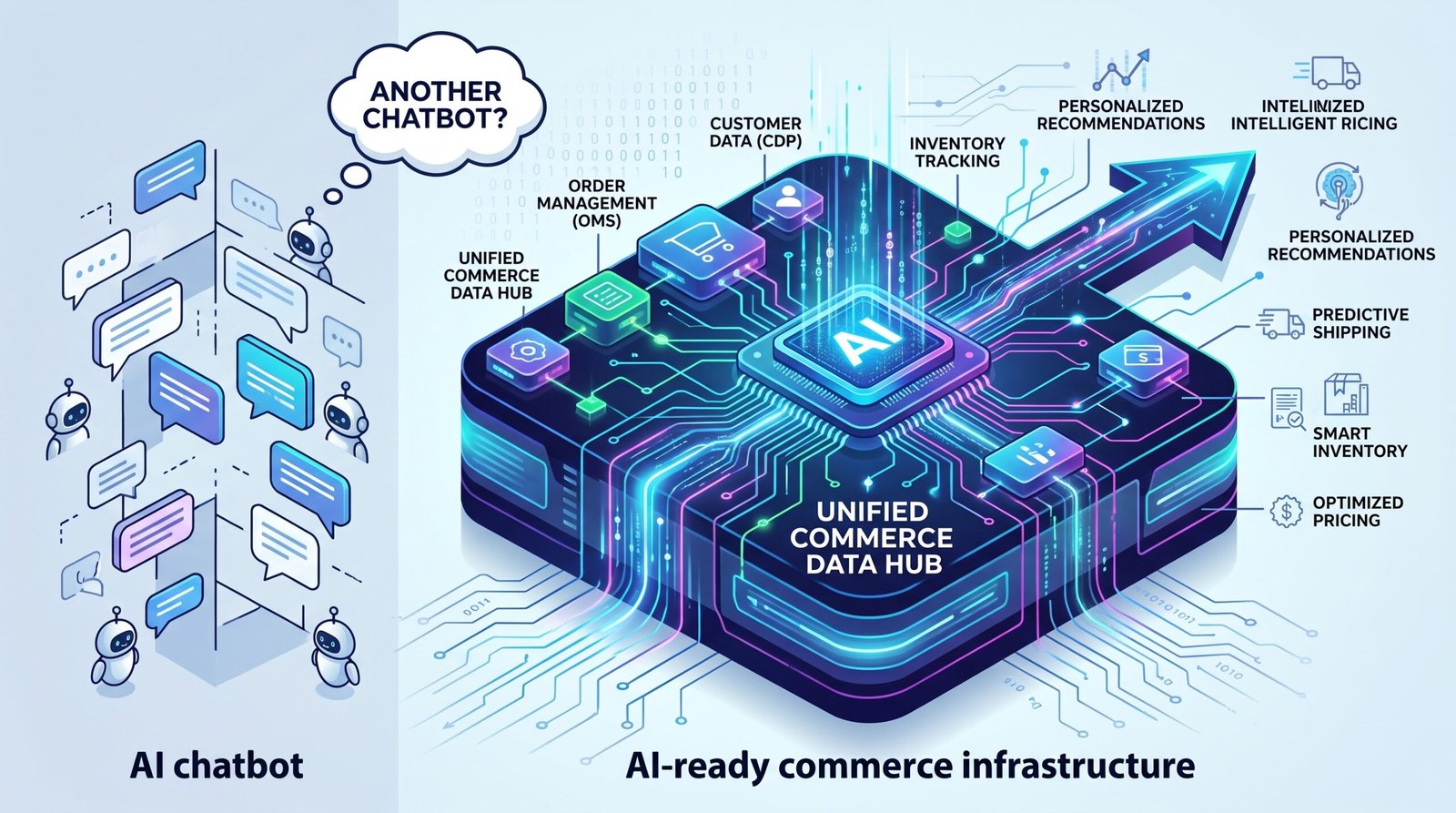
You Don’t Need Another AI Chatbot. You Need AI-Ready Commerce Infrastructure.
Every week brings another AI tool promising to automate customer service, write product descriptions, optimize advertising, analyse sales or become your company’s next digital employee.
For e-commerce businesses, the temptation is understandable.
Add a chatbot. Connect an automation platform. Install an AI app. Build an agent.
Done. You’re now an AI-powered business.
Except you probably aren’t.
The biggest opportunity in AI commerce isn’t adding another chatbot to your website. It is building the infrastructure underneath your business that allows AI to actually understand your products, economics, customers and operations.
That difference is becoming increasingly important.
The Chatbot Is Only the Surface
A chatbot is an interface.
A customer asks:
“Do you have this product in stock?”
For the chatbot to provide a genuinely reliable answer, it needs access to accurate inventory.
Then the customer asks:
“Can you deliver it to Toronto by Friday?”
Now the AI needs fulfillment information, shipping rules and possibly warehouse location.
Then:
“Is there another model that’s cheaper but has similar features?”
Now it needs structured product specifications, pricing and product relationships.
The intelligence may appear to live inside the chatbot, but most of its usefulness actually comes from the systems behind it.
Without those systems, you have a very sophisticated conversational interface sitting on top of incomplete information.
That is the difference between using AI and being AI-ready.
Commerce Is Moving Beyond the Website
For years, e-commerce strategy revolved around the website.
Drive traffic to the store. Improve the product page. Optimize checkout. Increase conversion.
Those things still matter.
But the purchasing journey is becoming more distributed.
Consumers can now discover products through marketplaces, Google, social platforms and increasingly AI assistants.
OpenAI says product recommendations in ChatGPT can use merchant and product metadata such as availability, price and other product information. Merchants can also provide product feeds so information stays current.
Shopify is seeing the same shift. It reported that in Q1 2026, AI-driven traffic to Shopify stores grew more than eightfold year-over-year, while orders originating from AI-powered searches increased nearly thirteenfold.
That changes an important question for retailers.
It is no longer only:
“Can customers understand my product page?”
It is increasingly:
“Can machines understand my products?”
Your Product Data Is Becoming Part of Your Marketing
Imagine someone tells an AI shopping assistant:
“Find me a compact air purifier under $300 that is quiet enough for a bedroom, available in Canada and suitable for a 400-square-foot room.”
The AI needs to understand:
- product category
- dimensions
- price
- availability
- room coverage
- noise level
- shipping destination
- specifications
- compatible use cases
If Brand A provides clean, structured information and Brand B has most of those details buried inside images, PDFs and inconsistent descriptions, the AI has a much easier time evaluating Brand A.
Shopify describes this directly: AI agents use structured information including titles, descriptions, images, pricing, inventory and shipping data to determine which products to surface.
This means product information is no longer simply website content.
It is becoming commerce infrastructure.
And potentially a new form of distribution.
But Clean Product Data Is Only Layer One
An AI-ready commerce business needs several connected layers.
The first is product and operational data.
SKUs, attributes, inventory, pricing, promotions, shipping rules and policies should be accurate and consistent.
The second is connectivity.
Your website, marketplaces, advertising platforms, CRM, inventory system, analytics and fulfillment tools should not operate as completely isolated islands.
The third is business economics.
This may be the most overlooked layer.
Suppose an AI system sees:
Revenue: $50,000
Advertising spend: $10,000
It calculates a 5× ROAS and recommends increasing advertising.
Sounds reasonable.
But what if it doesn’t know:
Product cost: $24,000
Marketplace fees: $6,000
Shipping: $5,000
Discounts: $2,000
Returns: $2,500
Suddenly, “increase advertising” might not be such a great recommendation.
An AI system that optimizes revenue without understanding profit can simply help you lose money faster.
AI-ready businesses therefore need clearly defined metrics such as contribution margin, customer acquisition cost, allowable advertising spend and inventory thresholds.
Then Comes Automation
Once the data and economics are reliable, AI becomes far more useful.
Imagine an AI commerce agent reviewing your catalogue every morning.
It identifies a product whose sales have fallen 25%.
Instead of simply reporting the decline, it checks:
inventory levels
advertising traffic
conversion rate
competitor pricing
promotion history
profit margin
It discovers that traffic is stable but conversion has fallen after competitors reduced their prices.
The system calculates that your current margin allows a temporary $15 promotion without dropping below your required contribution margin.
Now it can recommend:
“Test a $15 promotional discount for seven days.”
That is much more valuable than:
“Sales are down 25%.”
Eventually, the system might even prepare the promotion automatically.
But there should still be controls.
AI Automation Needs Guardrails
AI readiness does not mean giving an AI agent unlimited authority.
A sensible progression might be:
Stage 1: Analyse
AI identifies problems and opportunities.
Stage 2: Recommend
AI suggests actions.
Stage 3: Prepare
AI creates the campaign, pricing change or workflow but waits for approval.
Stage 4: Act Within Rules
AI can make specific changes within predefined limits.
For example:
“Advertising bids may change by a maximum of 10%.”
“Never reduce product margin below 22%.”
“Do not promote products with fewer than 15 units in inventory.”
“Any price reduction above $20 requires human approval.”
This is controlled automation.
The goal is not to remove humans from the business.
It is to remove repetitive decision-making while keeping humans responsible for strategy, exceptions and important decisions.
Agentic Commerce Makes the Infrastructure More Important
This isn’t theoretical infrastructure for some distant AI future.
Commerce platforms are already preparing for agent-led shopping.
OpenAI has expanded its Agentic Commerce Protocol to connect merchant product information with ChatGPT shopping experiences. Google has introduced agentic commerce technology of its own, while Shopify has developed infrastructure designed to distribute merchant catalogues across AI shopping environments.
The visible AI assistant may change.
Today it may be ChatGPT.
Tomorrow customers may shop through Gemini, Copilot or an AI assistant built into another platform.
The durable asset is not the chatbot.
It is the infrastructure underneath it.
Start With the Foundation, Not the AI Tool
Before asking:
“Which AI agent should we use?”
E-commerce businesses should start asking:
Is our product data clean?
Can our systems communicate?
Do we know the real profitability of every product and channel?
Are our business rules clearly defined?
Can AI access the information it needs?
Do we know which decisions AI can make and which require approval?
If the answer to those questions is yes, AI automation becomes dramatically more powerful.
If the answer is no, adding another chatbot may simply automate confusion.
The businesses that benefit most from AI will not necessarily be the ones installing the most AI tools.
They will be the ones that build businesses AI can understand.
Because the next stage of e-commerce isn’t simply AI-powered commerce.
It’s commerce built to work with AI.