The Buy Button Is Becoming an API: What Shopify’s AI Checkout Means for E-Commerce Businesses
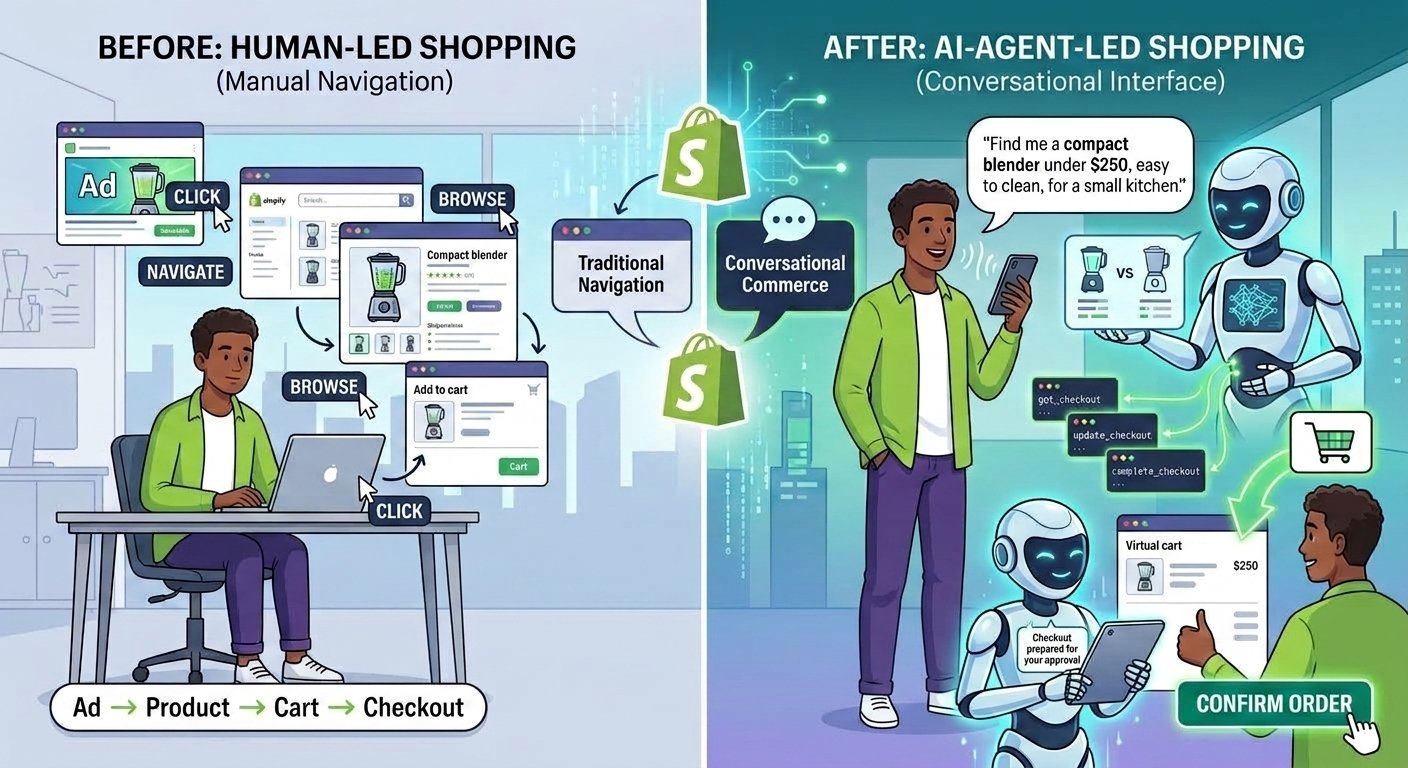
On September 28, Shopify quietly gave AI agents the ability to complete a purchase on your store, and most merchants have no idea what that means for them yet.
For years, e-commerce has optimized one familiar path: an ad or search leads someone to a website, then a product page, then a cart, then checkout. Shopify just took a real step toward changing that path. It expanded its WebMCP support into checkout, which means that on eligible Shopify checkouts, browser based AI agents can now read checkout details, update things like shipping information, and submit an order once the shopper confirms. Shopify built specific tools for this called get_checkout, update_checkout, and complete_checkout.
That sounds like a technical detail buried in a developer changelog. For store owners, the takeaway is simpler than it sounds. Your next customer might not shop your website the way people traditionally have. An AI agent may end up doing a lot of that shopping on their behalf.
What actually changed here
Picture a customer telling an AI assistant they need a compact blender under $250, mostly for frozen smoothies, in a small kitchen, and easy to clean. Until now, the AI would suggest a few products and hand over some links, and the customer would still do the actual browsing, cart building, and checkout themselves.
The new version looks different. The customer explains what they need, the AI searches and compares suitable products, the customer picks one, and the AI handles building the cart and preparing checkout. The customer still confirms the order themselves, and Shopify is clear that the buyer sees the same checkout screen and takes over for things like logging into Shop Pay or authenticating payment. So this isn’t AI quietly buying things on its own. It’s AI doing the legwork while the customer still gives final approval, and that distinction matters a lot.
Your website may not be the main shopping interface anymore
This might be the biggest shift buried in the announcement. Businesses have spent years polishing homepages, menus, filters, and search bars. Those still matter. But there’s now a second interface growing alongside them: conversation. Instead of clicking through Kitchen Appliances, then Blenders, then filtering by price, a shopper can just say what they want in plain language and let the AI translate that into a match.
That shifts the core question e-commerce teams need to ask. It used to be purely “can customers navigate our website.” Now there’s a second question sitting right next to it: can AI actually understand our products well enough to match them to what a customer needs?
Product data just became part of your marketing
Think about two stores selling similar blenders. One lists it as a “Premium Blender” with a description that says “powerful performance for every kitchen.” The other lists the motor wattage, capacity, height, dishwasher safe parts, blending programs, ice crushing ability, warranty length, and exactly what it’s good for. When an AI agent gets asked whether a blender will work for frozen smoothies in a small kitchen, the second store gives it something to actually work with. The first one doesn’t.
This is why product data can’t stay a backend afterthought anymore. It’s turning into part of how you acquire customers in the first place.
Your policies need to be just as clear
Shopify’s tools can also expose store policies and FAQs to agents. If a customer asks whether something can be returned, arrive by Friday, or comes with a certain accessory, the AI needs a solid answer. Buried, inconsistent, or missing policy information just adds uncertainty an AI can’t resolve on its own.
The product page isn’t going away
It’s tempting to assume AI shopping makes websites less important, but that’s too simple. People still want photography, video, reviews, and a sense of the brand. What’s changing is that product pages increasingly serve two audiences at once, people who want persuasion and reassurance, and machines that want dimensions, capacity, materials, and clear facts. The strongest pages will keep both. Keep the emotional line about making everyday cooking easier, but back it up with the exact dimensions, capacity, cleaning instructions, and warranty details right there too.
A new kind of conversion optimization is emerging
Classic conversion work focuses on button placement, page speed, checkout friction, and navigation. Once an AI agent is handling part of that journey, a new set of questions shows up. Does the AI find your product at all? Does it understand what it is? Does it consider it relevant to the request? Can it answer follow up questions? Can it confirm price and availability? Can it actually complete the transaction? That’s a genuinely different kind of optimization problem than the one most teams are used to solving.
What to actually do about this right now
There’s no need to overhaul your entire site because of one announcement, especially since agent support is still developing and Shopify itself excludes certain checkout types, like B2B and some standard checkouts, from this feature for now. But the direction is worth preparing for.
Start by auditing your product data for missing specifications, dimensions, materials, variants, and warranty details, since AI can’t recommend information you never gave it. Clean up messy variants, duplicate listings, and inconsistent model numbers, since humans can often work around a messy catalog but AI struggles with it. Review your shipping, returns, and FAQ content to make sure answers are explicit rather than assumed. Then actually test this yourself by asking AI tools realistic shopping questions about your products and seeing what comes back and what’s missing. And resist the urge to switch on full automation right away. Shopify’s own documentation flags real risks here, including prompt injection through checkout text, so a safer approach keeps AI assisting, business rules validating, and the customer confirming before anything executes.
The bigger shift underneath all this
Commerce is moving from websites built purely for people clicking through screens toward infrastructure that both people and software can use. That changes what counts as a valuable asset. Website design, advertising, and checkout optimization still matter, but structured product data, clear policies, clean product identity, real time inventory, and sensible automation rules are quickly becoming just as important.
The right question isn’t “how do I get an AI agent.” It’s whether an AI agent trying to shop your store today would actually understand what you sell, tell your models apart, know what’s compatible with what, and explain confidently why one product fits a customer better than another. Shopify just solved another piece of the technical checkout puzzle. The harder work for most merchants is everything that has to happen before checkout even starts, because AI needs to understand your business before it can ever shop it.