Stop Selling AI. Sell What AI Does for the Customer.
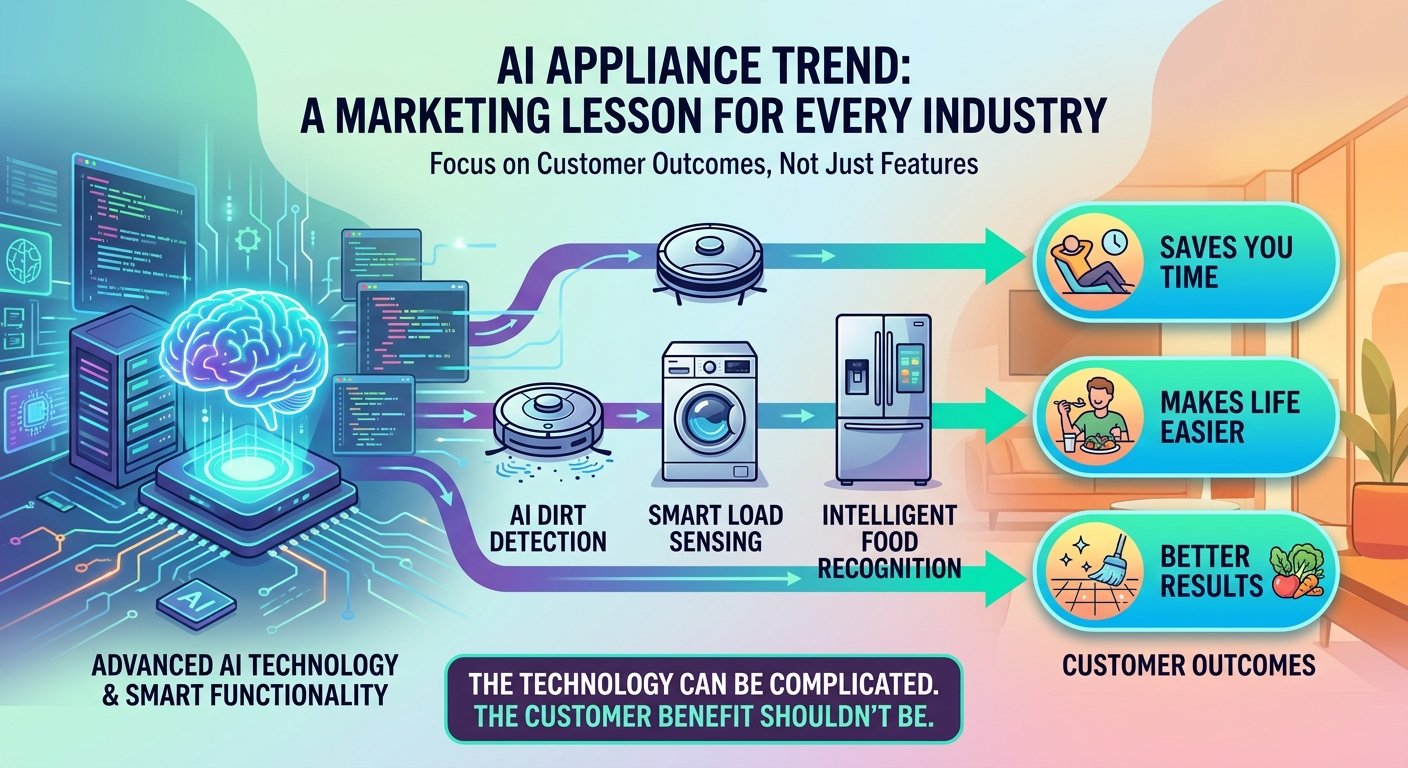
AI is moving out of our laptops and into our homes.
Robot vacuums can detect dirt and adjust cleaning. Washing machines can choose settings based on a load. Refrigerators can recognize food. Connected appliances can learn household routines, while cooking systems increasingly use intelligence to reduce guesswork.
So, are AI-enabled appliances the next big consumer trend?
Yes, but with an important qualification.
Consumers generally aren’t walking into stores saying, “I need an AI appliance.”
They’re saying:
“I want something that saves me time.”
“I want this to be easier.”
“I want better results.”
And that difference contains an important marketing lesson for almost every industry.
AI Is Growing, But “AI” Isn’t Necessarily What Customers Want
AI and smart functionality are clearly becoming more common in appliances. Samsung is expanding its Bespoke AI ecosystem, LG is developing an AI Home that coordinates connected devices, and Dyson’s latest cleaning products combine sensors, software and automation to make cleaning decisions themselves.
But NIQ’s 2026 appliance outlook reveals something more interesting.
Among robot-vacuum buyers surveyed, only 12% identified AI functionality as an important purchase factor, compared with 46% who cared about mopping functionality. For washing machines, AI was a deciding factor for only 7%, while 53% cared about energy efficiency.
That doesn’t mean AI is unimportant.
It means AI works best when customers don’t have to care about the AI itself.
They care about what it does for them.
Look at How Dyson Explains Technology
Dyson’s new R1 Nurovi Dry and R2 Nurovi Wash+Dry robots contain plenty of sophisticated technology.
There is real-time dust sensing. The machine can adapt cleaning based on detected dust. The app supports personalized schedules and cleaning zones. The system monitors cleaning activity. The R2 can wash and dry its own cleaning pads.
Dyson could market all of this primarily as: Advanced AI-powered autonomous cleaning technology.
Instead, much of its product story focuses on recognizable problems:
getting dirt out of corners
picking up different types of debris
reducing tangled hair
automatically cleaning dirty mop pads
reducing maintenance
The technology supports the story.
It isn’t the entire story. That’s smart marketing.
Feature → Function → Outcome
Businesses can borrow this approach using a simple framework:
FEATURE → FUNCTION → CUSTOMER OUTCOME
Imagine a washing machine with AI load detection.
Feature: AI-powered fabric and load detection.
Function: The machine recognizes characteristics of the laundry and adjusts its operation.
Outcome: Less guesswork when choosing settings and more appropriate care for the load.
Which one is easiest for an ordinary shopper to understand?
Usually the outcome.
Samsung’s Canadian appliance marketing provides a good example. Its research found 89% of respondents would find it helpful if appliances reduced time spent on chores, while 75% wanted laundry systems requiring less monitoring. Samsung consequently positions intelligent automation around reducing the household “time tax,” rather than expecting consumers to become excited simply because an appliance contains AI.
This Isn’t Just an Appliance Strategy
The same principle can be applied almost anywhere.
Kitchenware
Suppose a frying pan has an advanced multilayer construction.
Don’t stop at: 5-layer bonded construction.
Explain: Distributes heat more evenly, helping reduce hot spots while cooking.
The construction is the feature.
More consistent cooking is the reason someone cares.
Cosmetics
Imagine a skincare product contains a sophisticated moisture-retention ingredient.
Technical marketing might say: Advanced hyaluronic acid complex.
Customer-oriented marketing asks: What does that mean when someone looks in the mirror tomorrow morning?
Perhaps the legitimate, evidence-supported benefit is better hydration or skin feeling less dry. The scientific feature provides credibility. The customer outcome provides relevance.
Claims in categories such as cosmetics should, of course, remain supported and compliant rather than promising outcomes the evidence doesn’t establish.
Food
A food manufacturer might proudly advertise: Individually quick frozen using advanced freezing technology.
A shopper may care much more about: Portion what you need while keeping the rest frozen.
Same technology. Different story.
Don’t Remove the Feature, Connect It to the Benefit
This doesn’t mean technical specifications should disappear. Specifications are extremely important, particularly when customers compare products or AI recommendation systems need to understand them. The better product page contains both layers.
For example:
AI dirt detection
Detects changing levels of dirt and automatically adapts cleaning performance, reducing the need for you to manually adjust settings.
Now the page tells machines what the product does and tells humans why they should care. That’s increasingly important because product information is serving two audiences:
the person making the decision
and
the systems helping that person make the decision.
AI Is Actually the Enabler
NIQ makes an important distinction in its 2026 outlook: AI can enable benefits consumers already care about, including convenience, performance and energy savings, even when shoppers don’t identify “AI” itself as their reason for buying. That gives marketers a much better way to think about technology.
Don’t ask only: “What new technology does our product have?”
Ask: “What old customer problem does this new technology solve better?”
That question works whether you’re selling a $1,500 smart appliance, a $150 cookware set, a $50 skincare product or a $5 package of food.
The Bigger Marketing Lesson
Companies naturally want to advertise innovation. AI-powered. Smart. Automated. Sensor-driven. Connected. Advanced. Those words can help establish differentiation, but they aren’t automatically reasons to buy. Customers ultimately purchase outcomes, they want: a cleaner floor, less wasted food, lower energy consumption, better cooking results, less time spent doing chores, easier decisions…
So perhaps the most useful lesson from today’s AI appliance trend isn’t that every product needs AI.
It’s something much simpler:
The technology can be complicated. The customer benefit shouldn’t be.
And as more products become “AI-powered,” that distinction will become even more important.
Because eventually, saying your product contains AI may be no more remarkable than saying it contains a microprocessor.
The brands that stand out will be the ones that explain what the technology actually does for the customer.