Stop Guessing What Content to Create. Your Customers Already Told You.
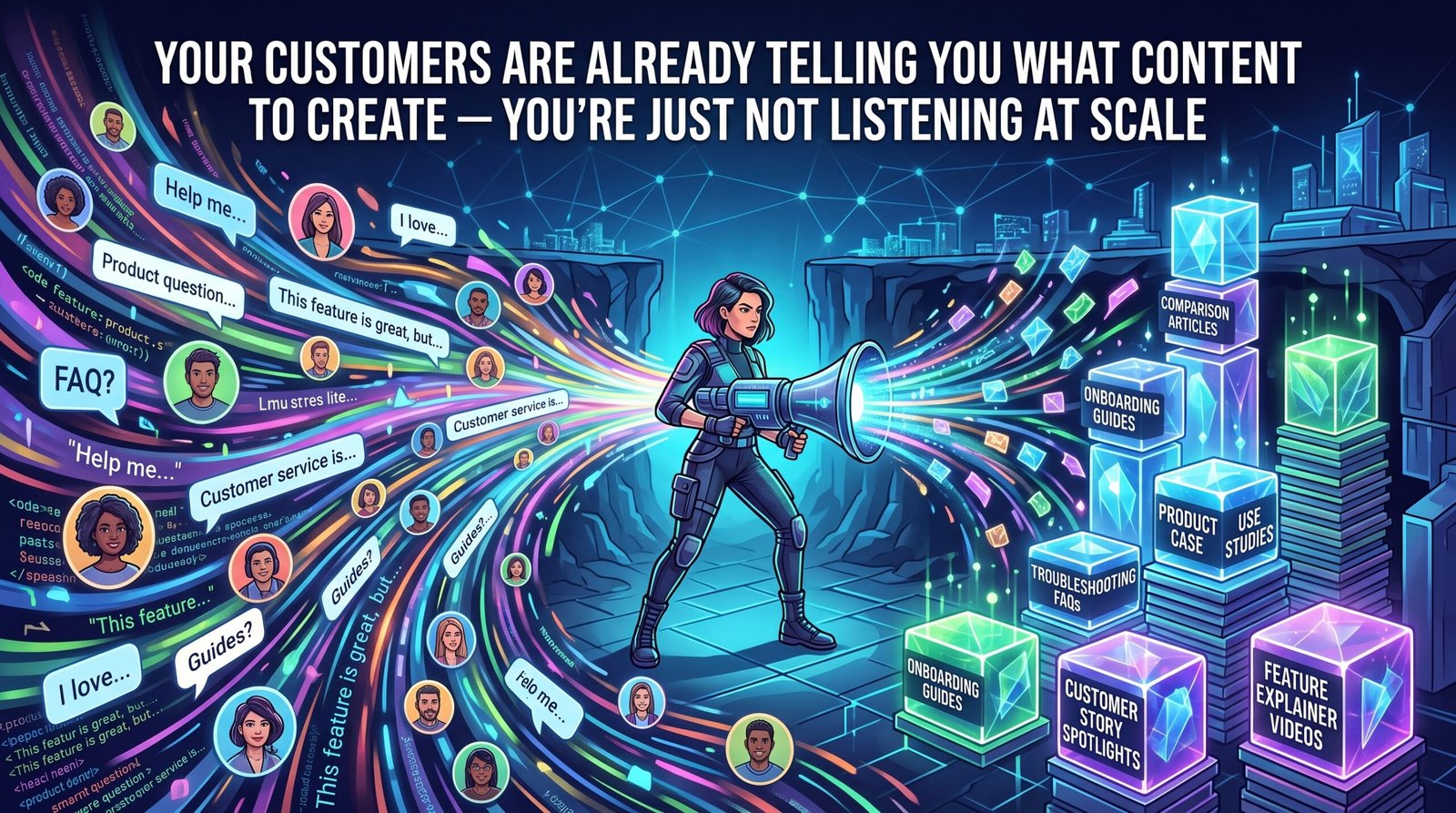
Your next 50 content ideas may already be sitting inside your inbox, product reviews, customer-service chats and search data. You just haven’t connected the dots yet.
One of the most common questions businesses ask their marketing team is:
“What should we post about this week?”
Then comes the brainstorming session.
Someone suggests a product promotion.
Someone else suggests a “5 Tips” article.
Another person asks AI to generate 20 social media ideas.
And eventually, something gets published.
But there is a much better place to start.
Your customers.
Every day, customers are telling businesses exactly what they want to know, what they don’t understand, what they’re worried about and what is stopping them from buying.
The problem is that nobody is listening to all of those conversations at the same time.
That’s where AI becomes extremely useful.
Your Business Is Already Collecting Content Ideas
Think about how many customer signals an established e-commerce business generates.
They are sitting inside:
- customer-service emails
- live-chat conversations
- product reviews
- marketplace reviews
- social media comments
- sales conversations
- return reasons
- website searches
- product Q&A
- customer surveys
- competitor reviews
Individually, each one might seem insignificant.
A customer asks whether two products are compatible.
Another wants to know the difference between two models.
Someone leaves a review saying a product was easier to use than expected.
Another customer returns something because it was larger than they imagined.
But when the same questions appear 20, 50 or 200 times, they are no longer random comments.
They are data.
And they are telling you what your customers need from your content.
Imagine You Sell Coffee Machines
Suppose your company sells several coffee machines.
Your marketing team could sit down and brainstorm blog topics.
Or you could collect six months of customer questions, reviews, support tickets and marketplace comments and let AI analyze them.
You might discover recurring questions such as:
“What’s the difference between Model A and Model B?”
“Is this difficult to clean?”
“Can I use regular coffee beans?”
“Is an automatic machine worth the extra money?”
“Can this make iced coffee?”
“Is this too complicated for someone who just wants coffee every morning?”
Now your customers have effectively created your content calendar for you.
One question could become:
Blog:
“Automatic Espresso Machine vs Capsule Machine: Which Is Right for You?”
Another becomes:
YouTube:
“5 Things to Know Before Buying Your First Automatic Coffee Machine”
Another becomes:
FAQ:
“How Much Cleaning Does an Automatic Coffee Machine Actually Require?”
Another becomes:
Comparison chart:
“Model A vs Model B: What’s the Difference?”
Another becomes:
Social post:
“Love Good Coffee but Hate Complicated Machines? Look for These 3 Features.”
And another could become:
Paid ad:
“Café-style coffee without turning your morning into a science experiment.”
The ideas didn’t come from AI.
They came from customers.
AI simply helped the business find the patterns.
Reviews Are More Than Social Proof
Most businesses think of reviews as something that belongs near the bottom of a product page.
★★★★★
“Great product. Highly recommended.”
But reviews contain far more useful information.
Positive reviews tell you why people actually value the product.
Negative reviews reveal expectation gaps and objections.
Three-star reviews can be particularly interesting because customers often explain both what they liked and what disappointed them.
Imagine customers repeatedly say:
“I love how powerful it is, but I wish I knew how large it was before ordering.”
That isn’t simply a review.
It is a marketing instruction.
Your product page may need:
- clearer dimensions
- a lifestyle image showing scale
- a “Will It Fit?” section
- a short measurement video
- an FAQ about size
You might even create:
“Before You Buy: How Much Counter Space Does This Appliance Need?”
Good content doesn’t always need to attract more visitors.
Sometimes its job is to help the visitors you already have make a better decision.
Your Customer-Service Team May Be Sitting on an SEO Goldmine
Ask your customer-service team:
“What questions do you answer every week?”
The answers can be incredibly valuable.
If customers repeatedly ask:
“Does this work with an iPhone?”
the product page should probably answer it.
If they repeatedly ask:
“What’s included in the box?”
show it clearly.
If customers keep asking:
“What’s the difference between the Standard and Pro versions?”
create a comparison page.
If people ask:
“Which size should I choose?”
create a buying guide.
These aren’t just customer-service questions.
They are search questions, pre-purchase questions and content opportunities.
And importantly, they’re based on real demand rather than assumptions about what people might want to read.
AI Makes Listening at Scale Possible
A business with 20 customer conversations a month can probably read everything manually.
A business with thousands cannot.
Imagine feeding several months of customer feedback into an AI analysis workflow and asking:
What are the 20 most frequently mentioned questions?
What confuses customers before purchasing?
What objections appear repeatedly?
What features do customers praise most?
What expectations lead to disappointment?
Which products are customers comparing?
What words do customers use to describe the problem our product solves?
Which questions should become FAQs?
Which topics deserve full articles?
Which issues should be explained with video instead of text?
Now AI isn’t being used to invent content.
It’s being used to analyze customer intelligence.
That’s a much more powerful application.
One Customer Insight Can Become Ten Pieces of Content
This is where the strategy becomes scalable.
Suppose AI discovers that customers frequently ask:
“Is an air fryer actually cheaper to run than an oven?”
Don’t create only one blog post.
Build a content cluster.
Long-form article
Air Fryer vs Oven: Which Costs Less to Run?
Short video
Air Fryer vs Oven in 60 Seconds
Instagram / Facebook carousel
5 Times an Air Fryer Makes More Sense Than an Oven
Are You Using Your Full-Size Oven When You Don’t Need To?
Product-page FAQ
Does an air fryer use less electricity than an oven?
Comparison chart
Compare capacity, cooking time, energy use, cleanup and best use cases.
Paid advertising angle
Cooking for one or two? You may not need to heat the whole oven.
Marketplace content
Add relevant information to product descriptions or enhanced content.
Sales script
Give customer-service staff a consistent answer.
Follow-up article
What Size Air Fryer Do You Actually Need?
One genuine customer concern has now produced an entire mini-campaign.
That’s content efficiency.
Don’t Just Listen to Your Own Customers
There is another useful source of intelligence:
competitor reviews.
Suppose you’re launching a new kitchen appliance.
Before creating the campaign, analyze hundreds of reviews for comparable products.
Not to copy competitors.
Instead, ask:
What do customers love about this category?
What frustrates them?
What did they wish they knew before buying?
Why do people return these products?
Which features do they actually talk about after purchasing?
What marketing claims appear less important once customers use the product?
You may discover that every competitor promotes “power,” while customers actually talk constantly about cleaning.
That is an opportunity.
Your campaign might focus on:
“Power is great. But you’ll clean it every day.”
Suddenly you’re speaking to a concern the entire category may be under-addressing.
Customer Language Can Improve Your Advertising Too
Businesses often describe products differently from customers.
The company says:
“Advanced ergonomic design.”
The customer says:
“My hand doesn’t hurt after using it.”
The company says:
“Space-efficient construction.”
The customer says:
“It actually fits in my tiny condo kitchen.”
The company says:
“Rapid heating technology.”
The customer says:
“I can make breakfast before the kids leave for school.”
Which language feels more human?
AI can analyze hundreds of reviews and identify the phrases customers naturally use when describing benefits.
Those insights can inform:
- advertising headlines
- product descriptions
- email subject lines
- landing pages
- social content
- video hooks
You don’t necessarily need AI to write better marketing language.
Sometimes you need AI to help you discover the language your customers already use.
Negative Feedback May Be Your Most Valuable Content Source
Businesses naturally love five-star reviews.
But from a content perspective, complaints can be even more interesting.
Suppose customers repeatedly complain:
“Setup was confusing.”
Don’t hide from it.
Create:
“How to Set Up Your Product in Under 5 Minutes.”
Customers say:
“I didn’t know which size to order.”
Create:
“How to Choose the Right Size Before You Buy.”
Customers say:
“I thought this feature was included.”
Fix the product page and create a clearer comparison chart.
Customers say:
“I don’t understand why the premium model costs $100 more.”
Create:
“Standard vs Premium: Is the Upgrade Worth It?”
Content isn’t only a traffic-generation tool.
It can remove friction from the buying journey.
Build a Customer Question Bank
This doesn’t require an expensive AI system.
Start with a spreadsheet.
Create columns for:
| Question / Comment | Source | Product | Category | Buyer Stage | Frequency | Content Opportunity |
|---|---|---|---|---|---|---|
| Which model is better? | Live chat | Model A | Comparison | Consideration | High | Comparison page |
| Is it difficult to clean? | Reviews | Model B | Objection | Consideration | High | Video + FAQ |
| How do I set it up? | Support | Model C | Education | Post-purchase | Medium | Tutorial |
| Is the upgrade worth it? | Sales | A vs Pro | Price | Decision | High | Blog + chart |
Have customer service, sales and marketing contribute to it.
Then, once a month, use AI to analyze the question bank.
Ask it to group questions into:
Buying questions
Product comparisons
Objections
Problems
How-to questions
Post-purchase questions
Complaints
Feature requests
Unexpected benefits
Now you have something far more valuable than a generic content calendar.
You have a customer-driven content system.
Then Prioritize the Content Closest to Revenue
You don’t need to create content for every question.
Prioritize questions that are:
Frequently asked + close to a purchasing decision + relevant to an important product.
For example:
“What is the history of espresso?”
Interesting.
But:
“Automatic vs semi-automatic espresso machine: which should I buy?”
Commercially much more useful.
Likewise:
“10 fun facts about air fryers”
may generate traffic.
But:
“4L vs 8L Air Fryer: What Size Do I Need?”
could help someone make a purchase.
Traffic matters.
Decision-making content can matter even more.
This Also Matters in the Age of AI Shopping
There’s another reason this strategy is becoming increasingly important.
Customers aren’t only searching Google anymore.
They can ask AI assistants increasingly detailed shopping questions:
“What’s the best option for a small apartment?”
“Which model is easier to clean?”
“What’s the difference between these two products?”
“Is the more expensive version worth it?”
That means e-commerce businesses need content that clearly answers real buying questions.
Good product data matters.
But so do:
- FAQs
- comparison pages
- buying guides
- reviews
- clear specifications
- compatibility information
- real-world use cases
The businesses that explain their products clearly are better prepared for both human shoppers and AI-assisted discovery.
Stop Asking AI What Your Customers Want
There is an interesting irony here.
Many companies open ChatGPT and ask:
“What content should my business create?”
But the better workflow may be:
Customer conversations → AI analysis → recurring patterns → content strategy → human creativity → publish → measure → learn.
AI shouldn’t replace customer understanding.
AI should help you understand more customers than a human team could realistically listen to individually.
Your customers are already telling you:
what they don’t understand,
what they’re worried about,
what they compare,
what they love,
what disappoints them,
and what they need before they’re comfortable buying.
You probably don’t need another brainstorming meeting to figure out what content to create.
You need a better system for listening.
And with AI, listening at scale has become much easier.
Not Sure Where to Start?
If your business has years of customer reviews, support conversations and sales data but you’re not sure how to turn them into a practical content strategy, NorthPilot Digital Agency can help. We can help identify the customer signals that matter, uncover content and conversion opportunities, and build an AI-assisted workflow that turns real customer insights into actionable marketing.
Contact NorthPilot and let’s turn what your customers are already telling you into content that helps your business grow.