Shopify or Marketplace First? The Smarter Starting Point for E-commerce Growth
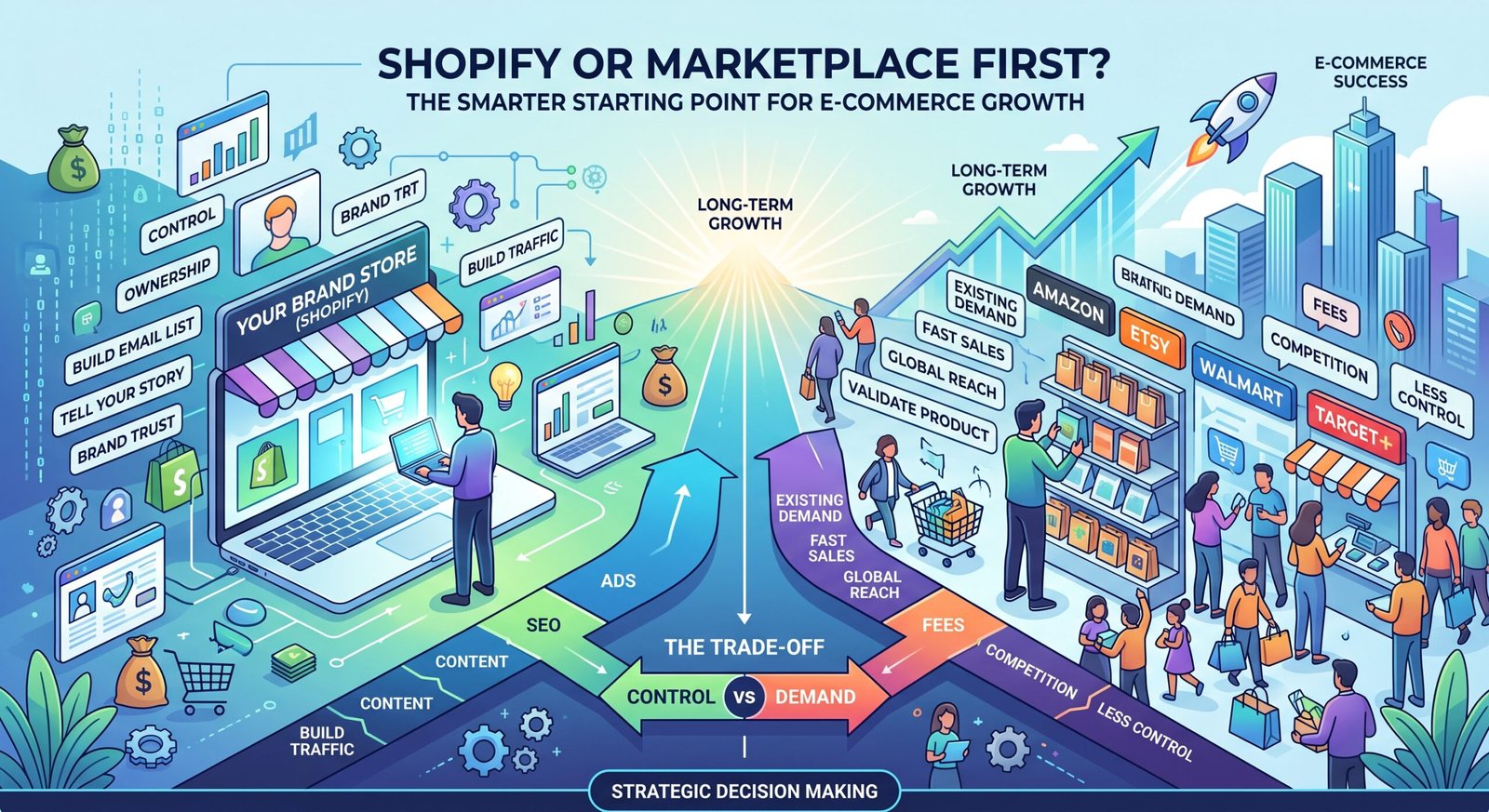
This morning, I was in a meeting with a new client who wants to start an e-commerce business and he asked me: Shopify or Marketplace First?
Before you decide where to sell first, ask a better question: do you need more control, or do you need more demand?
For many product-based businesses, one of the first big e-commerce decisions is whether to start with a Shopify store or sell through marketplaces such as Amazon, Walmart, Etsy, Best Buy, or other platform-based channels.
Both can work. Both can generate sales. Both can become important parts of a healthy e-commerce business.
But they are not the same.
Shopify gives you more control. Marketplaces give you access to existing shoppers. Choosing the right first step depends on your product, budget, timeline, operations, margins, and how much customer demand already exists.
The mistake is thinking one channel is automatically better than the other. The smarter approach is understanding what each channel is designed to do.
Shopify: Best When You Need Control
A Shopify store is your own digital storefront.
You control the branding, product pages, pricing presentation, customer journey, email list, content, checkout experience, analytics, bundles, promotions, and customer relationship.
That matters because a brand-owned website gives you room to explain the product properly.
You can create buying guides, comparison pages, FAQs, product education, landing pages, blog articles, lead magnets, email flows, and custom promotions. You can design the experience around the customer’s questions instead of forcing everything into a marketplace template.
This is especially useful if your product needs education.
For example, if customers need to understand size, compatibility, use case, installation, customization, materials, or long-term value, your own website gives you more space to build confidence.
Shopify is also stronger for brand building. When someone buys from your website, they are buying from you. You can build an email list, encourage repeat purchases, offer loyalty benefits, and guide customers into future products.
The downside is that Shopify does not automatically bring shoppers.
Launching a store does not mean people will find it. You still need traffic from SEO, ads, social media, email, referrals, influencers, partnerships, or content. That takes time, budget, and consistency.
So Shopify is powerful, but it is not magic.
It is best when you are prepared to build both the store and the demand engine behind it.
Marketplaces: Best When You Need Demand
Marketplaces already have shoppers. That is their biggest advantage.
People go to marketplaces with buying intent. They search, compare, filter, read reviews, check shipping dates, and make decisions quickly. For a new or growing business, this can create access to demand much faster than building a standalone website audience from zero.
Marketplaces can be especially useful when your product fits an existing category and shoppers are already searching for it.
For example, if customers commonly compare similar products by price, reviews, delivery speed, specifications, or ratings, a marketplace can help you appear where the buying decision is already happening.
But marketplace sales come with tradeoffs.
You have less control over branding. You compete side by side with other sellers. Fees can reduce margin. Reviews and account health become critical. Listing rules can change. Advertising costs can rise. Customer data may be limited. A product can generate revenue while still leaving very little profit after fees, fulfilment, discounts, returns, and ads.
Marketplaces are strong demand-capture channels, but they are not always strong brand-building channels.
They are best when your product economics are clear and your operations are ready.
The Real Difference: Control vs Existing Traffic
The simplest way to compare Shopify and marketplaces is this:
Shopify gives you control, but you must create traffic.
Marketplaces give you traffic, but you give up some control.
That tradeoff affects almost every decision.
On Shopify, you can tell a deeper story, but you need to work harder to attract visitors.
On marketplaces, visitors already exist, but you must win within the platform’s rules.
On Shopify, you can build long-term customer relationships.
On marketplaces, you may get faster sales signals, but less ownership of the customer journey.
On Shopify, your product data, content, SEO, and brand experience can become long-term assets.
On marketplaces, your listing quality, reviews, pricing, fulfilment, and ranking matter heavily.
Neither path is perfect. The right question is which constraint matters more right now.
When Shopify Should Come First
Shopify should usually come first when your business needs to build brand trust, educate the buyer, or control the customer experience.
This is often true when:
- your product is new or differentiated
- customers need education before buying
- your margins cannot survive heavy marketplace fees
- you want to build an email list
- you need strong content, guides, or comparison pages
- your product has customization or consultation needs
- your brand story matters
- you want full control over design and messaging
Shopify is also a strong first move when your long-term goal is to build a brand, not just move units.
The challenge is that you need a traffic plan. A Shopify store without SEO, content, ads, email, or social strategy is like opening a beautiful store on an empty street.
When Marketplace Should Come First
A marketplace may be the better first step when your product fits an existing search category and you need faster demand validation.
This is often true when:
- customers are already searching for this product type
- your product can compete on price, reviews, specs, or delivery
- your margin can handle platform fees
- your fulfilment process is reliable
- your product is easy to understand
- you want faster sales feedback
- you can maintain strong inventory and customer service
- you are ready to manage listing quality and account health
Marketplaces can help prove demand, generate early sales, and identify which products deserve more investment.
But do not mistake marketplace revenue for profit. Always calculate contribution after fees, fulfilment, advertising, discounts, and returns.
The Strongest Strategy Is Often Both, But Not All at Once
Many businesses eventually need both Shopify and marketplaces.
The smarter question is not:
Which one should we use forever?
It is:
Which one should we build first, and what role should each channel play?
A practical approach may look like this:
Start with Shopify if you need brand control and product education. Then use marketplaces to capture high-intent demand once your product content, pricing, and operations are ready.
Or start with a marketplace to validate demand. Then build Shopify as the brand hub, content engine, and long-term customer relationship channel.
In either case, the channels should support each other.
Your Shopify site can explain the product better. Your marketplace listings can capture ready-to-buy shoppers. Your content can improve SEO. Your product data can stay consistent across every channel. Your dashboard can show which channel is actually profitable.
Key Takeaways
Shopify and marketplaces are not enemies. They are different tools.
Shopify is better for control, brand building, customer education, and long-term ownership.
Marketplaces are better for demand capture, faster exposure, and reaching shoppers who are already comparing products.
The right first move depends on your current business need.
Do you need more control over the buying journey?
Start with Shopify.
Do you need faster access to existing demand?
Start with a marketplace.
Do you need long-term growth?
Plan for both, but build them with clear roles, clean product data, strong economics, and a realistic traffic strategy.
The goal is not to be everywhere.
The goal is to sell where your business can win profitably.