Shopify is giving us a much clearer picture of what an “AI-ready product” means
For most of the last decade, selling online followed a predictable formula: pick the right keywords, rank well, earn the click, convert the visitor. That formula still works. But a second layer is forming on top of it, and Shopify’s recent moves give us the clearest picture yet of what it demands from merchants.
Shopify is now showing merchants what AI sees
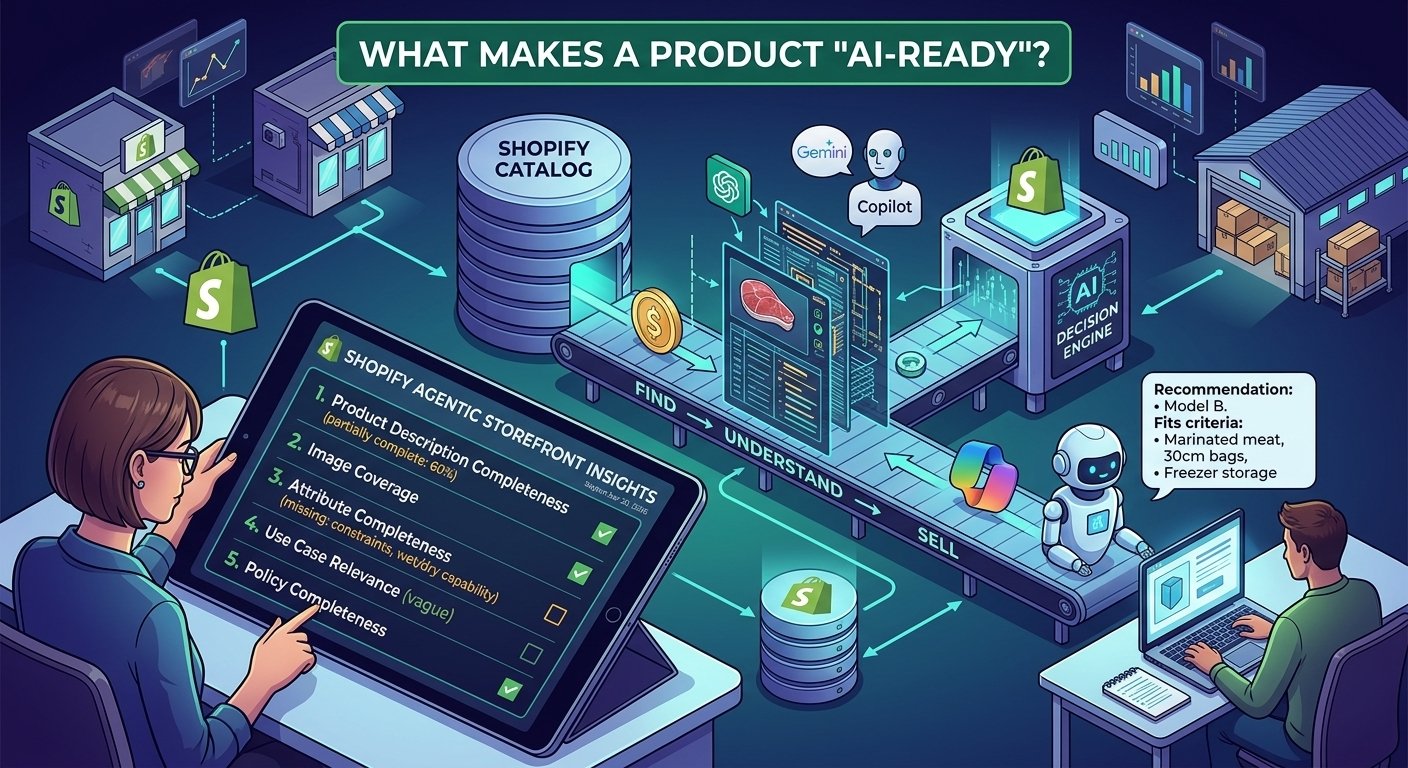
Shopify’s Agentic Storefronts interface reports more than AI-channel sales and sessions. It also surfaces the searches where your products appeared, plus listing-level signals: description completeness, image coverage, price competitiveness, and shop-policy completeness.
That last group is the interesting part. Shopify isn’t just telling you how much revenue AI channels drove. It’s telling you where your product information falls short of what an AI assistant needs to recommend you with confidence.
Traditional SEO asked: can this product be found?
Agentic commerce asks a harder question: can an AI correctly determine when this product fits a specific customer’s situation?
Consider a vacuum sealer. A conventional listing might say: 120W vacuum sealer, 5 modes.
A shopper browsing a category page can fill in the gaps by looking at photos, scanning reviews, or clicking a competitor. An AI assistant answering “I need something to seal marinated meat in 30cm bags for freezer storage” cannot. It needs to establish: suitable food types, bag compatibility, wet versus dry sealing capability, maximum bag width, storage use cases, included accessories, warranty terms, and stated limitations.
If your listing doesn’t answer those questions, the AI doesn’t guess in your favour. It recommends the product that does answer them.
This is why a product data audit is no longer just an SEO exercise. It’s the difference between being considered and being skipped.
You may not need to replatform to participate
There’s a second detail worth flagging, and it changes the conversation for a lot of businesses.
Shopify’s Agentic Plan allows businesses whose primary e-commerce platform sits elsewhere to add products to Shopify Catalog and distribute them to AI shopping channels — without migrating their existing website to Shopify. Shopify states there’s no monthly subscription charge; payment fees apply where Shopify Checkout handles the transaction.
For a WooCommerce store, a custom-built commerce platform, or an ERP-driven B2B operation, this reframes the whole discussion.
The pitch is no longer: “You should rebuild your website on Shopify.”
It becomes: “You may be able to add an AI-commerce distribution layer without replatforming your store.”
Those are very different projects with very different risk profiles. One is a six-month migration. The other is a data and distribution decision. If you’ve been putting off AI commerce because you assumed it required a platform change, that assumption is worth revisiting.
FIND, UNDERSTAND, SELL, and now MEASURE
Shopify currently supports discovery and selling through AI channels including ChatGPT, Microsoft Copilot, Google AI Mode and Gemini, and Meta, with availability and checkout options varying by merchant and market. Agentic Storefronts is enabled by default for eligible stores.
That maps cleanly onto how we think about AI readiness at NorthPilot:
FIND — Can AI discover and trust your brand? This is brand visibility: whether your business appears, and whether the information circulating about it is accurate and consistent.
UNDERSTAND — Can AI correctly interpret your products? This is product data readiness: attributes, use cases, compatibility, constraints.
SELL — Can those products actually participate in AI shopping channels? This is channel and catalogue configuration, including checkout eligibility.
MEASURE — Did AI actually contribute to revenue? As AI-assisted sessions grow, attribution stops being optional. You need to know whether these channels are producing orders or just impressions.
Most businesses we speak to are strong on one layer and blind on the rest. A brand with excellent PR and weak product data gets discovered and then passed over. A brand with meticulous specs and no public presence never enters the consideration set.
“AI-ready by default” doesn’t mean “nothing to optimise”
Shopify says its Catalog automatically structures, cleans, and syndicates product information across connected AI channels. That’s genuinely useful infrastructure, and it removes a real technical burden.
But notice that Shopify also advises merchants to enrich structured product data, publish clear policies and FAQs, and monitor AI visibility. Those two messages aren’t in conflict. The platform can make the pipe AI-ready. It cannot make weak source information excellent.
If your product page says: Premium blender. Powerful motor. Great for every kitchen.
then there is almost nothing meaningful to structure, clean, or distribute. No amount of automated syndication turns marketing filler into decision-useful context.
The honest summary is this: the platform can structure your product data. It cannot invent the product knowledge your business never supplied.
That’s not a reason for concern, it’s an opportunity! Automated infrastructure is now available to everyone equally, which means the remaining competitive advantage sits in the quality of what you feed it. The merchants who document their products properly will quietly pull ahead of those who assume the platform handles it.
If you’re unsure which layer is holding you back, that’s the audit worth running first.