September Is Not a Slow Month. It’s Your Q4 Launchpad.
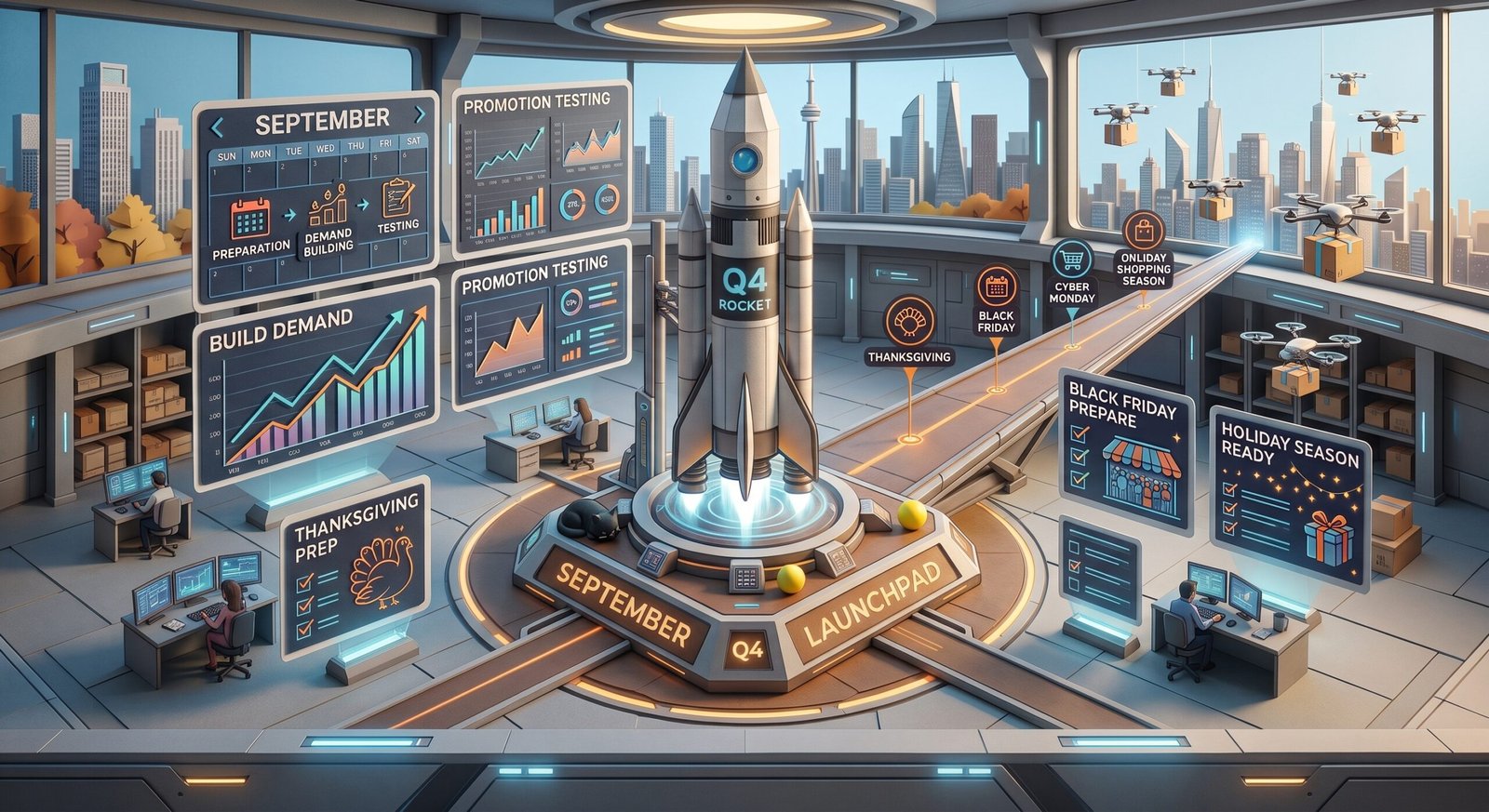
Why smart businesses use September to build demand, test promotions and prepare for Thanksgiving, Black Friday and the holiday shopping season.
September can feel like an awkward month for marketing.
Summer is ending. Back-to-school campaigns are wrapping up. Thanksgiving still feels a few weeks away, and Black Friday feels even further in the distance.
So many businesses wait.
They plan to “start holiday marketing in October.”
That may already be too late.
For Canadian businesses, Thanksgiving falls on October 12, 2026, while Black Friday arrives on November 27. More importantly, holiday shopping no longer begins on Black Friday. Research cited by Experian found that 45% of shoppers planned to start holiday shopping before November, while Shopify now explicitly describes September as the foundation-building stage of Black Friday preparation.
September isn’t the month before the selling season.
September is when the selling season begins.
1. Don’t Start With a September Discount
The temptation is to ask:
“What promotion should we run this month?”
Ask a better question:
“What do we want customers to be ready to buy from us over the next three months?”
September should connect to October and November rather than operate as an isolated campaign.
A simple calendar might look like:
September — Discover & Prepare
Introduce products, educate customers, build audiences and test messages.
October — Occasion & Intent
Thanksgiving, fall activities, early gifting, bundles and email-list growth.
November — Convert
Black Friday, Cyber Monday, gifting, urgency and retargeting.
That creates momentum instead of three unrelated monthly promotions.
2. Use September to Discover What Customers Actually Want
One major advantage of starting now is that you can test before advertising gets expensive and the stakes get higher.
Suppose you sell skincare.
Instead of waiting until Black Friday to discover which message works, test September content around:
- fall skincare routines
- dry-weather essentials
- starter bundles
- premium vs basic products
- gift-worthy products
Watch what customers click, save, search and buy.
If “Fall Skincare Starter Kit” significantly outperforms generic product ads, you’ve learned something valuable before November.
The same principle applies to fashion, electronics, furniture, food, beauty, professional services and almost any other category.
September marketing generates sales, but it also generates intelligence.
3. Build Your Audience Before You Need It
Imagine two businesses reaching November.
Business A starts advertising its Black Friday sale on November 20.
Business B has spent September and October collecting email subscribers, attracting website visitors, publishing useful content and building retargeting audiences.
Who has the advantage?
Business B isn’t starting from zero.
Shopify recommends using the pre-peak period to prepare email capture, customer segmentation and retargeting rather than relying entirely on expensive last-minute acquisition.
September is therefore an excellent time for:
lead magnets
email sign-up offers
buying guides
quizzes
comparison content
educational videos
social campaigns
giveaways
early-access lists
For example, instead of:
“Join our newsletter.”
Try:
“Get Our 2026 Holiday Gift Guide.”
or:
“Join the Black Friday Early Access List.”
Give customers a reason to enter your ecosystem now.
4. Create Content Before You Create Discounts
September is also the right time to answer the questions customers will ask before purchasing.
If you sell electronics:
Which model should I choose?
If you sell furniture:
What size dining table do I need for six people?
If you sell skincare:
What should I change in my routine for colder weather?
If you sell kitchen products:
Multi-function vs single-purpose appliance: which is better?
Create this now:
buying guides → comparisons → FAQs → videos → social posts → product education
Why?
Because by the time the customer sees your Black Friday offer, they may already know which product they want.
The November promotion then doesn’t need to create the entire purchase decision.
It only needs to close it.
5. Decide What You Will Promote Before Ordering More Inventory
September marketing shouldn’t happen separately from inventory planning.
Look at last year’s Q4 performance and ask:
Which products generated revenue?
Which generated profit?
Which sold well during promotions?
Which products frequently sell together?
Which inventory is moving too slowly?
What could run out if demand increases?
Shopify recommends using product-level sales data and inventory analysis early when deciding which products should receive Black Friday promotion.
Don’t automatically discount your bestseller 30%.
Perhaps it only needs 10%.
Meanwhile, slower inventory might work better in a bundle.
Promotion should follow product economics, not the other way around.
6. Build Bundles Before Black Friday
September is an excellent month to test bundles.
Think beyond:
Product A — 20% off
Try:
Starter Kit
Fall Essentials Bundle
Family Pack
Professional Bundle
Gift Set
Complete Setup
Bundles can increase perceived value without training customers to expect deeper discounts.
They also help answer another important question:
What should I buy together?
That’s useful for customers, merchandising systems and increasingly AI shopping assistants.
7. Fix Your Store Before You Send More Traffic
There’s little value in doubling advertising if the website leaks customers.
Use September to check:
mobile experience
page speed
checkout
payment options
shipping information
return policy
product descriptions
product specifications
images
FAQs
inventory accuracy
analytics and conversion tracking
Shopify’s current BFCM guidance specifically recommends using the early preparation period to test site speed, mobile responsiveness and checkout while reviewing product-page accuracy and inventory.
Black Friday week is a terrible time to discover that your checkout isn’t working properly on mobile.
8. Create Your Q4 Promotion Map Now
Open a spreadsheet.
Create these columns:
| Date | Campaign | Products | Offer | Audience | Channel | Goal |
|---|---|---|---|---|---|---|
| Sep | Fall campaign | Selected products | Bundle | New customers | Social/Search | Awareness |
| Oct | Thanksgiving | Seasonal products | Gift/Bundle | Existing + New | Email/Ads | Sales |
| Early Nov | Holiday Preview | Gift products | Early access | Subscribers | Intent | |
| Black Friday | BFCM | Selected SKUs | Main offer | All | Multi-channel | Conversion |
| Dec | Holiday | Gift-ready products | Shipping/Gifting | Gift buyers | Multi-channel | Sales |
Now marketing, inventory and advertising are working from the same plan.
September’s Job Isn’t to Maximize September
This is perhaps the most important point.
Don’t judge every September campaign purely by immediate ROAS.
Some campaigns should generate sales.
Others should build:
email subscribers
retargeting audiences
product awareness
content engagement
customer data
promotion insights
purchase intent
Canadian payment provider Moneris recently described Black Friday as a 90-day campaign rather than a single day, recommending that businesses use the early stage to establish the foundation before moving into momentum-building and conversion.
That’s a much better way to think about Q4.
Start Now, So November Isn’t a Guess
September gives businesses something November cannot:
TIME
Time to test an offer.
Time to fix a product page.
Time to order inventory.
Time to build an email list.
Time to discover which content resonates.
Time to create bundles.
Time to prepare creative.
Time to fix tracking.
Time to learn what customers actually want.
By Black Friday, you shouldn’t still be asking:
“What should we promote?”
You should already know.
Your September marketing should help you find the answer.
Because the businesses that perform well during Q4 aren’t necessarily the businesses that create the biggest Black Friday discount.
They’re often the businesses that started preparing before everyone else started shouting about Black Friday.
Get Your Q4 Marketing Ready
If you’re heading into the busiest selling months without a clear promotion calendar, content strategy or e-commerce plan, NorthPilot Digital Agency can help.
We can help turn your September preparation into a practical Q4 roadmap, from content and promotions to e-commerce, marketplaces, advertising and performance measurement.
Start preparing now, so your Q4 marketing has a plan behind it.
Want to Know How AI-Ready Your Catalog Really Is?
Run the audit yourself with NorthPilot’s free 20-Point AI-Ready Product Catalog Checklist.
In about five minutes, you’ll see where your product data is strong, where information is missing, and what you should improve first.