Prime Big Days Ends Tonight, Now The Useful Part Begins
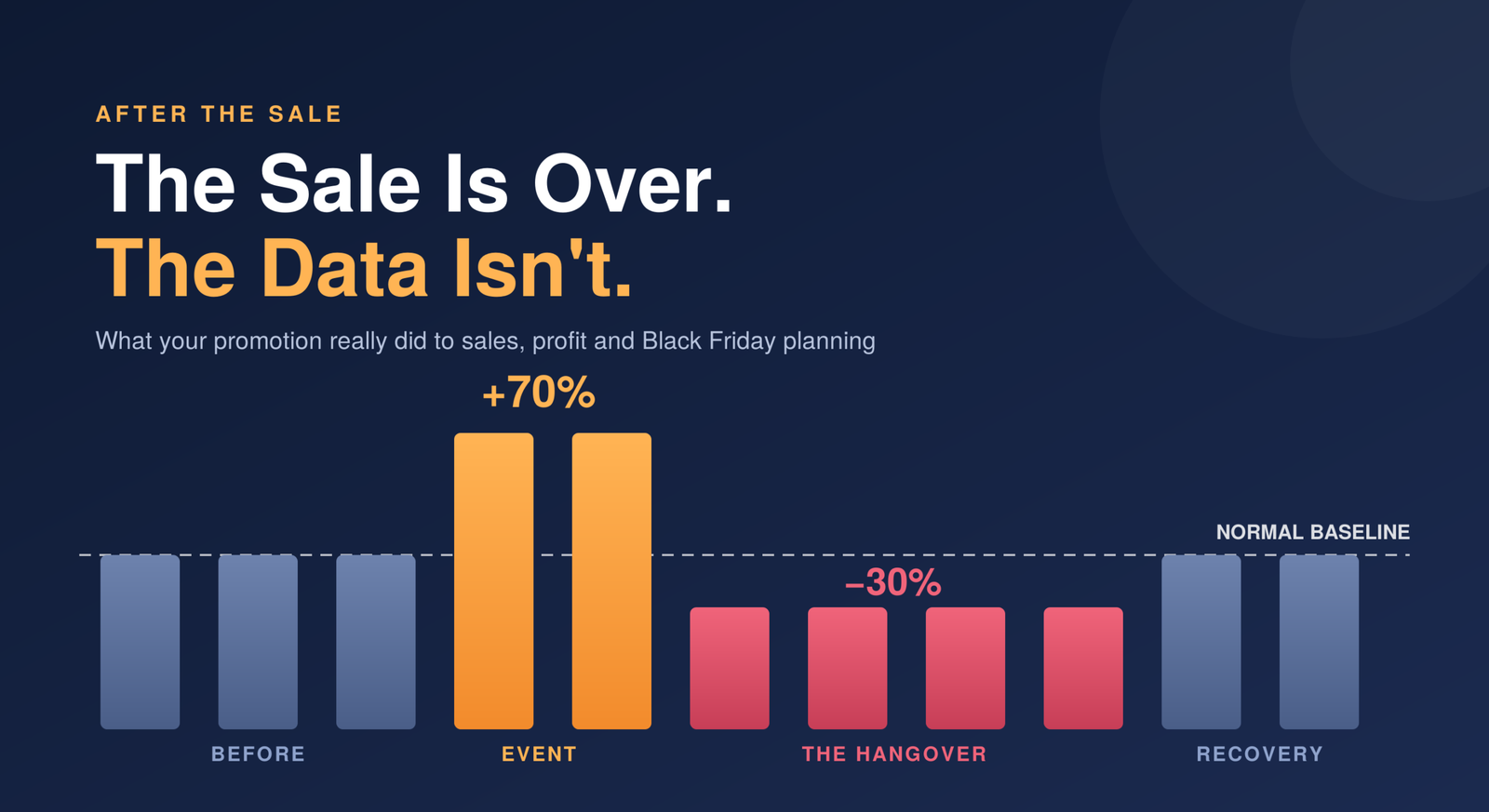
Amazon’s October 6-7 Prime Big Deal Days wraps up tonight, with heavy discounting reported across kitchen appliances, cleaning appliances, electronics and home products (New York Post). Many sellers will check their dashboards, see a spike, and move on.
That’s a missed opportunity. The most useful data often arrives in the days after the event, and it will shape how you approach Black Friday.
Why The Headline Number Can Mislead
A sales spike during a promotion doesn’t tell you how much new demand you created. Some of it is simply demand pulled forward: customers who would have bought from you next week bought now because the price was lower.
Here is a simple example. Say your normal baseline is 100 units a day.
- October 6-7 (event): 170 units a day, a 70% lift, so 340 units over two days
- October 8-11 (following four days): 70 units a day, a 30% dip, so 280 units over four days
Over the six days you sold 620 units. Your baseline would have given you 600. The “70% growth” was really about 3% extra volume, and you gave up margin on every discounted unit to get it.
These numbers are illustrative, but the pattern is common. The dip afterwards is sometimes called the post-event hangover, and it’s the part most sellers never measure.
What To Measure From Tomorrow
You don’t need a complex model. Starting October 8, track a few things in a simple spreadsheet.
1. Sales against baseline. Compare October 6-7 and October 8-12 with your normal daily average from a comparable non-promotional period, such as the three weeks before the event. Look at the combined window, not the event days alone.
2. Profit, not just revenue. Take the discounted price, subtract product cost, fees, shipping and advertising, and compare the result with a normal sales day. A product that sold 70% more at a 25% discount may well have earned less in total.
3. Advertising efficiency. Event-day traffic is crowded and click costs often rise. Check whether your cost per sale during the event was sustainable, and whether it came back down afterwards.
4. New versus repeat customers. If the event brought in first-time buyers, that has lasting value. If it mostly rewarded people who already buy from you, you gave a discount to customers you would have kept anyway.
5. Inventory position. Did you sell through too fast and run low on stock, which can hurt your ranking? Or did you overstock and still hold units you expected to move? Both tell you something about your Black Friday quantities.
6. Reviews and returns. Heavy promotions can bring in buyers who are less certain about the product. Watch return rates and early reviews over the following weeks.
Turning The Results Into A Black Friday Plan
Once you have the numbers, a few decisions become much clearer.
If your post-event dip was small and your profit held up, the promotion probably created real demand. You can consider a similar discount depth in November.
If you saw a large dip and thin profit, you may have mostly trained customers to wait for deals. A shallower discount, a bundle or a limited-quantity offer may work better than a deeper price cut.
If one product dominated, consider concentrating your discount and ad budget there instead of spreading it across the whole catalogue.
If some products barely moved even at a discount, that points to a problem with the listing, the price position or the product itself. Check whether the page answers customers’ questions clearly before you cut the price again.
Black Friday and Cyber Monday are only weeks away, so treat October’s results as a rehearsal. A common pattern is to match last year’s discounts without checking whether they paid off. This data lets you decide on evidence.
A Note On Seasonality
One caution: Prime Big Deal Days is not Black Friday. Customer behaviour, competition and ad costs differ between them. Use this event to understand your own patterns, such as how deep your post-event dip runs and which products respond to discounts, rather than to predict November exactly.
Key Takeaways
A promotion isn’t finished when the event ends. It’s finished when you understand what it really did to your sales, profit and customer base. If you set aside an hour this week to compare the event, the four days after it and your baseline, you will go into Black Friday knowing which discounts earn their cost.
If you’d like help setting up that comparison for your own store, that’s a good first step to take with us.