More Traffic or Better Conversion? Fix the Right Problem First
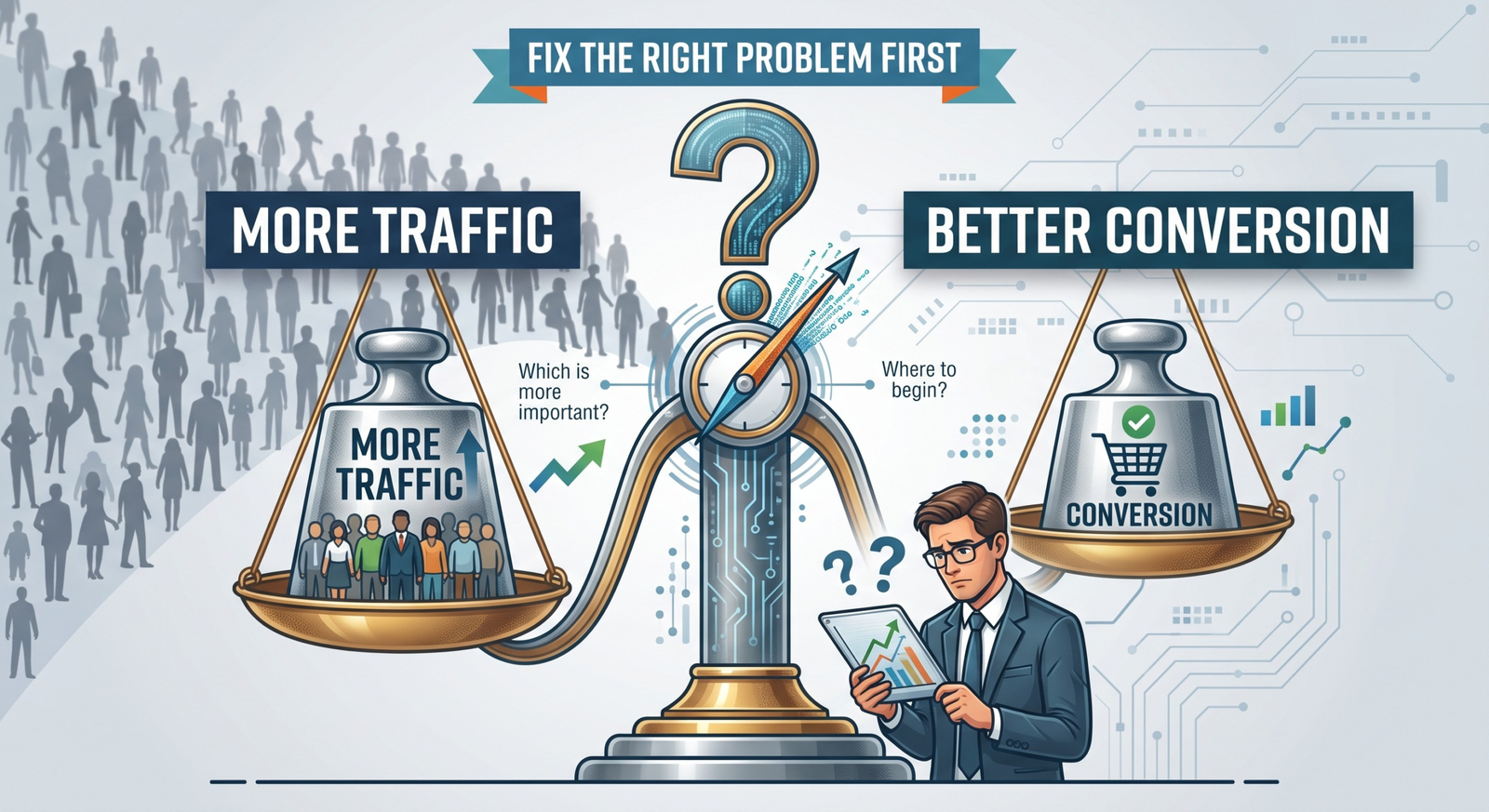
Getting more visitors sounds like growth, but if those visitors are landing on a page that does not convince them to buy, traffic can become an expensive way to prove your store is leaking sales.
One of the most common questions in e-commerce is:
Should we focus on getting more traffic, or improving conversion first?
It is a practical question because most businesses do not have unlimited time, budget, or attention. They need to know whether to invest in ads, SEO, marketplace visibility, social content, influencers, email campaigns, product-page improvements, website redesign, better offers, or checkout optimization.
Both traffic and conversion matter.
But they solve different problems.
Traffic answers:
Are enough people seeing our products?
Conversion answers:
Are enough of those people buying?
The right priority depends on where the business is losing opportunity.
More Traffic: When Visibility Is the Problem
Traffic is the top of the funnel. It includes website visitors, product-page views, marketplace impressions, ad clicks, social referrals, email clicks, search traffic, and any other path that brings people to your offer.
If almost no one is seeing the product, conversion improvement has limited impact.
A beautifully optimized product page cannot sell if nobody visits it.
Traffic should usually be the focus when:
- website sessions are very low
- marketplace impressions are weak
- ads are not getting enough clicks
- SEO visibility is minimal
- product pages have few views
- brand awareness is low
- email list is small
- social channels send little traffic
- products do not appear for relevant searches
In this situation, the business may not have a conversion problem yet. It may simply not have enough exposure.
For example, if a Shopify store receives only 200 visits per month, it is difficult to draw strong conclusions from the conversion rate. A small number of visitors can make the data unstable. One extra order may change the numbers dramatically.
In that case, the business may need more qualified traffic before making major decisions about conversion.
But not all traffic is useful.
More visitors from the wrong audience will not fix the problem. A store does not just need traffic. It needs the right traffic: people with a real reason to care about the product.
Better Conversion: When the Buying Journey Is the Problem
Conversion is about how well the business turns attention into action.
That action could be a purchase, add-to-cart, inquiry, email signup, quote request, booking, or another meaningful step.
Conversion should usually be the focus when there is already traffic, but customers are not moving forward.
Common signs include:
- product pages get views but few add-to-carts
- carts are created but checkout is abandoned
- ads drive clicks but not sales
- customers ask basic questions already answered poorly on the page
- bounce rate is high
- marketplace listings have impressions but weak sales
- many people view the same product without buying
- returns happen because expectations were unclear
- customers do not understand the difference between similar products
In this case, buying more traffic may only make the leak bigger.
If 1,000 visitors produce almost no sales because the product page is confusing, sending 5,000 visitors will not automatically solve the issue. It may simply increase ad spend while the underlying problem remains.
Conversion issues often come from weak product information, unclear value proposition, poor images, confusing pricing, missing shipping details, lack of trust, unclear returns, weak product comparison, slow website speed, or a checkout journey with too much friction.
For marketplaces, conversion issues may come from poor titles, incomplete attributes, weak images, low reviews, unclear sizing, bad pricing, slow delivery, or weak differentiation from competitors.
The Real Question: Where Is the Bottleneck?
The best decision comes from identifying the bottleneck.
A bottleneck is the point where customers stop moving forward.
If very few people arrive, traffic is the bottleneck.
If people arrive but do not act, conversion is the bottleneck.
A simple way to think about it:
Low traffic + low sales = visibility problem.
Decent traffic + low sales = conversion problem.
Strong traffic + decent conversion = scale carefully.
Strong traffic + poor profit = economics problem.
That last point is important.
Sometimes traffic and conversion both look acceptable, but profit is weak. In that case, the issue may be product margin, shipping cost, advertising cost, marketplace fees, discounts, or returns.
A business should not judge growth only by traffic or conversion. It should also ask what the business actually keeps after costs.
Why Fixing Conversion First Often Makes Sense
For many e-commerce businesses, improving conversion before increasing traffic is the smarter first move.
Why?
Because every future visitor becomes more valuable.
If a store converts poorly, more ad spend is inefficient. But if the product pages, offer, checkout, trust signals, and product data are improved first, the same traffic can produce better results.
For example, improving product pages may help:
- paid ads perform better
- marketplace listings convert more efficiently
- SEO traffic create more sales
- email campaigns drive more revenue
- customers choose faster
- support questions decrease
- returns decline
Conversion work improves the foundation.
Then, when the business invests in traffic, more of that traffic has a chance to become revenue.
This is especially important before seasonal campaigns such as Black Friday, Christmas, back-to-school, or major marketplace promotions. Sending holiday traffic to weak product pages wastes opportunity.
When Traffic Should Come First
There are still situations where traffic should be the first priority.
A new store with almost no visitors needs visibility. A new brand may need awareness. A new product may need testing. A marketplace listing with few impressions may need better keyword targeting, category placement, advertising, or promotional exposure.
In this situation, the goal is not only to get sales. It is also to collect data.
You need to learn:
- who clicks
- which product attracts attention
- which message works
- which channel sends better visitors
- which offer creates interest
- which audience is worth pursuing
Without enough traffic, the business is guessing.
But even then, the traffic should be intentional. Do not pay for broad attention just to make the visitor number look larger. Focus on qualified traffic that can teach you something useful.
The Best Strategy Is Usually Sequential
The strongest approach is not choosing traffic or conversion forever.
It is sequencing them correctly.
A practical growth sequence looks like this:
First, make sure the basic buying journey is not broken.
The product should be understandable. The price should be clear. The images should be strong. Shipping and returns should be visible. The customer should know who the product is for, what problem it solves, and why they should choose it.
Second, drive enough qualified traffic to test the offer.
Use ads, SEO, content, marketplaces, email, social, or partnerships to bring relevant shoppers into the journey.
Third, study where people drop off.
Do they click but not add to cart? Add to cart but not check out? Buy once but never return? Compare but choose a competitor?
Fourth, improve the weakest point.
That may be traffic. It may be conversion. It may be pricing. It may be product data. It may be fulfilment. It may be margin.
Growth becomes much clearer when decisions follow the bottleneck.
Key Takeaways
More traffic and better conversion are both important, but they are not interchangeable.
More traffic helps when not enough qualified people are seeing your offer.
Better conversion helps when people are already seeing the offer but are not buying.
The mistake is spending more on traffic before fixing a broken buying journey. The other mistake is endlessly redesigning the website when the real problem is that not enough people are arriving.
The smarter question is not:
“Should we get more traffic or improve conversion?”
The smarter question is:
“Where are customers dropping off, and what is the next bottleneck to fix?”
When the buying journey is clear, traffic becomes more valuable.
When the traffic is qualified, conversion data becomes more useful.
And when both are connected to profit, growth becomes much easier to manage.