Canada’s Trade Surplus Jumped to $4.2 Billion. Why Online Sellers Shouldn’t Read Too Much Into It
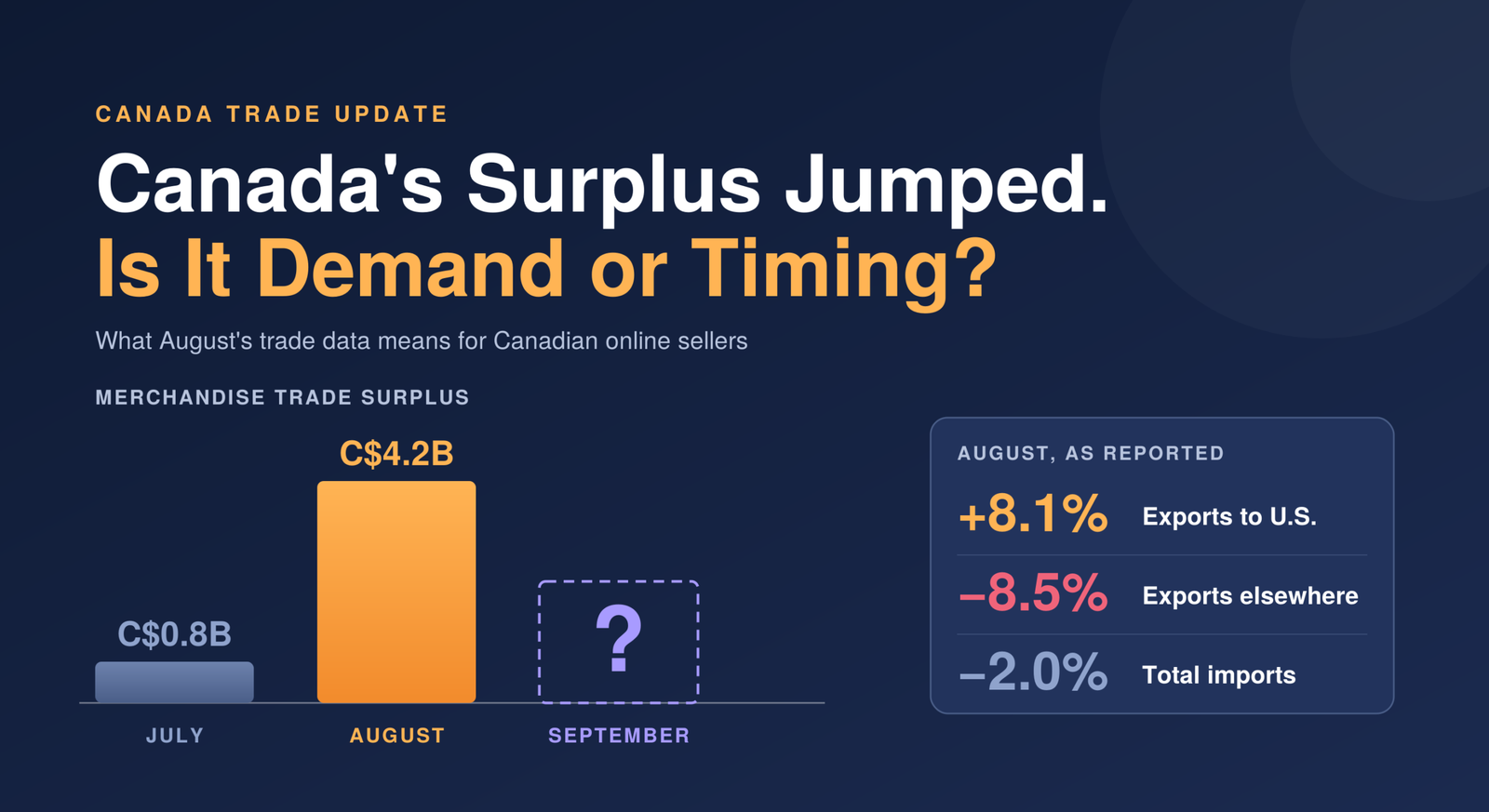
Canada’s merchandise trade surplus widened to C$4.2 billion in August, up from C$787 million in July, according to Statistics Canada figures reported by The Canadian Press and BNN Bloomberg. Exports rose 2.5%, while imports fell 2.0%.
It sounds like good news. For anyone running a Canadian online business, the more useful question is why it happened, because the answer changes how much you should rely on it.
What was behind the jump
Exports to the United States rose 8.1% in August, while exports to other countries fell 8.5%. Statistics Canada said the surge may reflect U.S. buyers rushing orders to get ahead of higher tariffs, which took effect on August 22. One economist quoted by The Canadian Press, CIBC’s Katherine Judge, expects the jump to be temporary and to reverse in September.
That is an expert’s expectation, not a certainty, and we won’t know until next month’s figures. But the logic is worth understanding, because it applies to your own sales too.
Why a spike isn’t always new demand
Imagine a Canadian furniture maker who normally ships 1,000 units a month to U.S. customers. Ahead of a tariff, buyers order early:
- August: 1,600 units shipped
- September: 400 units shipped
The two-month total is 2,000, exactly the normal amount. August looked like a 60% jump, but customers didn’t want more furniture. They simply bought it sooner.
This is the same “pulled-forward demand” pattern retailers see after big sales events. A strong month tells you something only when you also look at the months around it.
What this means for Canadian e-commerce
If you import products, such as appliances or electronics
The trade data doesn’t say anything specific about appliances, so there’s no reason to panic. But it’s a good prompt to review the things that quietly eat margin:
- Currency: Reports noted a stronger Canadian dollar in August. Exchange rates can swing both ways, so check how much of your cost base is priced in U.S. dollars and when you pay suppliers.
- Supplier costs: Ask whether quotes are fixed, for how long, and what triggers a change.
- Duties and customs: Canada’s counter-tariffs took effect on September 8, according to the Canadian Press report. Check with your customs broker whether any of your products or components are affected.
- Replenishment costs: What will it cost to restock the same item in three months, not what you paid last time? Price from the replacement cost.
If you sell into the U.S.
Reported coverage of the new tariffs includes categories such as furniture, clothing and sports equipment. Check your own product codes, rather than relying on a headline list. Then separate two things:
- Temporary distortions: Orders that came early, stock-ups or one-off spikes.
- Sustainable demand: Repeat customers, steady order rates and growth that holds after the rush.
A simple test is to compare September and October orders with the same months last year and with your pre-August average. If the “extra” August sales are followed by a matching dip, treat August as timing.
A short checklist
- Compare your August U.S. orders with your June-July average.
- Watch September and October for a dip that cancels out the gain.
- Recalculate landed cost (product, shipping, duties, currency) for your top ten items.
- Check whether any of your products appear in the new tariff lists.
- Avoid raising inventory orders or ad budgets based on one strong month.
A national headline can hide a lot. Here, strong exports to one market sat alongside weaker exports to others, and part of the surge may simply be timing. Your own numbers deserve the same scrutiny: don’t plan on the spike repeating, and watch the months after it.
This isn’t customs or tax advice, so confirm duty and tariff treatment with your broker or accountant. If you’d like help separating one-off spikes from real demand in your store data, get in touch.