Canada’s Factory Slowdown Is a Warning Sign for Your Q4 Pricing, Not Just an Economic Headline
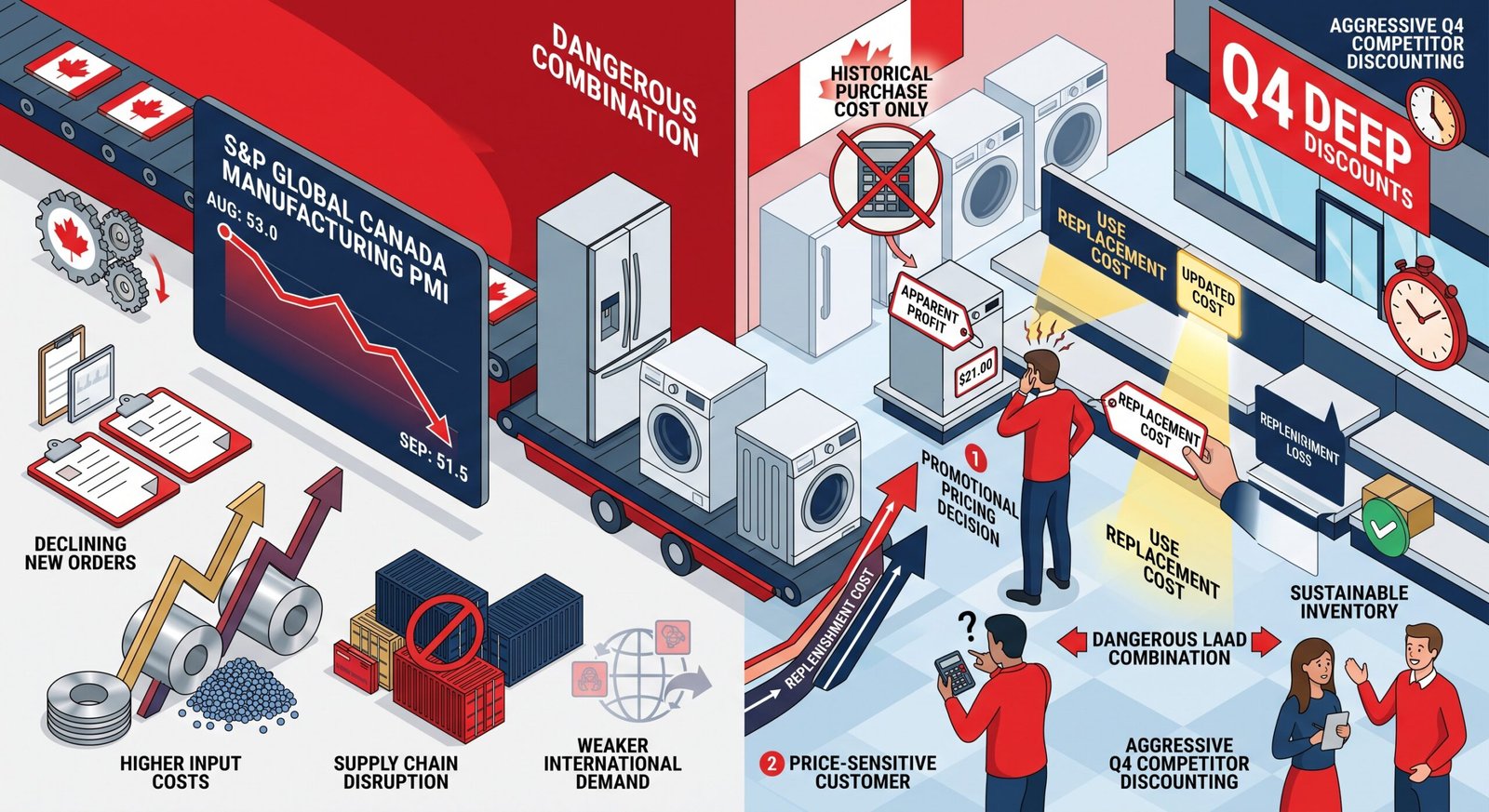
A number most retailers will never read just quietly raised the risk of running a Q4 promotion that loses money the moment you need to restock it.
Canada’s manufacturing PMI fell to 51.5 in September 2026, its weakest reading in six months, as new orders declined and manufacturers reported higher costs and supply chain disruption. For Canadian retailers importing appliances and similar goods, this signals rising input costs colliding with limited pricing power and aggressive Q4 discounting. The fix is pricing Q4 promotions against replacement cost rather than historical purchase cost, so a promotion that looks profitable today doesn’t quietly lose money once you need to restock.
What Did Canada’s September PMI Actually Show?
The S&P Global Canada Manufacturing PMI dropped from 53.0 in August to 51.5 in September, according to Reuters. That’s still above the 50 mark separating expansion from contraction, so the sector technically kept growing, but the pace slowed to its weakest point in six months. New orders declined during the month, and manufacturers reported higher costs, supply chain disruption, and softer international demand. S&P Global’s own data through 2026 shows this isn’t an isolated blip either, cost pressures and tariff related disruption have shown up repeatedly in the agency’s releases throughout the year, with earlier readings in the spring showing similar strain from high prices and softer demand.
Why Does a Manufacturing Index Matter to a Retailer Who Doesn’t Manufacture Anything?
Because the PMI is measuring exactly the pressures that eventually show up in your landed cost. Rising input costs and supply chain disruption among manufacturers don’t stay contained to factories, they flow downstream into what importers and retailers pay to restock the products they sell. If you import appliances or similar goods, a weakening PMI combined with reports of higher costs is an early signal that your next replenishment order may cost more than your last one, even if nothing about your own business has changed.
What’s the Dangerous Combination This Creates for Q4?
Three pressures are converging at once. Input costs are rising as manufacturers deal with higher costs and supply disruption. Customer pricing power remains limited, since shoppers heading into the holidays are leaning toward value seeking behavior rather than accepting higher prices without resistance. And Q4 brings its usual wave of aggressive competitor discounting on top of both. Individually, each of these is manageable. Together, they create real risk for anyone pricing promotions the way they normally would.
Why Does Historical Cost Pricing Fail Under These Conditions?
Most retailers price a promotion against what they actually paid for the inventory sitting in the warehouse right now. That math works fine in a stable cost environment. It breaks down when replacement costs are rising, because the promotion’s profitability gets measured against a cost basis that’s already out of date by the time you need to reorder. You can run a Black Friday promotion that looks perfectly profitable on paper, sell through the discounted stock, and then discover that replenishing it now costs meaningfully more than it did when you set the price, turning what looked like a win into a loss the moment you restock.
What Does Replacement Cost Pricing Actually Mean in Practice?
Instead of calculating your promotional floor from what you paid for existing inventory, calculate it from what you’d realistically pay to replace that inventory today, given current supplier pricing, shipping costs, and exchange rate conditions. If your supplier has already signaled a cost increase, or if sector level cost pressure like September’s PMI data suggests one is likely, build that expected cost into your price floor now rather than after the increase lands on an invoice.
How Should Retailers Actually Apply This Before Q4?
Start by checking in directly with your key suppliers about pricing stability heading into the season rather than assuming your last purchase order reflects future costs. For any product you expect to need restocking during or shortly after Q4, calculate your contribution margin using an estimated replacement cost instead of your historical cost, and set your promotional floor against that higher number. This is especially important for high velocity SKUs you expect to sell through quickly and need to reorder while demand is still running hot, since those are exactly the products where a cost increase will bite fastest.
Key Takeaways
A PMI reading rarely makes it into a retailer’s daily decisions, but September’s slowdown is exactly the kind of early signal worth paying attention to before Q4 promotions go live. Rising costs, limited customer pricing power, and heavy competitor discounting are a combination that can quietly turn a seemingly profitable promotion into a loss once replenishment time comes. Pricing against replacement cost rather than historical cost is a small shift in method that can be the difference between a Q4 that looks good in December and one that still looks good in February.
Side Note:
What is Canada’s current manufacturing PMI?
The S&P Global Canada Manufacturing PMI stood at 51.5 in September 2026, down from 53.0 in August and its weakest reading in six months, though still above the 50 threshold indicating overall expansion.
Why does a weakening PMI matter for retailers who don’t manufacture products?
A weakening PMI often signals rising input costs and supply chain disruption among manufacturers, which flows downstream into higher landed costs for importers and retailers restocking inventory.
What is replacement cost pricing?
It’s a pricing approach that calculates promotional floors based on the estimated cost to restock inventory at current supplier prices, rather than the historical cost of inventory already purchased.
Which retailers should prioritize this approach?
Importers of goods like appliances, where input costs are sensitive to global supply chains and tariffs, and especially for high velocity SKUs likely to need restocking during or right after the holiday season.