Can Google Understand Your Product Well Enough to Recommend It?
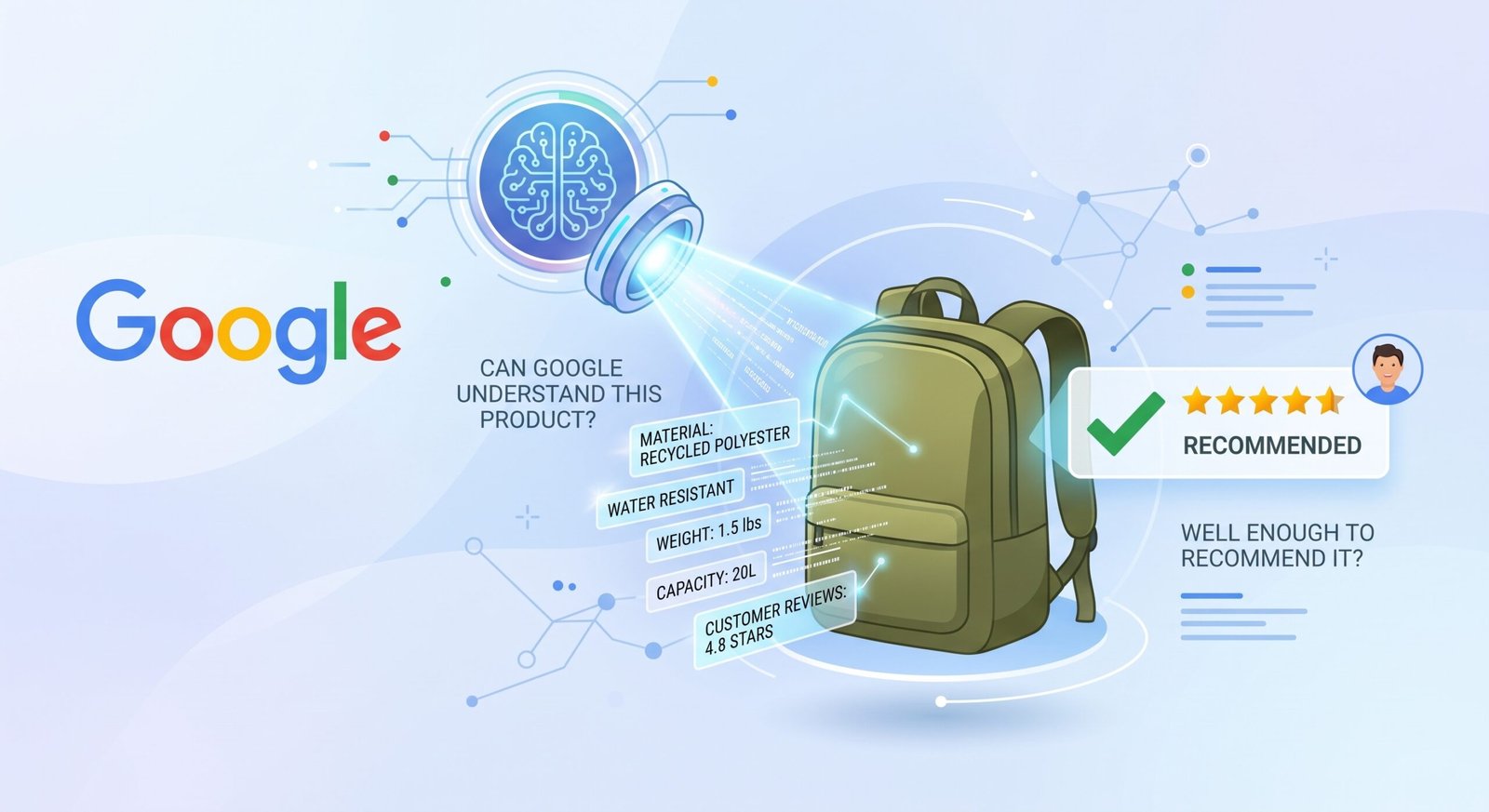
Your product may appear on Google. But if a shopper asks Google which product is right for their particular situation, would Google know enough about yours to recommend it?
For years, e-commerce businesses have focused heavily on one question:
Can Google find my product?
We optimize product titles. We research keywords. We improve descriptions. We submit product feeds. We work on SEO so products appear when someone searches for them.
Those things still matter.
But AI-powered shopping is introducing another question that may become even more important:
Does Google understand my product well enough to know when it should recommend it?
That is a very different challenge.
Shoppers Don’t Always Search for Products Anymore
Traditional e-commerce search is often product-focused.
A shopper might search:
“30-inch stainless steel range hood 550 CFM.”
This is relatively straightforward. The shopper already knows approximately what they want, and the search engine needs to find products matching those specifications.
But conversational and AI-assisted shopping can look very different.
Someone might instead ask:
“What type of range hood should I buy for a small condo kitchen if I stir-fry several times a week?”
Now Google needs to do much more than match keywords.
It needs to understand the shopper’s situation, evaluate possible products and determine which ones may be appropriate.
That requires context.
Specifications Tell Google What a Product Is
Imagine a range hood product page containing:
- 30-inch width
- 550 CFM
- Stainless steel
- Three fan speeds
- LED lighting
This is useful product information.
But does it tell Google whether this range hood is a suitable choice for someone who cooks frequently in a smaller kitchen?
Not necessarily.
Additional information could help explain questions such as:
Is it suitable for a standard 30-inch cooktop?
What type of cooking environment is it designed for?
How loud is it at different settings?
What installation configuration does it require?
What makes this model different from another option?
Specifications help machines understand what a product is.
Context helps them understand when, why and for whom the product may be appropriate.
Modern product information increasingly needs both.
Think About the Questions Customers Actually Ask
And this isn’t just about appliances.
Consider a backpack.
A conventional product listing might emphasize:
25-litre capacity. Water-resistant fabric. Padded laptop compartment.
But a shopper might ask:
“What’s a good backpack for commuting to work every day that can carry a 15-inch laptop and still fit under an airplane seat?”
Or consider a skincare product.
The listing might emphasize:
50 ml. Lightweight formula. Fragrance-free.
But a shopper might ask:
“What type of moisturizer should I look for if I want something lightweight that works well under makeup?”
Or consider a desk chair.
The listing might say:
Adjustable height. Lumbar support. Mesh back.
The shopper asks:
“What’s a comfortable chair for someone working from home eight hours a day in a small office?”
The specifications haven’t become unimportant.
The difference is that an AI shopping system must connect those specifications to the shopper’s real-world situation.
If your product information doesn’t provide enough context to make that connection, the AI has less reliable information to work with.
Google Is Building for Conversational Shopping
This isn’t simply a prediction about where search might eventually go.
Google is already developing shopping experiences around AI and conversational product discovery.
Merchant Center product data gives Google structured information about products, while structured data on product pages can help search systems understand important information such as price, availability, ratings, shipping details and product characteristics.
Google has also been developing additional product-data capabilities intended to help AI systems better understand product nuances in conversational shopping experiences.
The direction is becoming increasingly clear:
Product information is evolving from something written primarily for shoppers and traditional search engines into information that AI systems also need to interpret.
That changes how e-commerce businesses should think about their catalogs.
Your Product Page Has Another Audience
Traditionally, we might think about a product page as serving two audiences:
The shopper and the search engine.
Now there is effectively another audience:
The AI system trying to understand the product.
This doesn’t mean product pages should become robotic databases filled with awkward keywords.
Quite the opposite.
Good product information should clearly explain the product in natural language while maintaining accurate, structured information behind it.
A strong product page should help answer:
What is it?
What category and type of product is this?
Who is it for?
What type of customer or situation could benefit from it?
What problem does it solve?
Why would someone need this product?
When is it appropriate?
What situations or use cases make this product relevant?
How is it different?
Why might someone choose this option instead of a similar alternative?
Those answers are useful to shoppers.
They are also useful to machines trying to understand what the product means.
Searchable Is Not Necessarily Understandable
This distinction may become one of the most important changes in e-commerce optimization.
A product can be perfectly searchable.
It can have a good title, relevant keywords and an optimized description.
But that doesn’t necessarily mean an AI system understands it well enough to confidently recommend it in context.
Imagine an online store with hundreds or thousands of SKUs.
Some products have incomplete attributes. Others use inconsistent terminology. Compatibility information may be buried in PDFs. Important dimensions might be missing. Product descriptions may simply repeat specifications without explaining practical use cases.
A human shopper may be able to investigate further.
An AI system has to work with the information it can reliably understand.
And when it has many competing products to consider, clearer and better-structured product information may become increasingly valuable.
A Simple Test for Your Product Catalog
Choose one of your best-selling products and ask five questions:
What exactly is this product?
Who is it best suited for?
What problem does it solve?
In what situations would someone choose it?
Why might someone choose it instead of a similar alternative?
Now look at your product page, product feed and structured product information.
Can those answers actually be found there?
If you need to explain the answers yourself because the catalog doesn’t contain them, you may have discovered an AI-readiness gap.
The Next Phase of E-Commerce Optimization
SEO isn’t disappearing.
Product feeds aren’t disappearing.
Keywords aren’t disappearing.
Instead, they are becoming part of a larger product-information ecosystem.
The next generation of e-commerce optimization will increasingly involve making products:
Searchable. Structured. Understandable. Recommendable.
That means businesses should start looking beyond whether their products appear in search results.
The better question is:
If an AI shopping assistant were helping a customer choose the right product today, would it understand yours well enough to confidently include it in the conversation?
Because in AI-powered commerce, getting found may only be the first step.
Getting understood could be what gets you recommended.
Is Your Product Catalog Ready for AI Shopping?
NorthPilot Digital Agency’s AI-Readiness Product Data Audit helps e-commerce businesses identify gaps in their product information, catalog structure and readiness for a world where AI increasingly participates in product discovery and recommendations.
The objective isn’t simply to add more content to every product page.
It’s to make sure the right information is accurate, structured, contextual and understandable — for shoppers, search engines and the AI systems increasingly connecting the two.