Before: “Look what AI agents can build!”. Now: “How do we stop agents from breaking things?”
For the past couple of years, much of the AI conversation has focused on one question:
“What can AI agents do?”
Write code. Analyze spreadsheets. Answer customers. Update databases. Research competitors. Create reports. Process orders. Manage workflows.
The list keeps growing.
But as AI agents become capable of taking real actions inside businesses, a much more important question is emerging:
“How do we stop them from doing the wrong thing?”
For business owners, this shift is important to understand.
A chatbot gives advice. An agent takes action.
This is the fundamental difference.
Imagine asking ChatGPT:
“Should I refund this customer?”
It gives you a recommendation, but a person still decides what happens.
Now imagine an AI customer-service agent connected directly to your e-commerce system.
It can look up the order, approve the refund, issue a coupon, update the customer record and send an email.
That’s much more useful.
It’s also much more dangerous if something goes wrong.
What happens if the agent accidentally refunds $1,000 instead of $100?
Or gives every complaining customer a 50% coupon?
Or changes the inventory of the wrong product?
Or publishes incorrect prices across 500 SKUs?
The more power we give AI, the more important control becomes.
Think of an AI agent like a new employee
When you hire an employee, you normally don’t give them access to everything on their first day.
A customer-service representative probably doesn’t need access to payroll.
A marketing assistant shouldn’t be able to transfer money from the company’s bank account.
A warehouse employee doesn’t need administrator access to the website.
AI agents should be treated the same way.
The question isn’t simply:
“What systems can we connect to the AI?”
It should be:
“What is the minimum access this AI actually needs to perform its job?”
This concept is sometimes called least-privilege access, and it will become increasingly important as businesses adopt AI agents.
Some actions should require human approval
Suppose an AI agent manages customer-service requests.
It might be allowed to:
Check order status automatically.
Answer product questions automatically.
Send tracking information automatically.
But perhaps:
Refunds under $25 → automatic.
Refunds from $25–$100 → employee approval.
Refunds above $100 → manager approval.
Now the AI still saves substantial time without receiving unlimited authority.
The same idea can apply to marketing.
An AI agent could prepare a Google Ads campaign automatically.
But instead of immediately spending money, it sends the campaign to a manager:
“Campaign ready. Proposed budget: $1,500. Approve?”
AI does the repetitive work.
Humans retain control over consequential decisions.
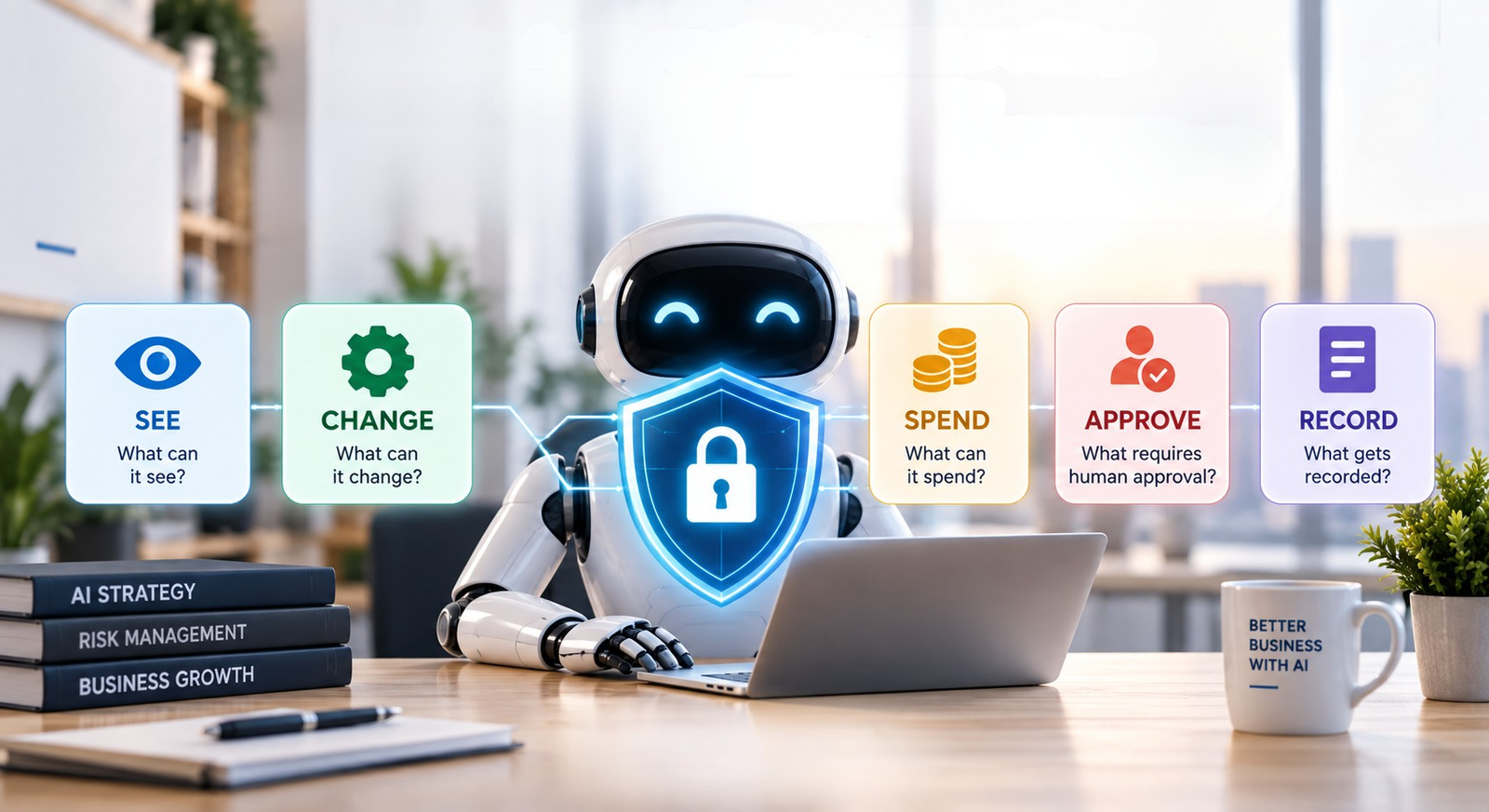
Business owners should think about five controls
Before allowing an AI agent to operate independently, ask:
1. What can it see?
Customer information? Sales reports? Product data? Financial information?
2. What can it change?
Can it update inventory? Edit products? Publish content? Modify customer records?
3. What can it spend?
Can it issue refunds, purchase advertising or order inventory?
4. What requires human approval?
Define where automation ends and human judgment begins.
5. What gets recorded?
If something goes wrong, can you determine what the agent did, why it did it and which systems it accessed?
That last point is particularly important.
An AI system shouldn’t simply say:
“Task completed.”
Businesses increasingly need an audit trail.
This changes how businesses should evaluate AI automation
For a while, AI demonstrations were impressive because an agent could perform 20 steps without human involvement.
But complete autonomy isn’t necessarily the goal.
A better AI system might automate 15 of those steps and deliberately stop for approval at the five important ones.
That can actually be better automation.
The objective isn’t to remove humans from every workflow.
The objective is to remove unnecessary work while preserving human judgment where it matters.
This also changes the question business owners should ask AI vendors
Don’t just ask:
“What can your AI automate?”
Ask:
“What happens when it makes a mistake?”
Can permissions be restricted?
Can spending limits be established?
Can certain actions require approval?
Can the agent’s activity be logged?
Can access be revoked immediately?
Can sensitive information be protected?
Can a person intervene?
These questions may ultimately matter more than another impressive AI demo.
The next stage of AI isn’t just more powerful agents
Businesses are moving from experimenting with AI to connecting it with real systems, real customers, real inventory and real money.
That changes the risk.
An AI-generated paragraph that isn’t perfect is inconvenient.
An AI agent that accidentally changes 2,000 product prices is a business problem.
So the AI-development market is gradually shifting from:
“Look what agents can build!”
to:
“How do we stop agents from breaking things?”
That’s not a sign that AI agents are failing.
It’s a sign that they are becoming useful enough to require proper business controls.
The companies that benefit most from AI may not be the ones that automate everything.
They may be the ones that understand what to automate, what to control, and where humans should remain in charge.
to:
“How do we stop agents from breaking things?”