Are You Training Your Customers to “Wait for Black Friday”
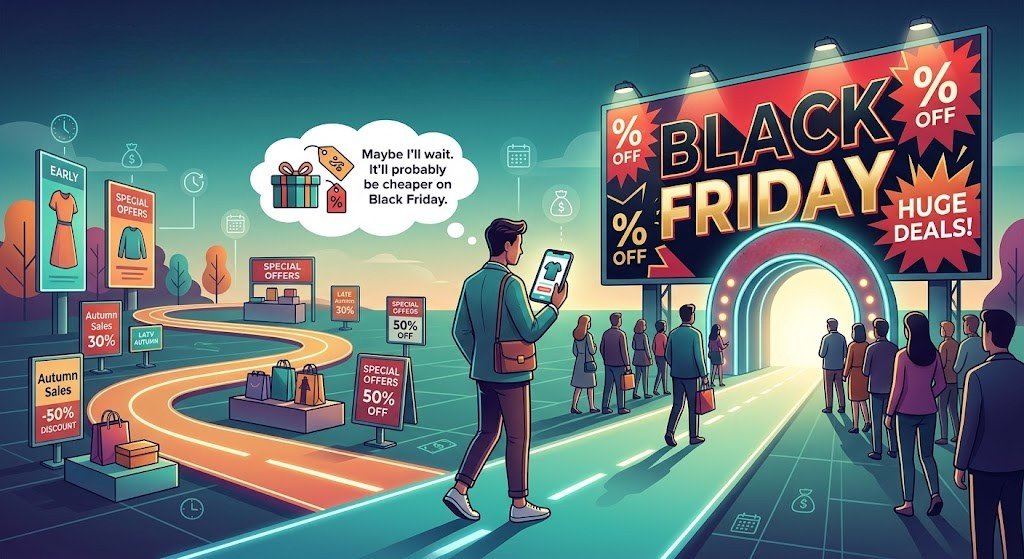
Q4 is approaching, and retailers are already turning up the promotional pressure.
Recent U.S. appliance promotions have included discounts approaching 45% across major brands such as Samsung, LG, Whirlpool and GE Appliances, alongside substantial savings on multi-appliance packages.
Canadian sellers shouldn’t copy U.S. prices or promotions directly. But they should pay attention to the behaviour these promotions create.
Retailers are teaching customers something:
There is probably another deal coming.
And as Black Friday approaches, that can become a serious problem.
A shopper sees a $699 appliance in September and thinks:
“Maybe I’ll wait. It’ll probably be cheaper on Black Friday.”
The seller hasn’t lost the customer to a competitor yet.
They’ve lost the customer to waiting.
The Q4 discount trap
Discounting works because it creates an immediate financial reason to buy.
But when promotions become too frequent, the opposite can happen.
Customers learn your regular price isn’t really the price.
Imagine a product normally sells for $499.
September: 10% off.
October: Thanksgiving promotion.
November: Black Friday.
December: Holiday Sale.
December 26: Boxing Day.
What has the customer learned?
Not: “This product is worth $499.”
But: “Never pay $499.”
That’s a dangerous position for any brand.
The solution isn’t to stop running promotions. Q4 is too important for that.
The better strategy is to give customers different reasons to buy now without making lower prices the only reason.
Add value instead of constantly removing price
Suppose an appliance normally sells for $399.
The easiest Black Friday strategy is:
Regular $399 → Sale $319
That’s an $80 reduction before considering advertising, marketplace fees, fulfilment and other costs.
Another approach could be:
$399 + free $59 accessory
If that accessory costs the seller only $20, the customer may perceive $59 of additional value while the seller sacrifices $20 rather than $80.
That difference matters.
It also creates a different purchasing message: “Buy now and get more.”
rather than: “Wait long enough and we’ll charge less.”
Bundles can make comparison harder, in a good way
Bundles have another advantage during Q4.
Customers can easily compare identical products.
If five retailers sell the same coffee machine, a shopper can quickly compare:
$599
$579
$549
$529
Price becomes the deciding factor.
But suppose one retailer offers:
Coffee Machine + Milk Frothing Pitcher + Cleaning Kit + Coffee Starter Pack
Now the comparison isn’t as straightforward.
The seller has created a package, not simply another price.
This works particularly well for appliances because many products naturally have complementary items.
A vacuum sealer can be bundled with bags or containers.
A rice cooker can include useful kitchen accessories.
An espresso machine can be paired with cups, cleaning supplies or coffee-related accessories.
The key is relevance.
A random free gift creates promotion.
A useful accessory creates value.
Free shipping can sometimes beat another discount
Shipping deserves special attention in Canadian e-commerce.
A customer may happily accept a $349 product and then abandon the checkout when another $30 appears for shipping.
Instead of offering:
$30 OFF
consider whether:
FREE SHIPPING
creates a stronger message.
Financially, the cost may be similar.
Psychologically, however, they solve different problems.
The discount says: “We’re cheaper.”
Free shipping says: “There won’t be an unpleasant surprise at checkout.”
That can be particularly valuable for larger products where customers naturally worry about delivery costs.
Give customers a reason to buy before Black Friday
There are many other ways to create urgency without permanently attacking price.
A retailer might offer:
Free accessory with purchase
Free shipping this week
Extended warranty
Installation credit
Buy two and save
Limited bundle
Bonus loyalty points
Gift-with-purchase
Guaranteed pre-holiday delivery
These offers answer the customer’s question: “Why should I buy today?”
without always answering: “Because it’s cheaper.”
Not every product should receive the same promotion
This is also where Q4 planning becomes more strategic.
Your bestseller with healthy margin might support a meaningful discount.
A low-margin product might need a bundle instead.
A premium product may benefit more from an extended warranty.
A bulky appliance might convert better with free shipping.
An accessory-heavy product might work particularly well with a starter kit.
The promotion should fit the economics and purchasing barrier of the product.
A universal “20% off everything” campaign ignores both.
Black Friday should be part of Q4, not the entire Q4 strategy
There will always be customers who wait for Black Friday. That’s fine.
But businesses shouldn’t accidentally teach every customer to do it.
The better Q4 strategy is to create different reasons to purchase at different moments:
September might emphasize a bundle.
October might use a gift-with-purchase.
Black Friday might feature selected aggressive discounts.
December might focus on shipping deadlines and gifting.
Boxing Day might clear specific inventory.
Now every promotion has a purpose.
And importantly, not every promotion destroys the reference price of the product.
As Q4 discounting becomes louder, the businesses that stand out may not be those shouting the biggest percentage.
They may be the ones that understand what their customers actually value.
Because the goal of a promotion shouldn’t simply be to make a product cheaper.
It should be to make the decision to buy easier.