Amazon’s October Deal Event Is Coming. Smart Sellers Should Be Thinking Beyond Prime Shoppers.
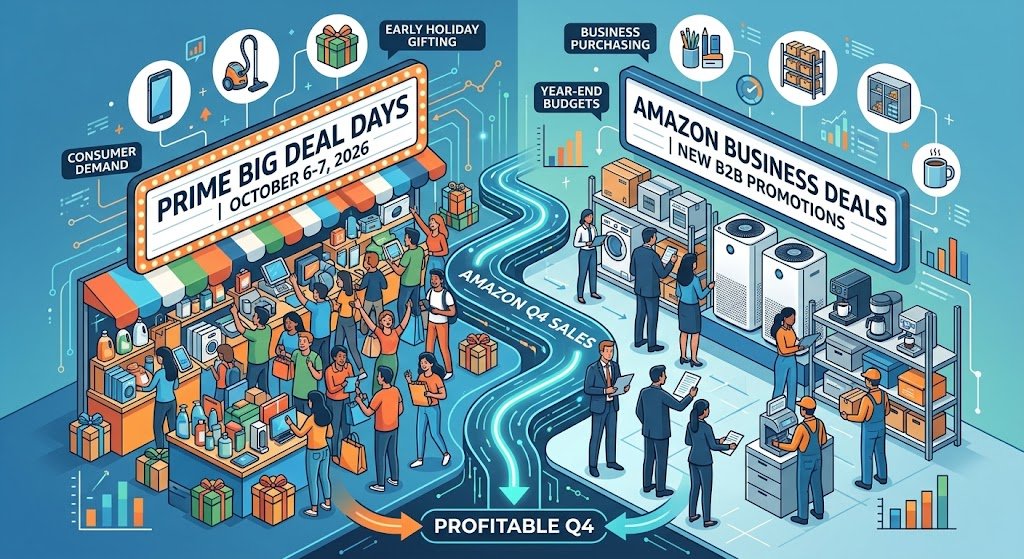
Amazon has officially confirmed that Prime Big Deal Days will return October 6-7, 2026, giving Prime members 48 hours of deals across more than 35 categories, including home, kitchen, technology and early holiday gifting. Amazon describes the event as the kickoff to the holiday shopping season.
For e-commerce sellers, that means Q4 is no longer something happening “later.”
It’s already beginning.
But there’s another Amazon opportunity that deserves more attention this year: Amazon Business Deals.
Starting August 31, eligible sellers in Canada and several other markets can create limited-time promotions specifically for Amazon Business customers. Together, these two programs give sellers an interesting Q4 question:
Are you selling only to consumers, or could some of your products be selling to businesses too?
Prime Big Deal Days is becoming the unofficial start of Q4
Black Friday may still receive most of the attention, but October shopping events increasingly pull holiday demand forward.
Amazon says Prime Big Deal Days will feature millions of offers, with new “Today’s Big Deals” drops appearing three times each day. Categories include kitchen, home, electronics, beauty and seasonal products. That creates both opportunity and pressure:
Customers arrive expecting discounts.
Competitors become more aggressive.
Advertising becomes more expensive.
And products that normally sell comfortably at regular price suddenly appear beside heavily promoted alternatives.
The natural reaction is: “We need a bigger discount.”
But that’s not necessarily the best response.
Don’t chase Q4 revenue without calculating Q4 profit
Imagine a product normally sells for $299. For Prime Big Deal Days, the seller reduces it to $239. Sales increase dramatically. Great result? Maybe.
Now subtract:
marketplace referral fees,
fulfilment,
advertising,
product cost,
shipping,
returns,
and the promotional discount.
The $299 product may have generated substantially more profit per order than the $239 promotional version. That doesn’t mean the promotion was a mistake. A lower-margin product can attract new customers, increase ranking, move inventory or generate accessory sales. But the seller should know why the product is being discounted.
Before Q4 promotions begin, classify products by their role:
A traffic product attracts customers.
A profit product protects margin.
An attach product increases basket value.
An accessory, filter, replacement part or related product might actually generate better economics than the heavily discounted hero product that brought the customer in. That’s a much healthier way to plan Q4 than applying 20% off across the entire catalogue.
Amazon Business Deals creates a second audience
This year there’s another dimension.
Amazon Business says it now serves more than 11 million organizations worldwide and reached $60 billion in annualized gross sales in Q2 2026. Its new Business Deals feature allows eligible sellers to create promotions specifically for business customers in markets including Canada.
Regular Business Deals require at least a 10% discount, while major shopping events such as Prime Big Deal Days, Black Friday and Cyber Monday require at least 15%. Eligible products also need a rating of at least 3.5 stars, must be sold in new condition, and need to satisfy Amazon’s pricing and seller-performance requirements.
Amazon says qualifying event deals can receive additional email and push-notification exposure at no additional promotional cost through the end of 2026. That creates an interesting opportunity for products that businesses already use but sellers continue marketing almost exclusively to consumers.
Look at your catalogue through a business customer’s eyes
Consider a vacuum sealer.
A consumer might buy it for: meal preparation, food storage or sous-vide cooking.
But a business customer might be: a restaurant, catering company or small food operation.
A rice cooker could be positioned for a family kitchen, but certain suitable models might also interest restaurants, offices or hospitality businesses.
An air purifier could be marketed to homeowners while also serving: offices, salons, clinics or waiting rooms.
The product hasn’t changed. The buying situation has.
That means sellers should review their catalogue and ask: Could a business reasonably use this product?
If yes, check whether the listing actually gives a business buyer enough information to make a decision.
They may care more about:
capacity,
durability,
warranty,
replacement supplies,
quantity pricing,
delivery reliability,
dimensions,
maintenance,
and total operating cost.
B2B shouldn’t mean copying “commercial” into the title
There is an important caution here. Don’t market a consumer product as commercial equipment if it isn’t designed or certified for commercial use. Instead, describe legitimate business-use situations where appropriate.
For example: “Suitable for office kitchens and staff break rooms”
is very different from claiming: “Professional commercial restaurant equipment.”
Accurate positioning matters.
The objective isn’t to make the product sound more capable than it is. It’s to help another legitimate customer segment discover that the product may fit their needs.
Think about Q4 as two selling seasons
For many sellers, Q4 planning looks like this:
Prime Big Deal Days → Black Friday → Cyber Monday → Christmas
But Amazon Business creates another possible track:
Consumer demand + business purchasing
Business customers may be buying for:
year-end budgets,
office upgrades,
employee gifts,
hospitality,
inventory replenishment,
or operational needs.
That means the same catalogue may contain completely different promotional opportunities.
A seller doesn’t necessarily need more products. They may need to understand the different jobs their existing products can perform for different buyers.
The smartest Q4 strategy starts with the catalogue
Prime Big Deal Days will bring enormous attention to Amazon on October 6-7. That’s valuable. But traffic alone doesn’t guarantee profitable growth.
Before the event, sellers should know:
Which products deserve a discount?
Which products should protect margin?
Which accessories can increase basket value?
Which products could appeal to business customers?
Which listings need stronger B2B information?
What is the actual contribution profit after promotion and advertising?
Amazon is giving sellers multiple ways to participate in Q4 demand. The opportunity isn’t simply to sell more. It’s to sell the right products, to the right customers, with the right economics. And that may mean looking beyond the Prime shopper and realizing that your next Q4 customer could be buying not for their home,but for their business.