Amazon, Shopify and Walmart Are Pointing Toward a New Seller Architecture
If you sell on more than one marketplace, you probably run the same business several times over.
That’s been the reality of multichannel e-commerce for years. You log into Amazon to manage Amazon, open Walmart Seller Center for Walmart, and run your website through Shopify. Then come the separate advertising dashboards, inventory tools, shipping software, and a stack of spreadsheets holding it all together. Each platform has its own product IDs, listing rules, reports, and workflows. Change a product specification and you update it several times. Launch a promotion and you type the price into multiple systems. Want a monthly report? Export a handful of files and stitch them together by hand.
It works, but the complexity grows fast as the business does. And recent moves from Amazon, Shopify, and Walmart suggest all three companies are chipping away at that problem from different directions.
Amazon wants Seller Central to manage more than Amazon
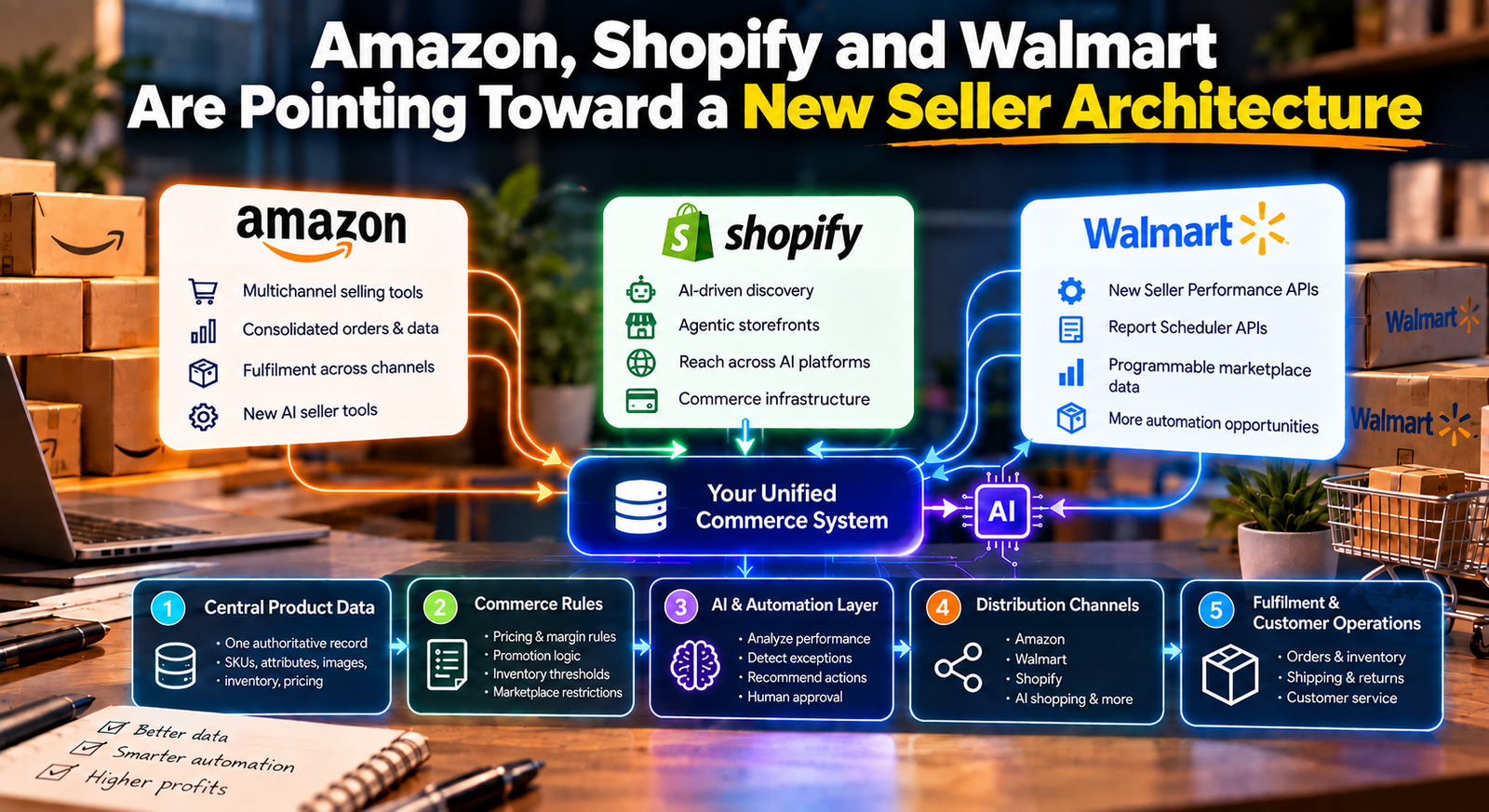
At Amazon Accelerate 2026, the company announced new multichannel tools that let U.S. sellers connect Shopify, Walmart, eBay, and TikTok accounts to Seller Central. The first version can import and link listings, consolidate orders, and let sellers fulfill orders across channels. Amazon says later updates will add cross channel listing changes and profitability views that combine sales, traffic, and advertising data. The rollout is gradual and currently limited to U.S. sellers.
Amazon also says more than 95% of its independent sellers sell through multiple channels, though it hasn’t published how it arrived at that number, so treat it as a rough indicator. The direction is still clear. Amazon wants Seller Central to help run your whole commerce business, not just your Amazon slice of it. It has also introduced integrations that connect seller catalog data and live metrics to outside AI tools such as Claude.
Shopify is taking almost the opposite approach
Rather than pulling every marketplace into Shopify, the company wants its infrastructure to work wherever shoppers happen to discover products. Increasingly, that means AI. Shopify’s Agentic Storefronts can distribute merchant products into ChatGPT, Microsoft Copilot, Google’s AI Mode, and Gemini. Shopify reports that AI driven traffic to its stores grew eightfold year over year in Q1 2026, and orders from AI powered searches grew nearly thirteenfold. Those are the company’s own figures, but they explain why it’s investing so heavily here.
In practice, an AI tool finds the product, Shopify supplies the structured product details, the price and availability get verified, and the merchant completes the sale and ships the order. Shopify doesn’t need to own the place where shoppers start. It wants to be the commerce engine underneath.
Walmart is making seller operations easier to automate
Walmart’s changes are quieter but could matter just as much. On September 24, it added Seller Performance APIs that cover returns, negative feedback, Item Not Received cases, and late shipments. The next day it launched Report Scheduler APIs that can automatically schedule recurring reports on inventory, promotions, item performance, listing quality, search terms, and Buy Box data. Both currently apply to Walmart’s U.S. marketplace.
Why does this matter? Because marketplace data no longer has to sit inside a dashboard waiting for someone to download it. Software, and increasingly AI agents, can pull it automatically, analyze it, flag problems, and suggest what to do next, with a person approving the final call.
What this adds up to
Put the three together and a different setup starts to take shape. At the center sits one authoritative product record with your SKU, GTIN, title, attributes, dimensions, compatibility, cost, inventory, images, and warranty. Around it sit your business rules, such as minimum prices, margin requirements, promotion limits, and approval steps. An automation and AI layer watches sales, inventory, ads, and feedback. Then the marketplaces, your website, and AI shopping channels become connected endpoints that pull from that core.
The marketplaces aren’t going away. Their role is shifting from separate islands to connected outlets.
Why your master product data matters so much
The most useful rule here is simple: don’t let any marketplace become your master database. One product might have an internal SKU, an Amazon SKU, a Walmart item ID, and a Shopify product ID. Your system should know these all describe the same thing, with one authoritative record that each channel maps back to.
Pricing works the same way. Instead of setting Amazon, Walmart, and Shopify prices independently, define a regular price, your cost, a minimum margin, and a maximum promotion discount. Then let channel specific prices be calculated from fees, ad costs, fulfillment, and those rules. This becomes essential once AI starts suggesting actions, because rules give it guardrails.
From dashboards to exceptions
Most marketplace software is built around dashboards full of charts that the owner still has to interpret. AI opens up a different approach. Instead of thirty charts every morning, you might get a short note saying three products need attention today. One may run out of stock in nine days. Another has ad costs up 34% while conversion fell. A third has a promotion price that dips below your minimum margin. Each comes with a recommended action and an approval request. For a busy owner, that beats another dashboard.
Don’t hand over the keys just yet
Connected systems bring efficiency, but they also raise the stakes. An agent misconfigured to change 500 prices is a much bigger problem than a weak product description. A safer flow is to observe, analyze, recommend, check business rules, get human approval, execute, and record what happened. Only when a workflow proves reliable over time should you consider removing approval for low risk actions. Autonomy should be earned, not switched on because it’s available.
The Real Takeaway
The lesson from Amazon, Shopify, and Walmart isn’t that you need more software. It’s that the walls between marketplaces are getting thinner. The sellers best placed to benefit won’t be those with the most accounts. They’ll be the ones with clean product data, consistent identifiers, centralized pricing rules, connected inventory, documented business logic, and carefully controlled automation.
The old question was how to manage Amazon, Walmart, and Shopify. The better question now is how to build one commerce operation that can sell well through all of them, and whatever channel shows up next.