Amazon seller tools are starting to escape Amazon
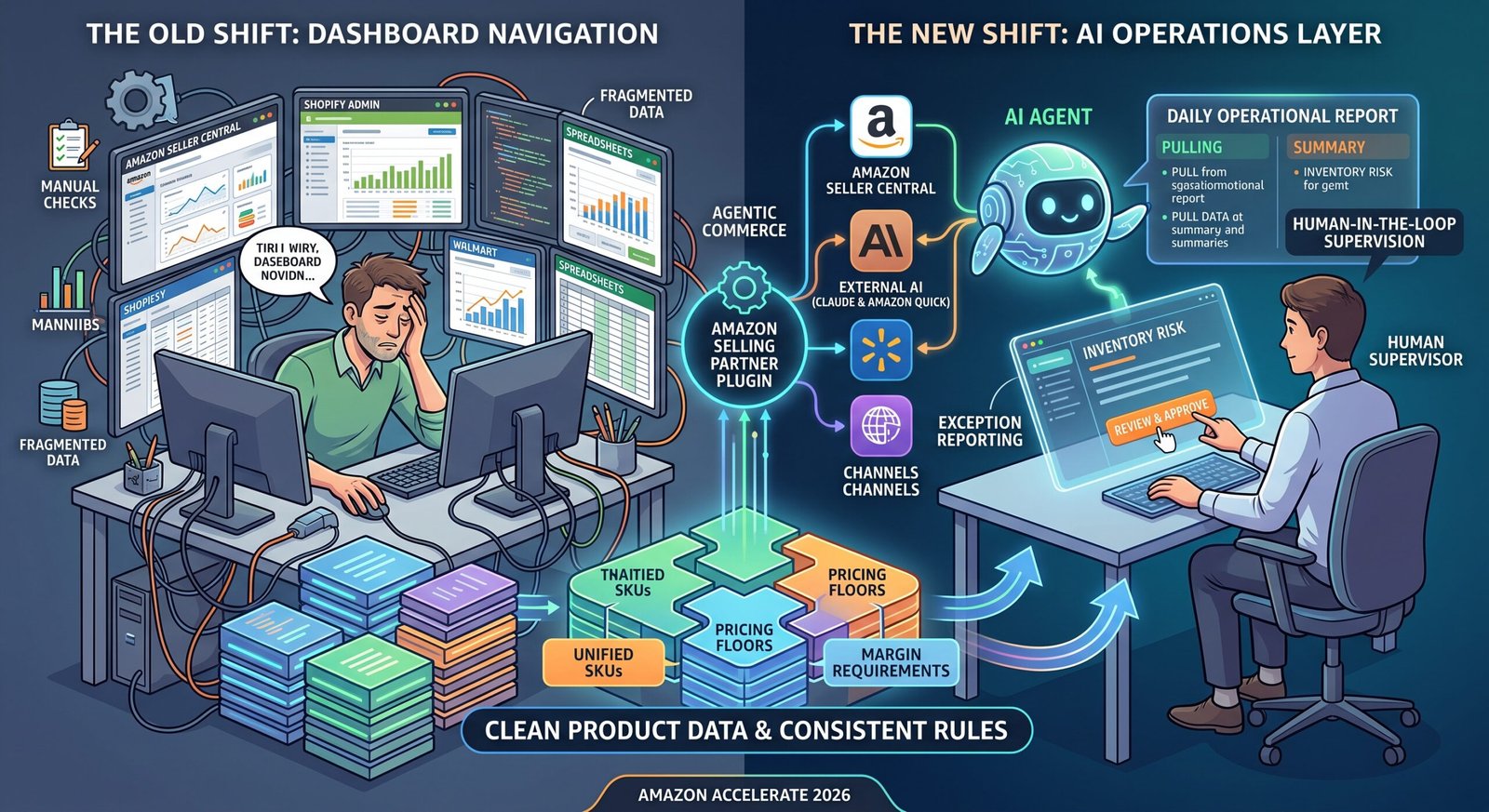
Amazon just told its own sellers they might never have to open Seller Central again, and that’s a much bigger deal than it sounds.
At Amazon Accelerate 2026, Amazon announced a Selling Partner plugin that connects Seller Central data and selling capabilities to outside AI tools, launching with Amazon Quick and in beta with Anthropic’s Claude. This lets sellers manage inventory, pricing, listings, and analytics from outside Amazon’s own interface entirely. The bigger shift isn’t the integration itself. It’s that marketplace management is starting to move away from dashboards altogether, and businesses that build clean, consistent product data now will be the ones actually able to use this well.
What Did Amazon Actually Announce?
On September 23, 2026, at Amazon Accelerate in Seattle, Amazon unveiled a Selling Partner plugin that brings its Seller Assistant AI into outside tools, starting with Amazon Quick and in beta with Claude. The plugin connects a seller’s Amazon data, including listing information, real time performance metrics, inventory levels, and sales analytics, directly to whichever AI agent the seller prefers, and that agent can take the same kinds of actions Seller Assistant already handles inside Seller Central. Amazon’s VP of Worldwide Selling Partner Experience, Mary Beth Westmoreland, described the goal plainly: sellers would ideally never need to log into Seller Central at all. Amazon also said that roughly 90% of its selling partners already use some outside AI tool to help run their business, which is part of why this integration exists in the first place.
Why Does This Matter More Than a Typical Feature Update?
Because it points at a bigger shift in how marketplace businesses could operate. Running a multichannel business today usually means logging into Amazon Seller Central, Shopify Admin, Walmart Seller Center, separate advertising dashboards, shipping software, and a pile of spreadsheets, just to answer a basic question like why a product’s sales suddenly dropped. Each piece of that answer lives in a different system, organized around whichever software built it, not around the question you’re actually trying to answer.
AI agents open up a different possibility: reorganizing commerce around the question itself, rather than the dashboard that happens to hold a piece of the answer.
How Would This Actually Work for a Multichannel Seller?
Picture a business selling through Amazon, Shopify, Walmart, and its own wholesale operation. Instead of checking four systems every morning, the owner could simply ask an AI assistant what needs attention today. The assistant checks each permitted source and reports back, something like noting that one product’s Amazon sales jumped but inventory might run out within nine days, that another’s Shopify conversion rate fell after a recent price increase, and that a third product appears to have lost competitiveness on Walmart. The operating model shifts from humans manually checking dashboards toward an AI layer that surfaces exceptions, with the human stepping in to make the final call.
Is Amazon’s Own Seller Assistant Changing Too?
Yes, alongside the external integration. Amazon says Seller Assistant is becoming more agentic, continuously monitoring areas like inventory, pricing, and account health, reasoning through problems, and helping take action within boundaries the seller sets. Amazon reports that Seller Assistant already has a substantial base of regular monthly users and that sellers accept its recommended actions the large majority of the time, figures worth treating as Amazon’s own reporting rather than independently audited numbers. Either way, the direction is consistent. Amazon is making its own assistant smarter while simultaneously letting that intelligence travel into tools sellers already use elsewhere.
Does This Mean Sellers Should Connect AI to Everything Right Away?
Not quite. The more useful first step is building a clean, unified commerce information layer before plugging AI into it. If your Amazon listing calls a product SKU-ABC, your Shopify store calls it ABC-01, and your warehouse spreadsheet calls it PRODUCT-A, an AI agent inherits exactly the same confusion your team already struggles with. AI doesn’t fix messy operational architecture on its own. It can actually execute the mistakes hiding inside that mess faster than a person would.
What Should a Commerce Architecture Actually Include?
A few core layers make this work well. Start with one authoritative product record covering SKUs, attributes, specifications, and identifiers across every channel. Layer documented commerce rules on top, covering pricing floors, margin requirements, inventory thresholds, and promotional limits. Then let an AI operations layer monitor performance and flag exceptions across your distribution channels, whether that’s Amazon, Shopify, Walmart, or elsewhere. Finally, keep a human control layer in place for decisions that actually matter, like pricing changes, advertising budgets, inventory commitments, refunds, or account level changes.
Where Should a Business Actually Start?
You don’t need to build an elaborate system on day one. A simple, practical starting point is asking an AI assistant to review your commerce operation each morning and flag what needs attention, looking for unexpected sales changes, inventory risk, pricing anomalies, advertising performance drops, listing problems, or return spikes. Instead of someone manually checking 500 products, the system might report that most are running fine and point directly at the handful that genuinely need a decision. That kind of exception reporting tends to deliver real value faster than trying to automate an entire operation at once.
Key Takeaways
Amazon’s integration with Claude and Amazon Quick might look like a small feature update, but it points toward something larger. Marketplace management is starting to shift from humans navigating software toward AI operating that software while humans supervise the decisions that matter. The businesses best positioned for that shift won’t be the ones that connect AI to everything first. They’ll be the ones that already have clean product data, documented business rules, and clear human approval boundaries in place, so that when an AI agent does start asking what needs attention today, it actually has a reliable answer to give.
Side Note:
What is Amazon’s Selling Partner plugin?
It’s a tool announced at Amazon Accelerate 2026 that connects a seller’s Amazon data and selling capabilities to outside AI tools, launching with Amazon Quick and in beta with Claude, so sellers can manage their business without opening Seller Central directly.
Does this replace Seller Central entirely?
Not yet. It’s in beta for U.S. sellers, and Amazon’s stated goal is for sellers to eventually not need Seller Central at all, but the rollout is still early.
Why does product data consistency matter for AI commerce tools?
Because an AI agent pulling from multiple platforms needs consistent identifiers and clean data to operate correctly. Inconsistent SKUs or product records across channels will confuse an AI agent the same way they confuse human employees.
What’s a good first step for sellers wanting to try this?
Starting with a simple daily exception report, asking an AI tool to flag unusual sales, inventory, or pricing changes, is a lower risk way to test the value before expanding into more automated actions.