Amazon Is Becoming More Than a Marketplace
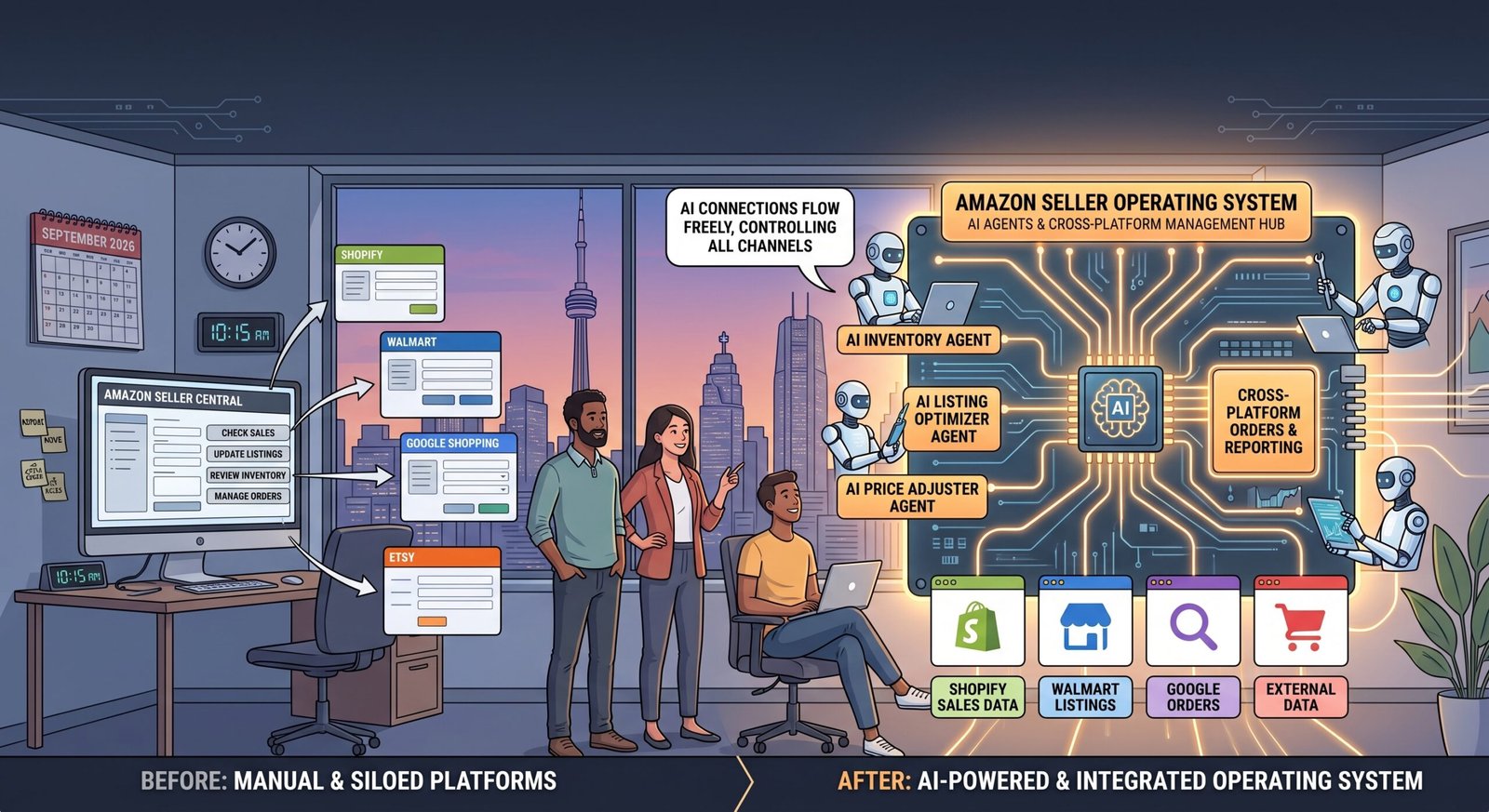
For years, selling on Amazon followed a familiar pattern: log into Seller Central, check sales, update listings, review inventory, adjust prices, manage orders, then move to another platform and repeat much of the same work.
Amazon’s latest seller announcements suggest that model is beginning to change.
At Amazon Accelerate 2026, the company introduced two developments that deserve particular attention from e-commerce businesses: AI agents can now connect directly to Seller Central, and Amazon is introducing tools for managing sales from competing commerce platforms inside its own seller environment.
Together, they point toward something bigger:
Amazon increasingly wants to become part of the operating system behind a seller’s entire e-commerce business.
1. AI Is Moving Inside Seller Operations
Amazon’s new Selling Partner plugin allows sellers to connect their Amazon business to external AI assistants, beginning with Amazon Quick and Anthropic’s Claude.
The Claude connector is currently in beta. It can access live Amazon selling information such as sales, inventory and listing performance, provide recommendations based on that information, and allow sellers to review and approve actions without returning to Seller Central. This is considerably different from uploading an Amazon report into an AI chatbot.
The traditional workflow might look like:
Seller Central → Export spreadsheet → Upload to AI → Ask questions → Return to Seller Central → Make changes
The emerging workflow becomes:
Seller Central ↔ AI Agent → Analysis → Recommendation → Approval → Action
The AI can potentially work with the seller’s actual business data rather than providing generic advice. That is where AI starts moving from assistant to operator.
2. Amazon Is Adding Guardrails Around AI Actions
Giving an AI access to a live seller account obviously introduces risk.
Amazon’s documentation therefore emphasizes permissions and seller responsibility. Sellers can choose what an agent is authorized to access, should grant only the minimum permissions required, can audit connected agents, and can revoke access. Amazon also warns that data passed to an external AI is processed outside Amazon’s systems and subject to that AI provider’s privacy terms. This provides an important lesson for any business considering AI automation:
Don’t give an AI agent unlimited authority simply because it can perform an action.
A pricing agent, for example, could operate under rules such as:
Minimum selling price: $249
Minimum margin: 25%
Maximum promotional discount: 15%
Never modify MAP-controlled products
Human approval required below 30% margin
The future of business AI may therefore be less about completely autonomous agents and more about controlled autonomy.
3. Amazon Also Wants to Manage Your Other Marketplaces
The second development may be equally significant.
Amazon is rolling out multichannel selling tools that will allow U.S. sellers to connect accounts from Shopify, Walmart, eBay and TikTok, link listings and view orders from those channels through Amazon’s seller environment. The rollout is expected to happen gradually over the coming months.
Think about what that means.
Many sellers currently operate something like:
Amazon Seller Central
+ Shopify Admin
+ Walmart Seller Center
+ eBay
+ spreadsheets
+ inventory software
+ fulfilment systems
Amazon increasingly wants to reduce that fragmentation, and fulfilment is another part of the strategy.
Amazon’s Multi-Channel Fulfillment already allows merchants to use Amazon inventory to fulfil orders originating outside Amazon. Amazon says MCF now supports hundreds of thousands of merchants across 11 countries, while new U.S. programs are extending Prime delivery and discounted fulfilment to off-Amazon orders.
Amazon is therefore expanding across three layers:
Marketplace → Operations → Logistics
Add AI agents, and a fourth layer appears:
Intelligence and automation.
4. Why This Matters Even If You Don’t Sell Primarily on Amazon
The bigger story isn’t about one new Amazon feature. It is about the architecture of e-commerce changing.
For years, businesses built separate workflows around individual marketplaces.
The emerging model looks more like:
Central Product & Business Data
↓
AI Operations Layer
↓
Amazon | Walmart | Shopify | eBay | Social Commerce
↓
Shared Inventory & Fulfilment
Instead of employees constantly moving between dashboards, AI systems may monitor multiple channels, identify exceptions and recommend, or eventually execute, actions.
Amazon’s existing Selling Partner API already allows software to programmatically update listings, inventory and prices and manage orders. The new agent layer makes those capabilities increasingly accessible through natural language interfaces rather than only traditional software integrations.
5. There Is Also a Strategic Risk
Centralization creates efficiency, but it also creates dependency.
If a seller uses Amazon for marketplace sales, multichannel order management, inventory, fulfilment and AI-driven operations, Amazon potentially becomes deeply embedded in that company’s commerce infrastructure.
Businesses should therefore ask:
Who owns my master product data?
Where is my inventory source of truth?
Can I switch fulfilment providers?
Can my AI workflows operate without Amazon?
Do I maintain independent access to my customer and operational data?
Convenience should not eliminate portability.
What Sellers Should Do Now
There is no need to rebuild your technology stack immediately. Instead, prepare the foundation.
Start documenting business rules around pricing, inventory, promotions, listing quality and approvals. Clean up product data. Create consistent SKU and product identifiers across marketplaces. Determine which decisions AI may make automatically and which should always require human approval. Most importantly, stop thinking about AI only as a tool for writing product descriptions. The much bigger opportunity is AI operating parts of the commerce business itself.
Amazon’s latest announcements provide a glimpse of that future.
The question for sellers is shifting from:
“How can AI help me sell on Amazon?”
to:
“How should AI help operate my entire multi-channel e-commerce business?”
That is a much more important question, and one every marketplace seller should start preparing for now.