AI Automation vs Regular Automation: What Should Your Business Use?
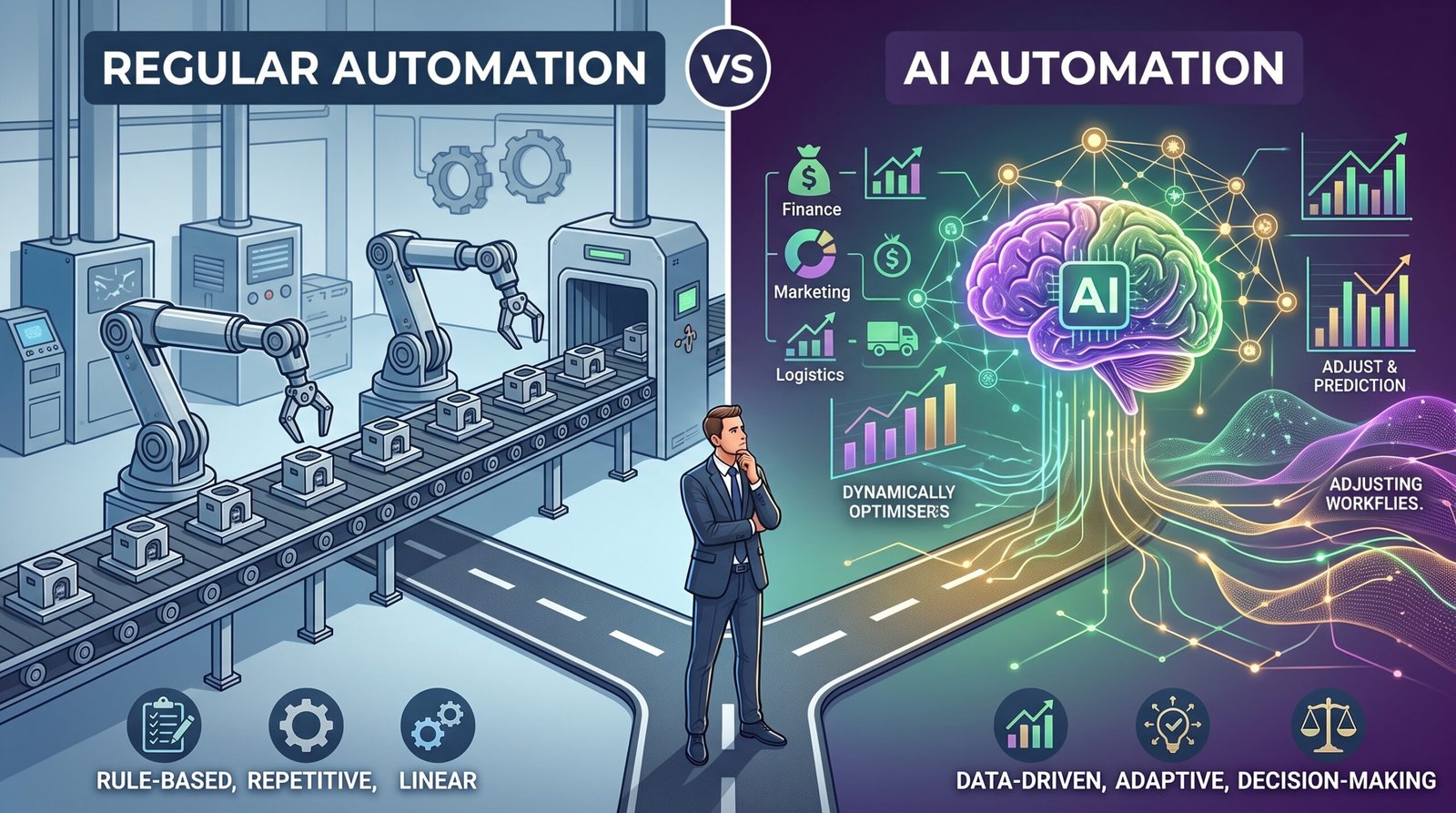
Not every repetitive task needs AI, and one of the biggest automation mistakes businesses make is using AI where a simple rule would work better.
Automation has become one of the most talked-about ways to improve business efficiency. But as AI enters almost every software category, an important distinction is getting lost: AI automation and regular automation are not the same thing.
Both can save time, reduce manual work and improve operations. The question isn’t which technology is more advanced. It’s which one is appropriate for the job you’re trying to automate.
What Is Regular Automation?
Regular automation follows predefined rules.
Think of it as:
When X happens → do Y.
For example, an e-commerce business might automatically:
- send an order confirmation after a purchase;
- reduce inventory when an order is placed;
- add a customer to an email list after signup;
- send an alert when inventory falls below 10 units;
- copy Shopify orders into an accounting system.
The workflow doesn’t need to understand anything. It simply needs to follow instructions consistently.
That’s actually one of regular automation’s greatest strengths.
If the same input should always produce the same action, predictability is valuable.
What Makes AI Automation Different?
AI automation becomes useful when a workflow requires some degree of interpretation, classification, generation or decision-making.
Instead of:
When X happens → do Y
the workflow may look more like:
When X happens → understand what X means → decide what should happen → take the appropriate action.
Imagine a customer sends this message:
“I bought this for my new kitchen, but I’m not sure whether I ordered the right size. Can someone check before it ships?”
Regular automation can recognize that a message arrived and create a support ticket.
AI automation can potentially understand that the customer has a pre-shipment product compatibility concern, identify the relevant order and product information, retrieve the appropriate specifications, draft a response and flag the order for human review before fulfilment.
That’s a very different type of automation.
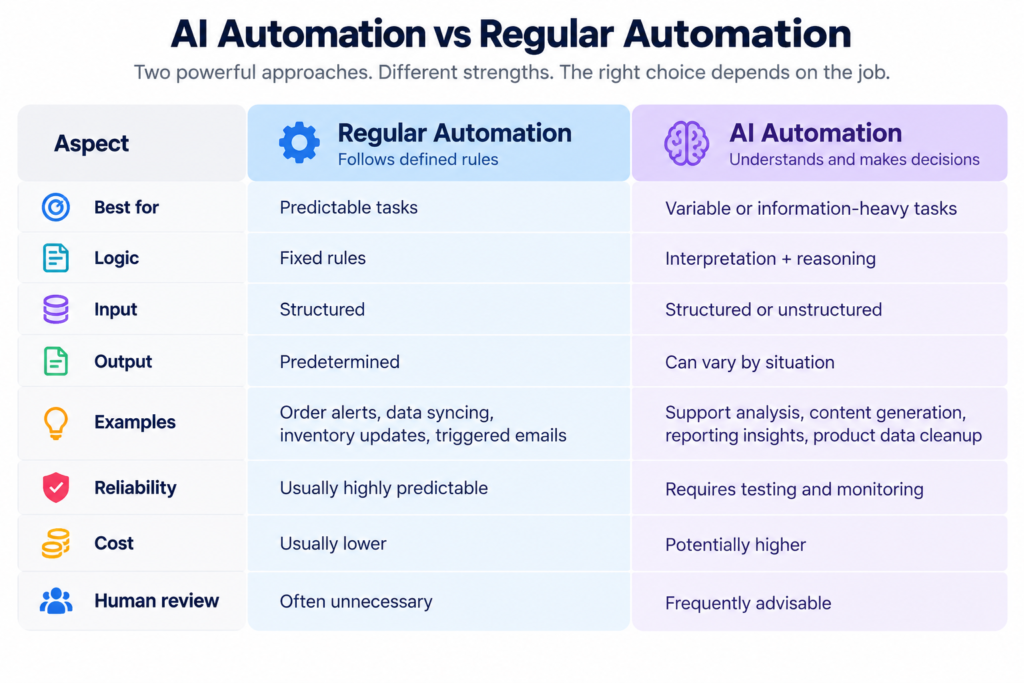
The important point is that AI automation isn’t automatically better automation.
Sometimes it is actually the worse choice.
When Regular Automation Is the Better Choice
Suppose you want your operations team to receive an alert whenever inventory falls below five units.
You don’t need an AI agent to think about it.
A simple rule:
IF inventory < 5 → send alert
is faster, cheaper, easier to troubleshoot and more predictable.
The same applies to tasks such as moving files, sending scheduled reports, updating database fields, syncing orders and triggering predefined emails.
If the logic can be expressed clearly with IF / THEN rules, regular automation should often be your starting point.
Adding AI may simply introduce unnecessary cost and uncertainty.
When AI Automation Makes More Sense
Now imagine you manage hundreds of products across Shopify and multiple marketplaces.
Every month you want to know:
- Which products are underperforming?
- Which products have high sales but weak profitability?
- Which listings may contain incomplete information?
- Which advertising campaigns are spending inefficiently?
- What changed compared with last month?
- What should the team investigate first?
Traditional automation can collect the data and calculate the numbers.
But interpreting what those numbers mean is much harder to accomplish with fixed rules.
This is where AI becomes useful.
An AI system could review the data, identify unusual patterns, categorize problems and produce an initial analysis for management.
The difference is important:
Regular automation moves information. AI automation can help interpret information.
The Best System Often Uses Both
Businesses shouldn’t really be choosing between AI automation or regular automation.
The strongest systems frequently combine them.
Imagine a monthly e-commerce reporting workflow.
Regular automation:
Shopify + marketplace exports
↓
Advertising data
↓
Cost data
↓
Spreadsheet/database
↓
Calculate revenue, ROAS and contribution margin
Then:
AI automation:
Analyze changes
↓
Identify anomalies
↓
Explain possible causes
↓
Prioritize issues
↓
Draft recommendations
Then:
Human:
Review assumptions
↓
Investigate important issues
↓
Make the business decision
The complete workflow becomes:
Automation → AI → Human Judgment
Each layer does what it is best at.
Don’t Automate a Broken Process
There’s another mistake businesses should avoid.
Imagine a company receives product information from suppliers through spreadsheets, PDFs, emails and handwritten notes. Product names are inconsistent, specifications are missing and nobody follows the same approval process.
Adding AI on top doesn’t necessarily solve the underlying problem.
You may simply create a faster version of a messy workflow.
Before automating anything, ask:
What is the current process?
Where does it break?
Which information is reliable?
Which decisions require human judgment?
Which steps are genuinely repetitive?
Sometimes the best first step isn’t AI.
It’s fixing the workflow.
A Simple Way to Decide
When considering an automation opportunity, ask these three questions.
1. Is the task predictable?
If the same condition should always trigger the same action, use regular automation.
2. Does the task require understanding?
If someone normally needs to read, interpret, classify, summarize or evaluate information, AI automation may help.
3. What happens if the system is wrong?
This question is especially important.
Having AI suggest an email subject line is relatively low risk.
Allowing AI to automatically change the price of 5,000 marketplace products is very different.
As the potential impact of an error increases, businesses should introduce stronger rules, permissions, testing and human approval.
So, Which Should Your Business Use?
Neither should be the default.
Start with the business problem.
Use regular automation for predictable work.
Use AI automation for work that requires interpretation or flexibility.
And use human judgment for decisions where context, accountability and consequences matter.
The goal isn’t to build the business with the most AI.
The goal is to build the business that operates most effectively.
A well-designed operation might actually use AI in only 20% of a workflow, and traditional automation for the other 80%.
That’s perfectly fine.
Because the smartest automation strategy isn’t:
“Where can we add AI?”
It’s:
“How should this work be done, and where can technology make it better?”
Ready to Automate, but Not Sure Where to Start?
NorthPilot Digital Agency helps e-commerce businesses identify which workflows should be streamlined with traditional automation, which can benefit from AI, and where human oversight still matters.
The starting point isn’t choosing an AI tool. It’s understanding the business process first.