Facebook Lets Users Describe Their Feed. What Should Online Sellers Take From It?

On October 13, Meta announced new AI-powered controls for Facebook. A feature called Your algorithm lets users describe, in their own words, the topics they want to see in Feed and Reels. It sits in a space reached from the three-dot menu, where people can add and manage topics.
Meta also says users will be able to give more natural-language feedback. After tapping “Interested” or “Not interested” on a post, they may be asked follow-up questions about what they want more or less of. Meta says its recommendations can adapt to this “within the same session.”
What it is, and what it isn’t
In plain terms, Facebook is giving people a way to tell the platform what they want instead of leaving it to guess from likes, comments and watch time. Meta says it uses AI language models to interpret what people write.
It’s equally important to be clear about what this is not:
- It isn’t a confirmed change to advertising auctions. Meta’s announcement doesn’t mention ads at all.
- It isn’t a guarantee of more or less organic reach. The announcement doesn’t mention businesses or creators.
- It isn’t confirmed for Canada. Meta says it’s “rolling out” but names no regions or dates, so you can’t assume Canadian users have it yet.
So don’t rebuild your content strategy around this announcement. But it does point in a direction worth noticing.
The direction: matching content to what people say they want
Platforms increasingly try to match content to a viewer’s stated interests and current needs, not only to broad popularity. When viewers can say “show me tips for small kitchens”, content that clearly deals with small kitchens is easier to match than content that is vaguely about appliances.
Even if this feature never changes your reach, the principle holds for people as much as algorithms. A viewer scrolling past a video decides in a second whether it’s about them. A clear subject and a clear audience help with both.
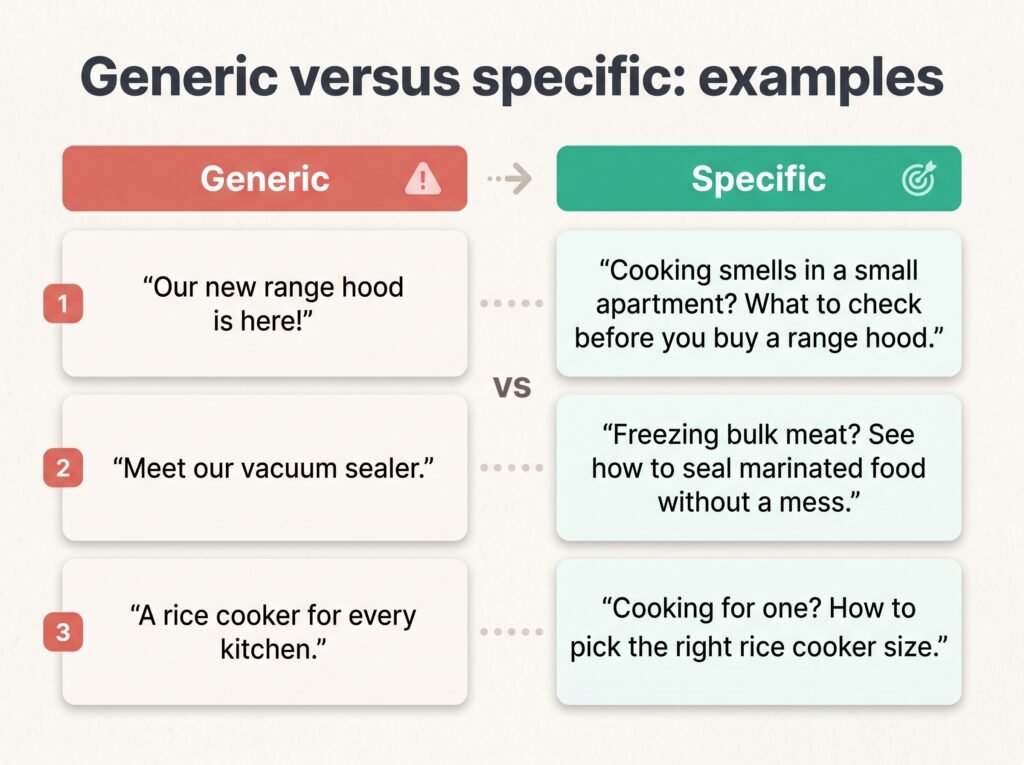
The specific versions name a situation, a person and a problem. They also tell you what to put in the video, and what questions the product page should answer. (Check that any claim you make is accurate and matches your product documentation.)
Five ways to make content more specific
- Choose one customer problem per video. One problem, one message.
- Name the audience or situation early. Put it in the first line, caption or on-screen text: “Small kitchen?”, “Cooking for a family of five?”
- Show the product in use. A short, realistic demonstration beats a slogan.
- Use clear, everyday language. Describe the topic the way a customer would type it, not the way your catalogue names it.
- Make the landing page match. If the video promises answers on range hood venting, the page should state venting requirements clearly.
Measure by topic
You don’t need new tools. Group your videos by the problem they address, and compare:
- Watch time and how many viewers stay to the end
- Saves and shares
- Clicks and product-page visits
- Orders
After a month, you’ll see which problems your audience cares about, and you can make more of those. Treat any change in reach with caution. Many things move organic performance, and this announcement doesn’t say this feature will.
Facebook’s new controls are about what viewers want to see. They don’t change the rules for businesses, as far as Meta has said. They do reinforce an old lesson: content that is clearly about something, for someone, serves viewers better than a generic product shot.