Sell Through Demonstrations, Not Generic Claims

TikTok has been expanding Smart+, its AI-assisted approach to advertising. According to TikTok’s own materials, it covers areas such as creative optimization, catalogue ads and lead generation (TikTok for Business). Its Canadian Smart+ Playbook says advertisers keep control over targeting, budgets, placements and creative assets (TikTok Smart+ Playbook). TikTok describes the product as automating work such as finding audiences, testing creatives and shifting budget.
The useful lesson for a small business isn’t “automate your ads right now”. It’s this: when platforms handle more of the setup, the quality of your creative and the way you measure results matter even more. The machine can only optimize the videos you give it.
Three videos, one product
Pick one product or service and make three short videos, each opening a different way. Here’s an example using a range hood.
Creative A: Problem first
Hook: “Still cleaning grease from your kitchen cabinets?”
Show the problem, demonstrate a relevant feature, then explain the benefit, without exaggerating what the product does.
Creative B: Demonstration first
Hook: “Watch what happens when we test this feature.”
Show the product in use with clear, realistic footage. No staged results.
Creative C: Comparison first
Hook: “Before choosing a range hood, compare these three specifications.”
Explain airflow (often listed in CFM), noise level and installation requirements in plain language, so a shopper knows what to look for even if they don’t buy from you.
Whatever the hook, keep every claim accurate and consistent with your product documentation. A video that overpromises produces returns, not repeat customers.
Keep the test fair
To learn which opening works, change one thing at a time. Use the same product, the same audience, the same landing page and offer, the same budget per video and the same run time. Otherwise you can’t tell whether the video or something else made the difference.
A realistic starting budget
For a small Canadian business, a test of CAD $150 to $300 can be useful for seeing how people respond to each creative. That’s around CAD $50 to $100 per video. Two cautions:
- This is a planning suggestion, not a platform minimum and not a guarantee of statistically meaningful results. Whether it delivers properly depends on your platform and campaign setup.
- A small budget produces small numbers, perhaps only a handful of orders. For perspective, TikTok’s own playbook looks for at least 10 conversions in the past 28 days before it suggests raising a budget. Treat early results as clues to follow up, not proof.
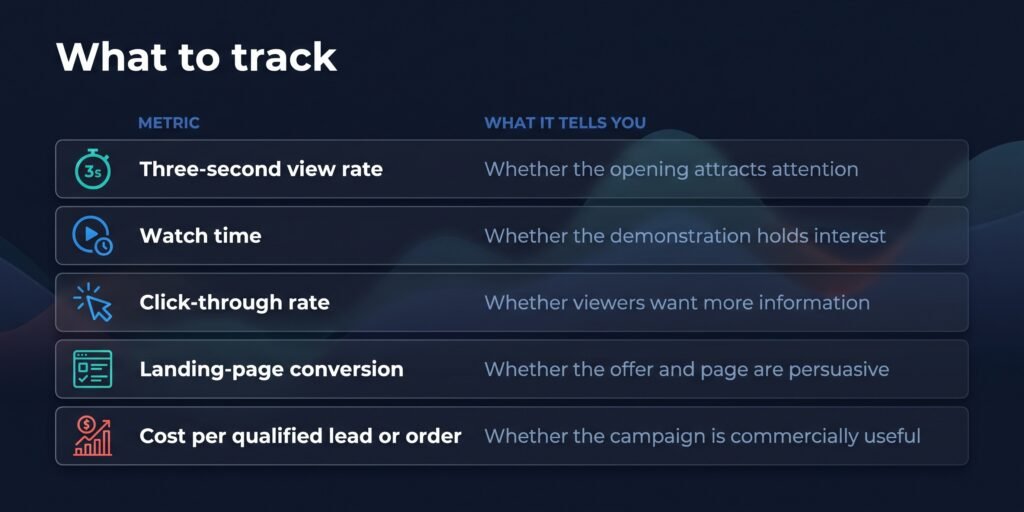
Read them in that order, as a funnel. Each one points to a different problem.
Don’t pick the winner on views alone
Here is a made-up example. Creative A gets the most views and the cheapest clicks. Creative C gets fewer views but produces the only two orders. Which one worked?
If you chose by views, you’d scale the video that attracts attention and sells nothing. The measure that matters most is the one closest to money: cost per qualified lead or order.
The pattern also tells you what to fix:
- High three-second views, low watch time: the hook works, but the demonstration doesn’t hold attention.
- Good watch time, few clicks: the video interests people, but the call to action is weak.
- Many clicks, few orders: look at the landing page, price, shipping information or product details.
Make the page match the video
A strong video sends people to your product page, and the page has to answer the questions the video raised. If the video compares airflow and noise, the page should state them clearly. Complete, accurate product information turns interest into orders and helps every channel, including AI shopping assistants.
Next steps
- Run the test for a fixed period, with all three videos live together.
- Pick the winner on cost per order or qualified lead, using views only as a clue.
- Make two or three variations of the winner and test again.
- Refresh creatives regularly, since viewers tire of the same video.
Automation helps with the mechanics of advertising. It doesn’t replace a clear demonstration of what your product does and an honest way of measuring whether it paid off. Three simple videos and a modest, well-run test will teach you more than guessing.