Not Every Retailer Is Welcoming AI Shopping Agents
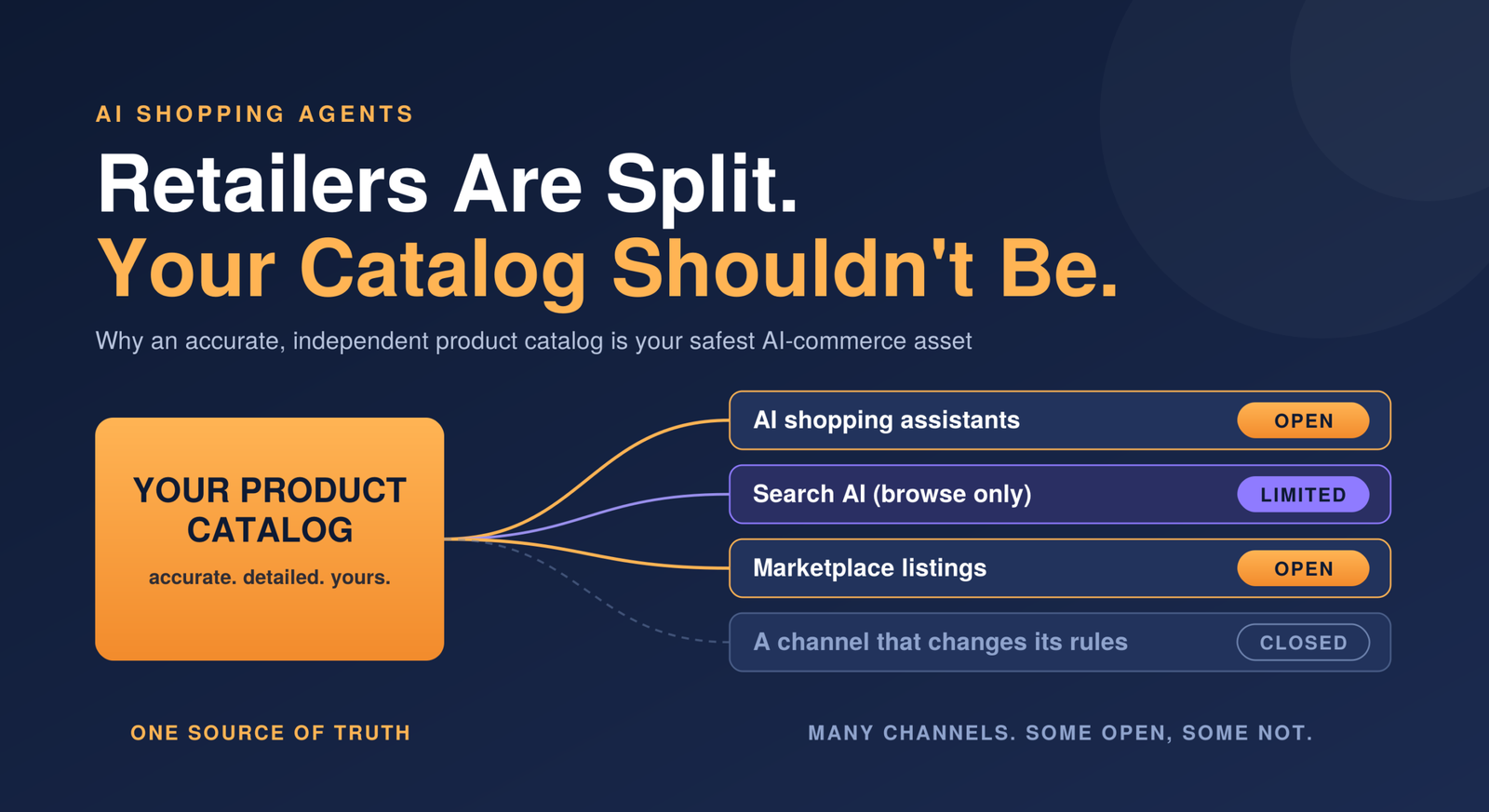
Most of the talk about AI shopping makes it sound like a one-way street: AI assistants will search, compare and buy, and every store will simply plug in. The reality is messier. The Wall Street Journal reports that major retailers are split on whether to let outside AI systems into their stores (WSJ), and that matters for every seller, large or small.
A divided industry
According to eMarketer’s summary of the WSJ reporting (eMarketer), retailers fall roughly into three camps:
- Open: QVC and HSN let agents complete purchases and send product catalogues to AI platforms such as OpenAI and Google.
- Cautious: Tapestry (Coach, Kate Spade) makes products purchasable through Google’s AI search, but doesn’t let agents buy directly on its own sites, citing fraud and inventory hoarding. Gap decides case by case.
- Closed: Kohl’s doesn’t allow agents to make purchases, and eBay has banned unauthorized AI agents. Amazon is reported to block agents from several AI companies.
These are examples, not a full survey, and some details come second-hand. The point is the pattern: there is no industry consensus.
Why retailers disagree
Each concern is one a smaller seller will recognize.
Who owns the customer? If a shopper buys through an AI assistant, their relationship may be with the assistant, not with you. You may lose the chance to collect an email, offer a loyalty perk or earn the repeat visit.
Fraud and stock. An automated agent can fill carts or reserve stock in ways a human wouldn’t. Imagine a limited run of 50 jackets that automated carts tie up while real customers can’t buy.
Consent and disputes. Did the customer truly approve this purchase? If an AI orders the wrong size, who handles the return, and who pays?
Checkout reliability. A human can work around a glitchy checkout. An automated process may simply give up.
Attribution. If the sale happens inside an AI app, how do you know AI drove it? Without tracking, you can’t tell a good channel from a costly one.
Big retailers can say no. Can you?
A retailer with a powerful brand and millions of direct customers can afford to be choosy. A smaller store often needs every route to a sale it can get. That’s a reason to be open to AI channels, but it isn’t a reason to be careless about which ones, or on what terms.
What sellers should do
1. Don’t depend on one AI-shopping platform. Rules change quickly. Picture a store that gets a fifth of its sales through one AI channel, then that channel changes its terms or access. Spread your bets, and keep your own website and marketplace sales strong.
2. Keep product information accurate everywhere. If your website says a product is $89, your marketplace listing says $95 and your product feed says $99, an AI may repeat whichever it finds. Treat one accurate version as the master, and make every channel match it.
3. Decide your stance on purpose. Think of three levels of access:
- Let AI read your catalogue. Low risk, and it helps you get found.
- Let AI recommend your products. Moderate risk. Make sure your policies and claims are accurate.
- Let AI complete purchases. Higher risk. You need clear fraud checks, stock rules and a return process first.
You don’t have to say yes to all three, and you can change your mind.
4. Check your current settings. On Shopify, for example, AI-channel distribution is on by default for eligible stores. Know which channels your products are being sent to.
5. Measure what AI actually sells. Track orders from AI channels separately, so your decisions rest on results.
The asset that outlasts the platforms
AI shopping is not automatically turning into one open ecosystem. Platforms will come and go, and retailers will keep drawing their own lines. What stays valuable whichever way it goes is an independent, reliable product catalogue that you own: accurate, detailed and consistent, ready to feed whichever channel proves worth joining.
If you’d like to know how ready your catalogue is, an audit of your product data and AI-channel settings is a good place to start. Get in touch and we’ll walk you through it.