American Express just published an Agentic Commerce playbook
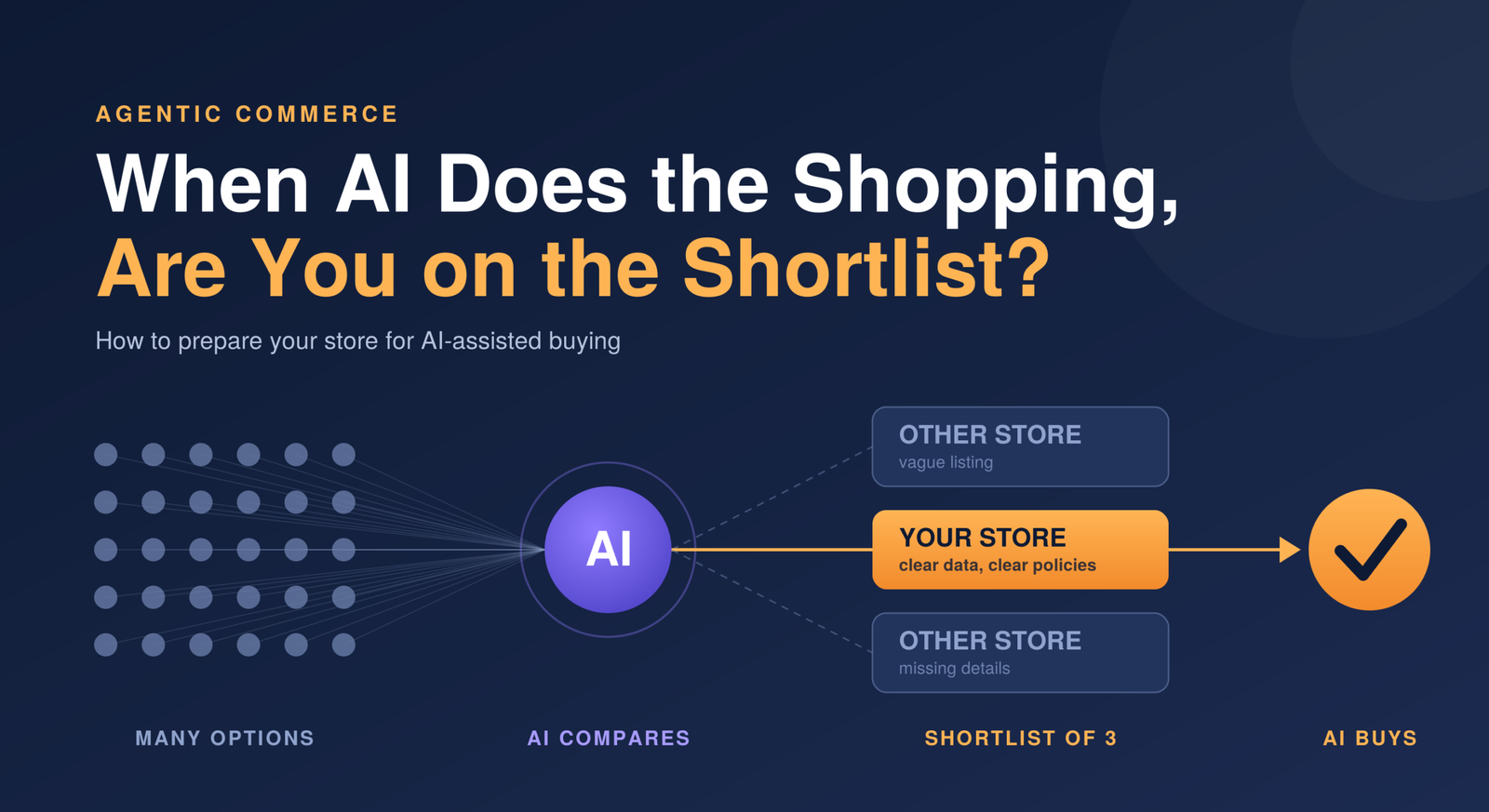
When one company talks about AI shopping, it’s a trend piece. When OpenAI, Google, Shopify and Amazon all talk about it, it’s a pattern. This week a payments giant joined in: American Express released a free Business Playbook for Agentic Commerce, aimed at helping merchants prepare for AI assistants that search, compare and increasingly buy on customers’ behalf (WebWire).
The reason this matters isn’t the playbook itself. It’s who published it.
Why a payment company’s voice carries weight
Platforms and AI companies are focused on discovery: helping shoppers find products. A payment network sits at the other end, where money moves and trust is tested. If an AI agent buys the wrong item, or a transaction is disputed, someone has to sort it out.
Amex says it’s working on technical specifications for bringing its cards into AI-driven purchases, and has announced plans for protection covering eligible purchases made by registered AI agents. That protection is described as an intention, not a live product, so don’t plan around it yet. But the direction is clear: the payments industry is preparing for a world where the buyer is partly software.
What merchants and shoppers are saying
Amex backed the playbook with two surveys (August 2026, US respondents). Roughly 62% of surveyed business leaders expect AI shopping agents to have a moderate or significant impact within a year, and about 41% are already experimenting. On the shopper side, around two-thirds said they’d likely use AI to find the best price.
One number deserves attention, though. Only about 15% of consumers said they’re comfortable letting AI buy high-value items, compared with 52% for everyday low-cost ones. In other words, AI is likely to influence big purchases long before it completes them.
A caution: these are Amex’s own surveys, run on online panels, so treat them as a directional signal, not hard forecasts.
What the playbook suggests you do
The press release summarises its advice in five practical steps. Here is how each could look in a real store.
1. Check how AI describes your business. Ask ChatGPT or Gemini something your customers might ask, like “best vacuum sealer for freezer bags under $150.” Are you mentioned? Is the description accurate? You may find AI quoting an old return policy or a discontinued model.
2. Keep your information accurate and consistent. AI tools pull from many places. If your website says free shipping over $75, your marketplace listing says $100, and Google Merchant Center says something else, an AI may repeat the wrong one. Align prices, stock, shipping times and return terms everywhere.
3. Look for gaps in the purchase journey. Walk through buying your own product as a stranger would. Is shipping cost visible before checkout? What happens when an item is out of stock? Small friction that a patient human tolerates can make an automated agent skip you.
4. Ask your providers how they’re preparing. Your e-commerce platform, payment processor and agency should have an answer. If they don’t, that tells you something.
5. Start with one focused improvement. Don’t try to fix the whole catalogue. Pick your ten best-selling products and make their data excellent first.
When AI narrows the choices, you need to be on the shortlist
A shopper browsing a category page sees dozens of products. An AI assistant often recommends three. That changes the goal from “rank on page one” to “be one of the few options the AI is confident about.”
Confidence comes from clear, specific information. A listing that states exactly who the product suits, what it’s compatible with, what it doesn’t do, and what the warranty and return terms are gives an AI something to work with. A listing that says “premium quality, great for everyone” gives it nothing to justify recommending you.
Keep it in proportion
This isn’t a reason to panic or to rebuild your store. Your website still matters for brand, trust and repeat customers. Shoppers are still cautious about AI handling expensive purchases. And parts of the Amex announcement, like purchase protection and industry standards, are still works in progress.
But the prep work is cheap, and it pays off regardless of how fast AI shopping grows. Accurate data, clear policies and a smooth checkout help human customers just as much.
Key takeaways
The conversation has moved from “will AI shopping happen?” to “how ready are we?” The merchants who benefit most won’t be the ones who predicted the future best. They’ll be the ones who quietly cleaned up their product information while others were still debating.
A good first step is a simple audit: how AI sees your brand today, how complete your product data is, and where the purchase journey leaks. If you’d like help running one, get in touch.