Amazon’s Real October Surprise Isn’t the Discounts, It’s the Button That Shops Without You
Somewhere out there, a customer’s Alexa is already waiting to buy your product the second it hits a price you haven’t even thought about yet.
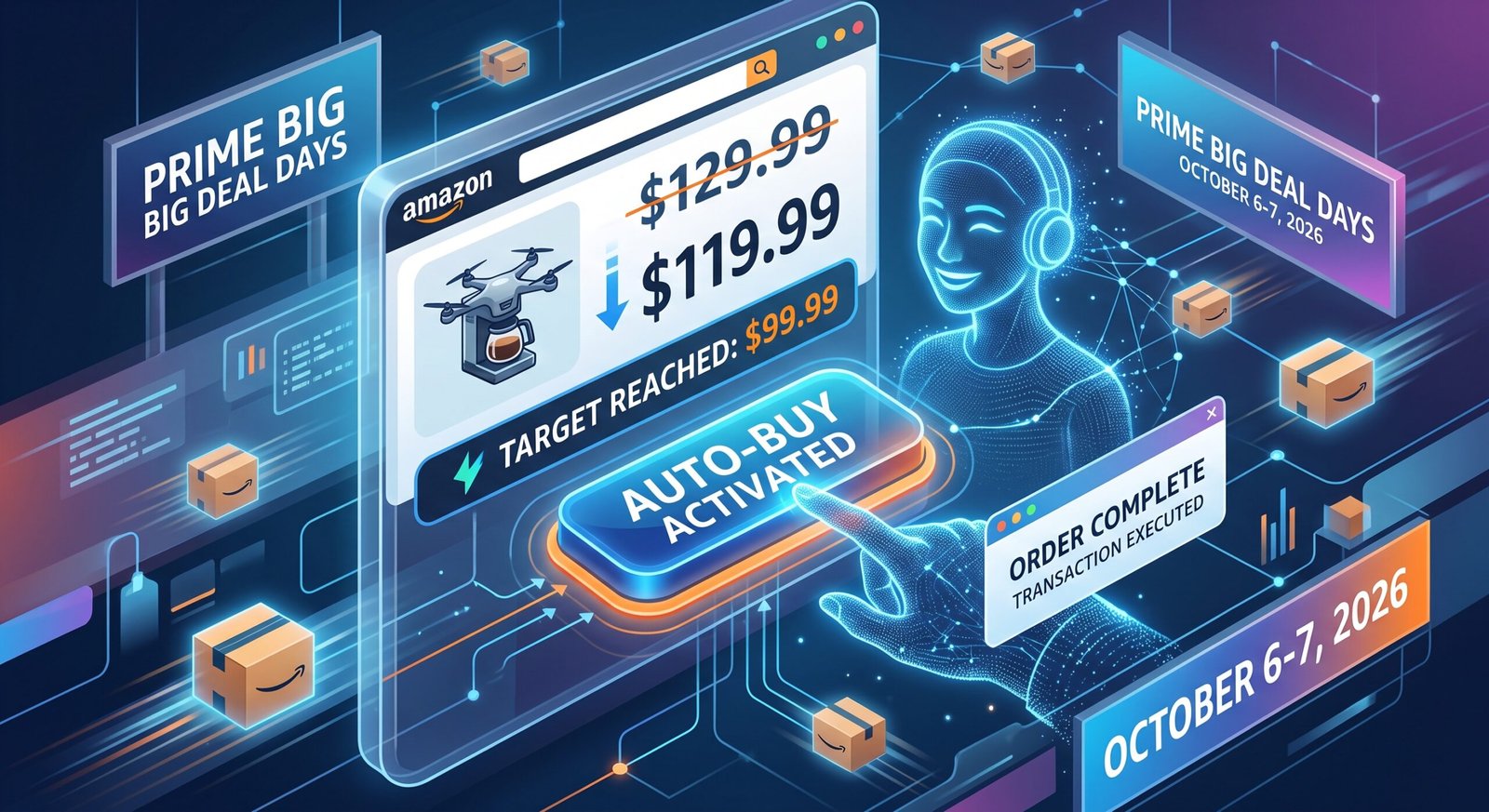
Amazon’s Prime Big Deal Days runs October 6 and 7, 2026, and this year’s standout feature isn’t a discount. It’s Auto-Buy, a tool that lets Alexa purchase a product automatically the moment it hits a shopper’s chosen target price. That turns pricing decisions into live triggers for invisible, pre-committed demand, and sellers need to plan their price floors with that in mind.
What Is Amazon Introducing for Prime Big Deal Days 2026?
Amazon’s fall sale runs for 48 hours starting October 6, with new deals released three times a day across more than 35 categories. The headline addition this year is Alexa for Shopping, now positioned as the event’s main price tracking tool. Shoppers can ask Alexa to monitor a category directly, saying something like “find me deals on espresso machines,” and get daily updates as matching deals appear. Amazon is also exposing up to 365 days of price history on hundreds of millions of products, giving shoppers a clear view of whether today’s price is actually a deal or just a relabeled list price.
What Is Auto-Buy and How Does It Work?
For individual products, shoppers can set a specific target price and turn on Auto-Buy. Once the product’s price drops to or below that threshold, Alexa completes the purchase automatically, without the shopper needing to be present or even aware the price dropped at that moment. Coverage of the feature has noted that Amazon hasn’t published any window to undo an Auto-Buy purchase once it triggers, so shoppers are advised to set thresholds carefully.
Why Does This Matter More Than Another Discount Event?
Because it changes the basic mechanics of how a price change reaches a customer. The traditional sequence is a price drops, a customer notices it, the customer decides, and then a purchase happens. Auto-Buy replaces that with a different sequence: the customer sets a purchasing rule in advance, Alexa monitors the price continuously, the condition becomes true, and the transaction executes on its own. That’s a genuine example of agentic commerce rather than simply an AI recommendation, since no human decision happens at the moment of purchase.
What Does This Mean for Sellers Setting Prices?
It means your price floor planning now needs to account for demand you can’t see. A product moving from $429 to $399 doesn’t just reach the customers actively browsing Amazon at that exact moment. It can also simultaneously trigger every Alexa Auto-Buy rule set below $399, instantly converting price sensitive shoppers who were never going to manually check back.
That’s a meaningful shift in how a single price change behaves. A discount you planned as a modest nudge for browsing customers could suddenly pull in a wave of pre-committed purchases the moment it crosses a threshold you didn’t know existed. If that threshold sits below your contribution margin floor, you could sell through inventory quickly at a price that actually loses money on every unit, without ever seeing a human make that individual buying decision.
How Should Sellers Prepare Before October 6?
Treat your price floor as a hard line that accounts for this new kind of demand, not just a number you’d prefer not to go below. Before the event, calculate your actual minimum acceptable price using full costs, including marketplace commission, fulfillment, advertising, and expected returns, the same way you would for any Q4 promotion. Then make sure that floor is enforced in your pricing tools or repricing software, since a quick manual price change made in the moment is exactly the kind of decision that can accidentally cross an Auto-Buy threshold you never intended to trigger.
It also helps to think about your 365 day price history deliberately. Since Amazon now surfaces this history directly to shoppers, a price that looks like a deal today but matches a price you ran casually six months ago won’t read as a meaningful discount, and savvy shoppers using Alexa’s price tracking will notice.
Key Takeaways
The discounts during Prime Big Deal Days will get most of the attention, but Auto-Buy is the feature actually worth sitting with. It turns a price change from something a human notices and reacts to into a live trigger that can instantly activate demand you never planned for. Going into this event, and the rest of Q4, price floor planning isn’t just about protecting margin from a visible shopper deciding whether to buy anymore. It’s about protecting margin from an automated rule you can’t see, sitting quietly behind a threshold somewhere, waiting for your price to cross it.
Side Note:
When is Prime Big Deal Days 2026?
It runs for 48 hours starting October 6, 2026, with new deals released three times daily across more than 35 categories.
What is Amazon’s Auto-Buy feature?
It lets Prime members set a target price on a specific product and have Alexa automatically complete the purchase once the price drops to that level, without further confirmation at the moment of purchase.
How is Auto-Buy different from a price alert?
A price alert notifies the shopper so they can decide whether to buy. Auto-Buy skips that step entirely and completes the transaction on its own once the target price is met.
Why does Auto-Buy matter for seller pricing strategy?
Because a price drop can now trigger a wave of automatic, pre-committed purchases the instant it crosses a threshold, rather than only drawing in shoppers who happen to be actively browsing at that moment.