Google Didn’t Win You That Sale. It Just Closed It.
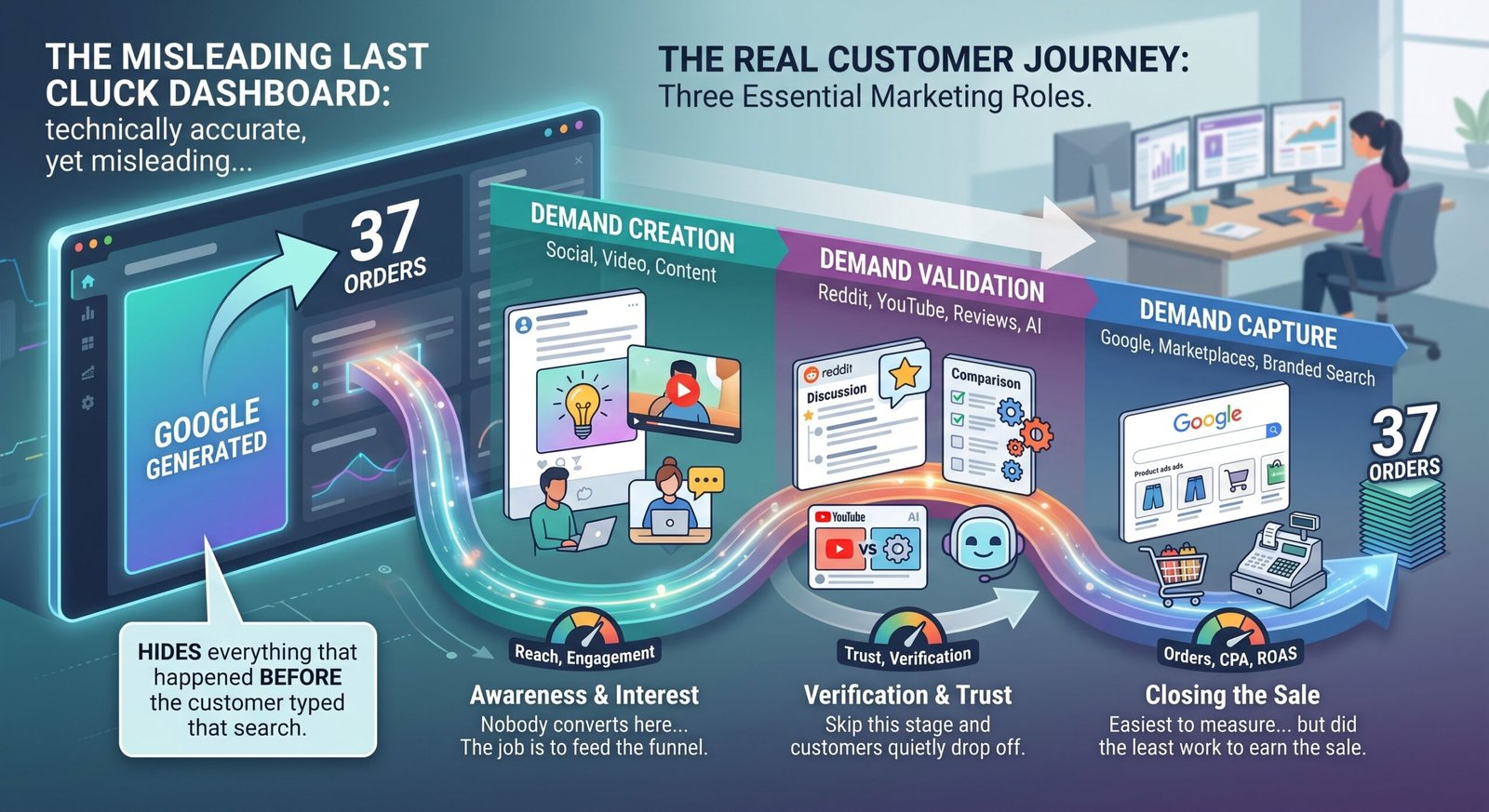
If your dashboard says “Google generated 37 orders,” it’s probably telling you where the sale finished, not where it started.
Last click attribution only shows which channel captured a purchase, not which channels created or validated the decision to buy. A better way to measure marketing ROI is to split your channels into three roles: demand creation, demand validation, and demand capture.
Why Is Last Click Attribution Losing Accuracy?
Yesterday’s look at how shoppers use Reddit points to a bigger problem across marketing measurement. Customers rarely follow a straight line from ad to purchase anymore. A more realistic path looks like this: social, then an AI assistant, then Google, then Reddit, then YouTube, then a marketplace, and finally the purchase.
Somewhere in that sequence, a video built the interest, a Reddit thread confirmed the product was worth it, and a Google search simply finished the job. Standard analytics credit that final Google click with the entire sale. It’s technically accurate and still misleading, because it hides everything that happened before the customer typed that search.
What Are the Three Roles a Marketing Channel Can Play?
For clients, we’ve started splitting channels into three jobs instead of judging every one of them by last click conversions.
Demand creation covers social media, video, and content. This is where someone first learns your product exists or realizes they have a need they hadn’t fully named yet. Nobody converts here on the first touch, and that’s fine. The job of this stage is awareness, not checkout.
Demand validation covers reviews, Reddit threads, YouTube comparisons, and AI recommendations. This is where a customer who already knows about your product decides whether to trust it. They’re asking whether it’s actually good, how it compares to alternatives, and what real owners think. Nothing gets sold directly here either, but skip this stage and a lot of otherwise interested customers quietly drop off.
Demand capture covers Google Shopping, marketplaces, branded search, and your product pages. This is where a customer who has already decided to buy finds you and completes the transaction. It’s the easiest stage to measure, which is exactly why it gets all the credit in most reporting, even though it usually did the least work to earn the sale.
Why Does This Framework Explain ROI Better Than Last Click?
Because it answers a different, more useful question. Instead of asking which channel generated the order, it asks which channel did which job, and whether each one is doing its job well.
A demand creation channel that isn’t showing up in last click reports might still be essential, because it’s feeding the top of the funnel that validation and capture later rely on. Cut its budget because it “isn’t converting” and you may quietly starve the channels that do get credit.
A demand validation channel is even trickier to evaluate, since it rarely shows up in analytics at all unless you’re specifically tracking it. If shoppers are reading Reddit threads or asking an AI assistant to compare your product before buying, that step influenced the sale even though no platform will hand you a conversion number for it.
Demand capture channels look the strongest on paper because they’re closest to the transaction. That doesn’t mean they created the demand. It usually means they were simply the last, easiest place for an already convinced customer to complete the purchase.
How Should Ecommerce Businesses Apply This?
Start by mapping your current channels into the three categories. Ask what each one is actually doing. Is this content introducing my product to new people, helping people who already know about it decide to trust it, or closing a sale someone already decided to make?
From there, set different expectations and different metrics for each stage. Demand creation should be judged on reach, engagement, and whether it’s feeding the funnel, not on immediate ROAS. Demand validation should be judged on whether your product actually holds up under scrutiny in reviews, comparisons, and community discussion, since that’s what determines how many people make it to the next stage. Demand capture should still be judged on conversion rate and cost per acquisition, but with the understanding that it’s finishing work that started somewhere else.
This also changes how you interpret a channel going quiet. If Google Shopping orders drop, the fix isn’t automatically to increase Google spend. It might mean fewer people are arriving convinced, which points back to a validation or creation problem instead.
Key Takeaways
A dashboard that says Google generated 37 orders isn’t wrong, it’s just incomplete. Google may have simply captured customers who were already convinced somewhere else. Understanding which channels create demand, which validate it, and which capture it gives you a far more honest picture of what your marketing is actually doing, and a much better basis for deciding where to invest next.