Q4 Pricing Strategy for Ecommerce: Why You Shouldn’t Automatically Match Competitors
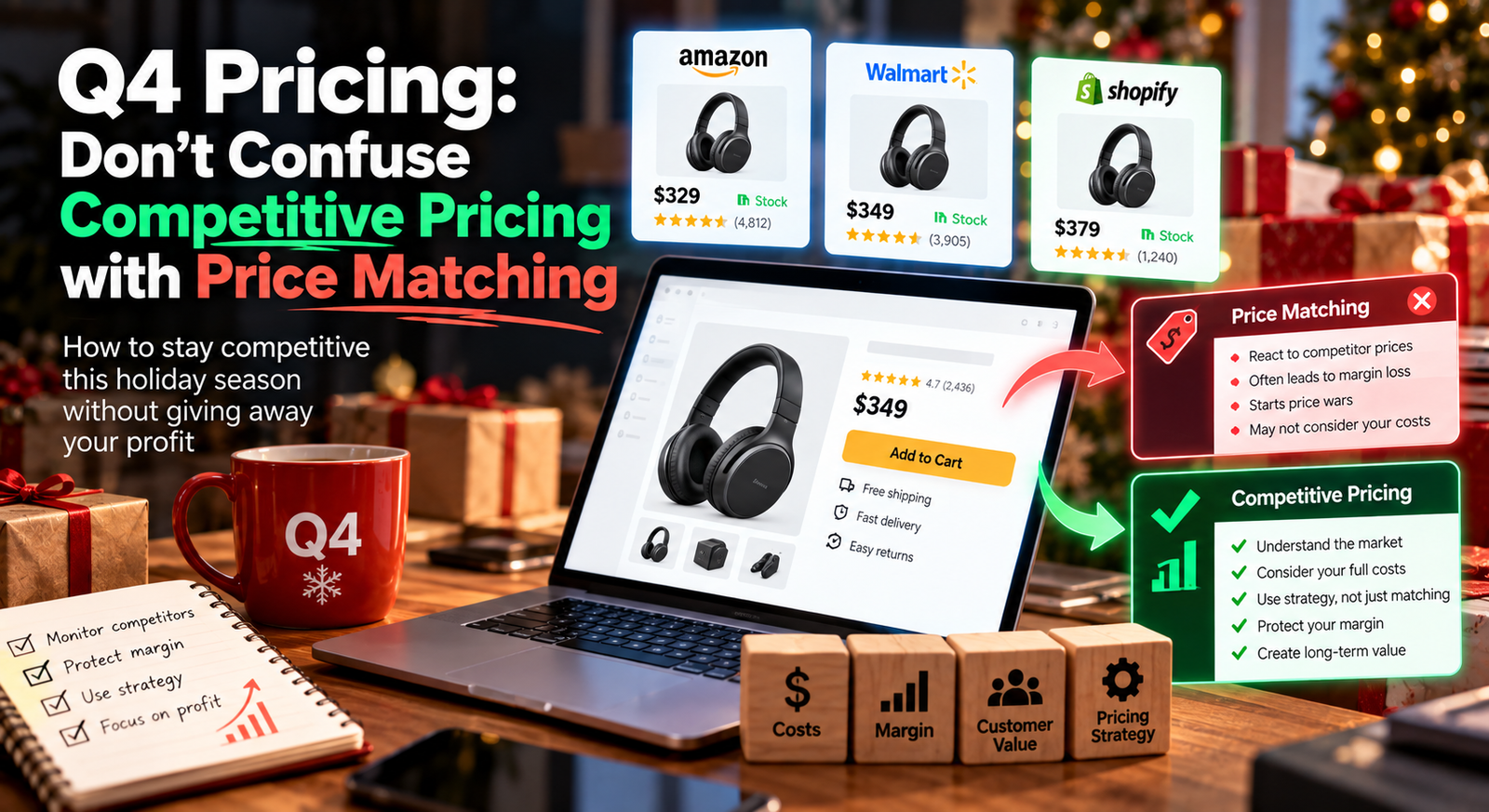
A competitor drops their price by $50, your sales slow down, and matching them starts to feel like the only move. This is how a store ends up with record Q4 revenue and disappointing profit.
Short answer: Sellers should not automatically match competitor prices in Q4. A smarter Q4 pricing strategy starts with your own price floor, compares the full offer instead of just the price tag, and uses bundles or added value before cutting prices.
What Is Competitive Pricing in Ecommerce?
Competitive pricing means knowing where your offer sits in the market and choosing your response on purpose. Matching a competitor is only one option. You can also stay slightly above, add a bundle, include free shipping, run a short promotion, or do nothing.
Marketplace tools can help. Walmart Canada’s Repricer, for example, supports strategies that meet or beat the Buy Box price. But a marketplace knows the competitive price. It doesn’t know your business economics.
How Do You Set a Price Floor Before Q4?
Before asking what everyone else charges, ask what the lowest price is at which a sale still makes sense for you. Shopify’s pricing guidance also recommends starting with a margin floor that covers payment fees, packaging, returns, discounts, duties, and customer acquisition costs.
Here is an example for a $399 product:
| Cost item | Amount |
|---|---|
| Selling price | $399 |
| Product cost | $190 |
| Marketplace commission | $48 |
| Fulfillment and shipping | $25 |
| Advertising | $30 |
| Returns and other variable costs | $10 |
| Contribution | $96 |
If a competitor drops to $339 and you match, your price falls about 15%. Your contribution falls from $96 to $36, a drop of more than 60%. Sellers miss this math all the time.
Why Is Q4 Pricing Harder Than the Rest of the Year?
Holiday economics rarely match your regular season numbers. Advertising costs rise, promotions run deeper, and carrier and fulfillment charges climb. Return volumes increase, free shipping adds cost, and customer service gets busier. A promotion that looked profitable when you planned it months ago can look very different in November.
Should You Respond to Every Competitor Price Cut?
No. Before reacting, find out why the price changed. The competitor may be clearing inventory, discontinuing the product, receiving marketplace funding, or simply making a mistake. If you copy a price without knowing the reason, their economics end up controlling yours.
How Do Shoppers Compare Offers Beyond Price?
Shoppers judge the whole offer. Compare these two sellers:
- Seller A: $329, $25 shipping, 7 to 10 day delivery, customer pays returns, thin product details.
- Seller B: $349, free shipping, 2 to 3 day delivery, easy returns, detailed specs, strong reviews.
Seller B can win despite the $20 gap, especially during the holidays when delivery confidence matters. Track price, shipping, delivery speed, reviews, warranty, return terms, availability, and bundles.
Can Bundles Help You Avoid a Price War?
Yes. Bundles make direct comparison harder. If everyone sells Product X near $299, offer a holiday bundle at $329 with the product, an accessory, a starter pack, and free shipping. Shoppers now compare a bare product to a complete package instead of $299 against $269. Bundles and free shipping thresholds raise order value without permanently lowering your base price.
How Should You Assign Pricing Roles to Products?
Applying one discount across your whole catalog is a common Q4 mistake. Give each product a job:
- Traffic products: Highly visible items priced sharply to bring shoppers in.
- Margin products: Differentiated items that stay more profitable.
- Bundle products: Items with natural add ons that lift order value.
- Clearance products: Inventory you genuinely want gone.
- Hero products: Items with strong demand, healthy stock, and good economics.
How Do You Use Automated Repricing Safely?
Automation without limits can quietly damage your margins. Give any repricing tool or AI agent clear rules, such as:
- Regular price: $399
- Minimum selling price: $329
- Target contribution margin: 25%
- Maximum event discount: 15%
- Human approval required below $349
- Never match automatically below $329
With these rules, the system isn’t just asking what the competitor charges. It’s asking whether a response makes sense given your costs, inventory, and promotion plan.
What Belongs in a Q4 Pricing Control Sheet?
For each important product, record the regular price, product cost, commission, fulfillment cost, expected ad spend, return allowance, minimum contribution, minimum selling price, maximum discount, competitor range, inventory position, promotion dates, and approval threshold. Setting boundaries in advance beats making emotional decisions at midnight on Black Friday.
Also plan your calendar as a whole. Marketplace promotion systems can consider historical or reference pricing, so a poorly planned October discount may weaken a later Black Friday deal.
Frequently Asked Questions
Should I match a competitor’s price during Black Friday?
Only if the match stays above your price floor and fits the product’s role in your catalog. Otherwise, consider a bundle or added value.
What is a price floor in ecommerce?
A price floor is the lowest price at which a sale still delivers your minimum acceptable profit after all variable costs.
How can I compete without lowering prices?
Offer faster delivery, free shipping, bundles, stronger product information, and easy returns.
Are automated repricing tools safe in Q4?
They are safe when they run within firm rules for minimum price, margin, and approval thresholds.
Key Takeways
A competitor’s price should be an input, not an instruction. When someone drops from $399 to $349 this season, skip the reflex question of whether to match. Ask why they did it and what response makes the most sense for your business. That shift can decide whether you celebrate record sales or record profit.