What Happens to Marketplace Advertising When AI Chooses What We Buy
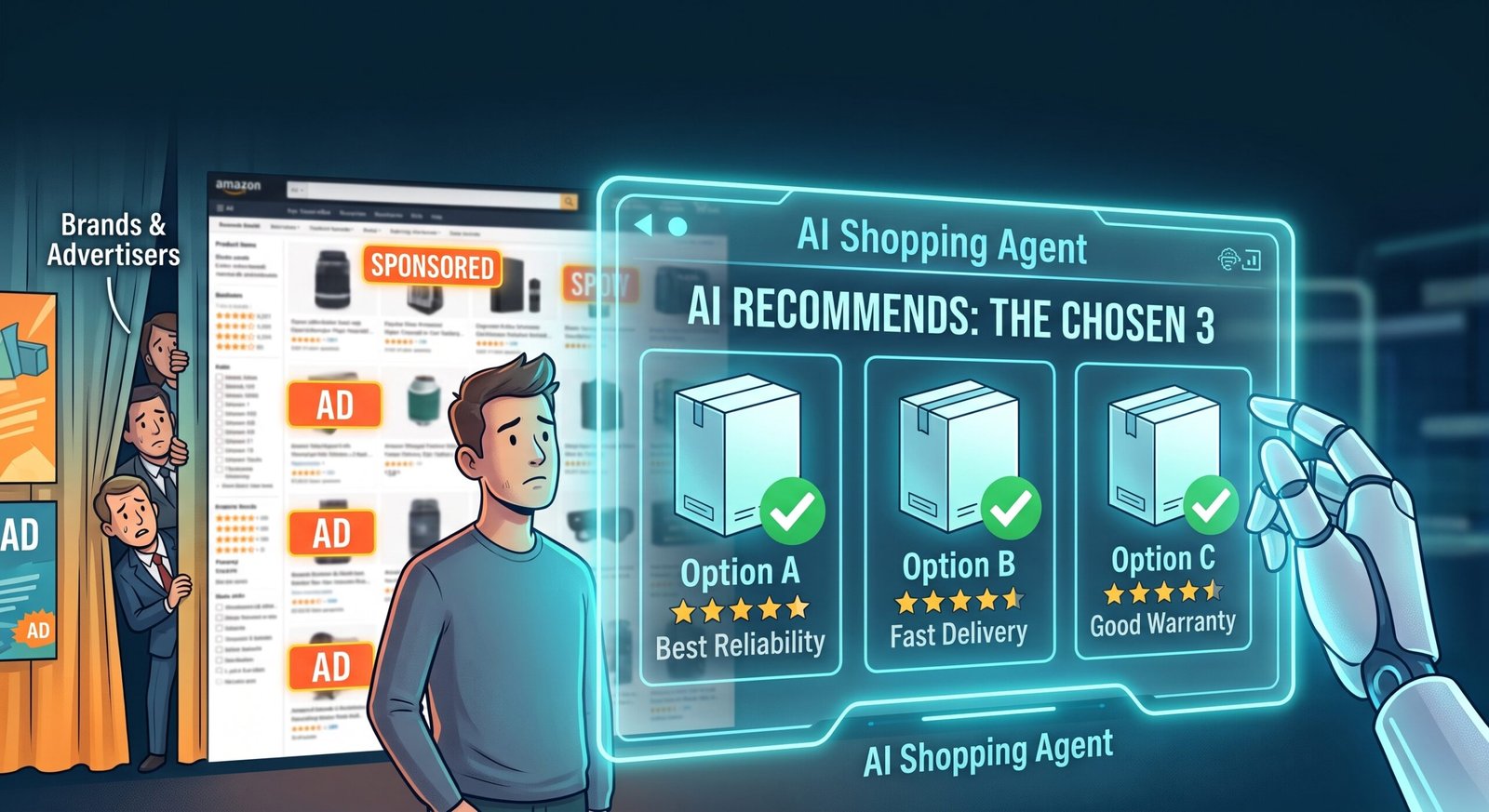
For years, marketplace advertising has followed a fairly predictable model.
A customer searches for a product. The marketplace displays organic and sponsored results. Brands compete for visibility. The customer clicks a listing, compares a few options and eventually makes a purchase.
AI shopping agents could change that journey significantly.
Instead of searching through dozens of products, a customer might simply say:
“Find me a reliable option under $300, with strong reviews, fast delivery and a good warranty.”
The AI researches the market, evaluates the products and returns three recommendations, and the customer may never see the other 97 products.
That creates an important question for e-commerce businesses:
What happens to marketplace advertising when AI becomes the first layer between the customer and the marketplace?
From Search Results to AI Recommendations
Today’s marketplace journey often looks like this:
Customer search → Sponsored results → Product listing → Comparison → Purchase
Advertising works because marketplaces control a valuable moment: the customer is actively searching and deciding what to buy. Brands pay to appear prominently during that moment. But now, AI shopping introduces a different journey:
Customer intent → AI research → AI consideration set → Recommendation → Purchase
Notice what disappeared?
Potentially, the traditional search-results page.
If an AI agent examines dozens (or hundreds) of products before presenting three options, the most important battle may no longer be winning the first position on a marketplace search page.
It may be getting into the AI’s consideration set in the first place.
AI Agents Don’t Search Like Humans
Humans have limited patience.
We might look at the first few search results, open several product pages, skim reviews and make a decision, but AI doesn’t necessarily have the same limitation. An agent can potentially evaluate information across multiple retailers, marketplaces, manufacturer websites, reviews and other sources.
It might compare:
- price
- specifications
- compatibility
- availability
- shipping
- warranty
- ratings
- product reviews
- return policies
- brand reputation
- suitability for the customer’s particular situation
That means a product ranked lower in traditional search could theoretically still become an AI recommendation if the available information indicates that it is the strongest match for the customer’s request. Conversely, being highly visible in marketplace search doesn’t automatically mean an AI will consider the product the best fit. This introduces a new kind of competition.
The New Metric: AI Consideration
Marketers already track Impressions, Clicks, CTR, Conversion rate, ROAS and Search ranking.
But agentic commerce could introduce another important measurement: AI Consideration Rate
In simple terms:
When AI evaluates products in your category, how often does your product make the shortlist?
Imagine testing 100 realistic shopping questions, your brand appears in 42 AI responses. Your products are actively recommended in 24, a competitor appears in 67. That information reveals something traditional advertising analytics cannot. You may have excellent marketplace advertising performance while being almost invisible in AI-assisted product discovery.
Product Information Becomes a Marketing Asset
This is where product data becomes much more important.
Consider these two descriptions:
Product A: “Premium quality. Innovative design. Exceptional performance.”
Product B: “Designed for small spaces, weighs 4.2 kg, includes a three-year warranty, requires no permanent installation and is suitable for beginners.”
The first might sound more like traditional marketing, and the second gives an AI system much more information to work with.
If someone asks: “What’s a good option for a beginner living in a small apartment?”
Product B contains evidence connecting the product to that customer’s needs.
This doesn’t mean businesses should stop writing persuasive copy. It means product content increasingly has two jobs:
Persuade humans and help machines understand when the product should be recommended
Does This Mean Marketplace Advertising Will Disappear?
Of course not. Advertising usually follows attention.
If consumers increasingly use AI assistants for shopping, advertising models are likely to follow them there. Instead of only bidding for a sponsored position in marketplace search results, brands may eventually compete for visibility inside AI-assisted shopping environments. But that creates an important challenge.
A trustworthy shopping agent needs to distinguish between:
“I recommend this because it best matches your needs.” and “You’re seeing this because the brand paid for placement.”
How AI platforms handle that distinction could become one of the most important issues in commerce advertising. For sellers, the safest strategy is therefore not to assume paid advertising will always compensate for weak product information.
Build strong organic AI discoverability as well.
Marketplaces and AI Platforms May Fight for the Customer Relationship
There is another dimension to this shift.
Marketplaces traditionally control much of the buying journey. But if customers begin their shopping journey inside an independent AI assistant, the AI platform may control product discovery before the shopper ever reaches a marketplace. That creates a strategic contest over who owns:
customer intent → product discovery → recommendation → transaction.
Marketplaces have strong advantages: enormous catalogs, reviews, transaction history, logistics and advertising infrastructure.
AI platforms have another advantage: They may understand the customer’s broader intent before the marketplace does.
The result could be a new commerce ecosystem where AI assistants, marketplaces, retailers and brands compete (and cooperate) at different stages of the same transaction.
What Should E-Commerce Businesses Do Now?
There is no reason to abandon marketplace advertising.
Instead, add another layer to your strategy. Continue optimizing sponsored ads, search rankings and conversion rates, but begin testing how AI systems understand and recommend your products. Ask realistic customer questions without mentioning your brand, and track:
Does your product appear?
Which competitors appear?
Why were they recommended?
Are your specifications correct?
Which sources does the AI rely on?
What information is missing?
Then improve the underlying product information, not simply to manipulate AI, but to make your products easier to understand and compare accurately.
The Next Advertising Battle May Happen Before the Search
Marketplace advertising has traditionally competed for the customer’s attention after they begin searching, but now, AI agents may move that competition one step earlier. Before the customer sees a sponsored listing, before they visit a product page and possibly even before they choose a marketplace, an AI system may already have decided which products deserve consideration. That creates a new marketing question:
When an AI agent is deciding what the customer should consider, is your product even in the conversation?
For e-commerce businesses, that may become one of the most important visibility questions of the agentic-commerce era.