Is Your Store Ready for an AI Customer? A 5-Layer Agentic Commerce Checklist
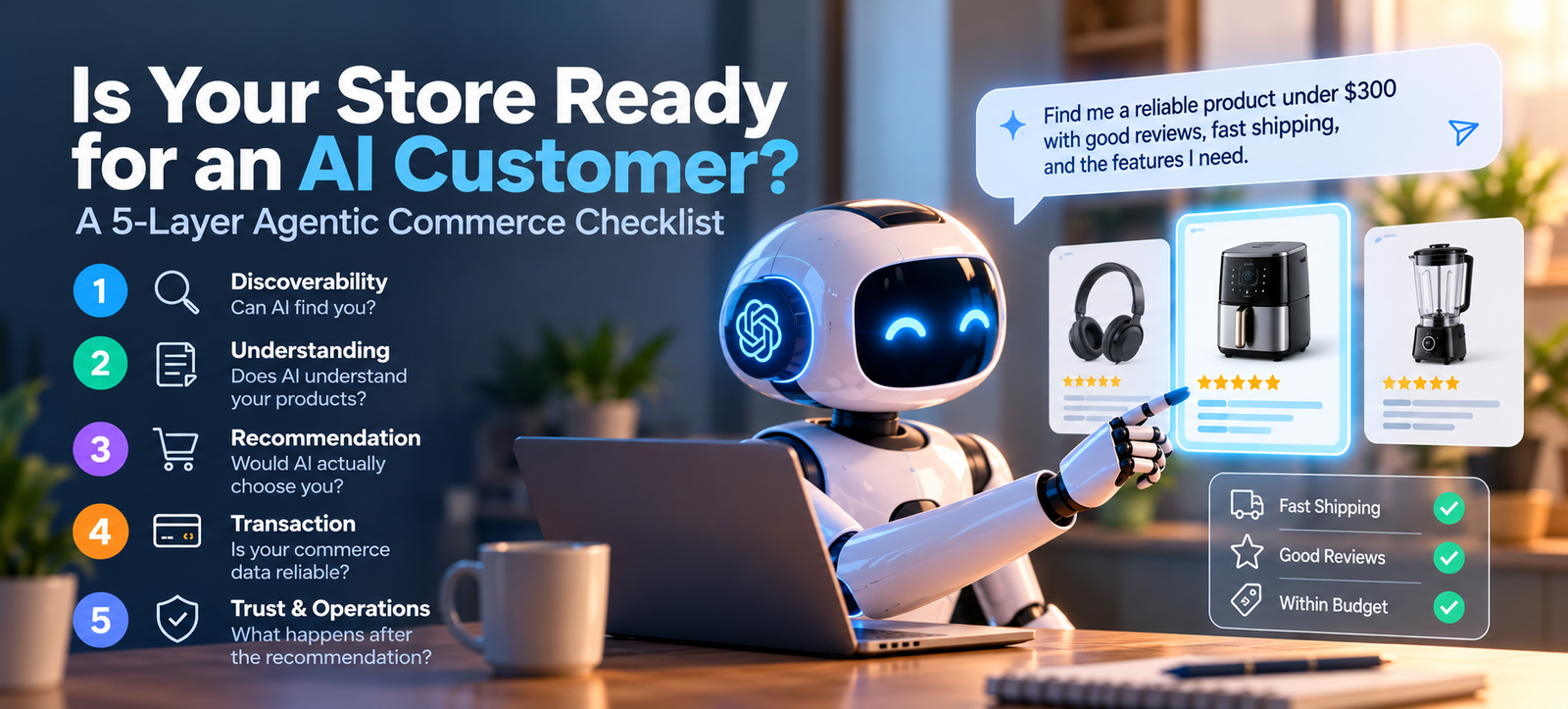
Your next customer may not browse your website, open five product pages, and compare specifications.
They may simply ask an AI assistant:
“Find me a reliable product under $300 with good reviews, fast shipping, and the features I need.”
The AI could research options, compare products, narrow the choices and help the customer decide what to buy. This is the beginning of agentic commerce — a shopping environment where AI doesn’t just help consumers search but increasingly acts on their behalf. For e-commerce businesses, this creates an important question:
Is your store ready for an AI customer?
AI readiness isn’t about installing a chatbot. Your commerce infrastructure needs to be discoverable, understandable, trustworthy and usable by AI systems. Here is a practical five-layer checklist.
1. Discoverability — Can AI Find You?
Before AI can recommend your products, it first needs to discover them.
Traditionally, businesses focused heavily on Google rankings. Search visibility still matters, but AI may gather information from websites, product feeds, structured data, marketplaces, reviews and other trusted sources.
Try this yourself
Ask several AI platforms realistic shopping questions related to your category:
“What are some good brands for [product category]?”
“Recommend a [product] under $300.”
“What are some alternatives to [major competitor]?”
Then check:
- Does your company appear?
- Are your products mentioned?
- Which competitors appear?
- What information or sources influence the answer?
Don’t include your company name in the initial prompt. The real test is whether AI can discover you when the customer doesn’t already know you exist.
2. Understanding — Does AI Understand Your Products?
Being discovered isn’t enough, AI needs to understand what you’re selling, including specifications, features, compatibility, benefits and intended use. A product page containing only technical specifications may make sense to an experienced shopper, but AI needs enough context to connect those specifications with customer needs.
Instead of simply listing a feature, explain why it matters and who might benefit from it.
Test it
Ask an AI assistant questions about one of your products:
“Who is this product best suited for?”
“What are its main features?”
“How is it different from similar products?”
“What are its limitations?”
Compare the answers with your actual product information. Watch for incorrect specifications, missing features, outdated information, confused models or invented claims. If AI repeatedly misunderstands your product, your product information may be too fragmented or ambiguous.
3. Recommendation — Would AI Actually Choose You?
An AI system may know your company exists and understand your products, but still never recommend them. Recommendation requires context, AI needs enough information to determine when your product is a good fit for a particular customer.
Strong product content should therefore answer questions such as:
Who is this product for?
What problem does it solve?
When should someone choose it instead of another option?
What makes it different?
Run a recommendation test
Create 5 to 10 realistic customer prompts:
“I need something affordable but don’t want the cheapest option.”
“What would you recommend for a beginner?”
“I need something compact and easy to maintain.”
Run the same prompts through several AI assistants. Record whether your brand appears, which products are recommended, which competitors appear and why. Repeat the exercise periodically and you have the beginnings of an AI Visibility benchmark.
4. Transaction — Is Your Commerce Data Reliable?
Being recommended is valuable, being recommended with the wrong price or unavailable inventory isn’t. AI commerce readiness therefore extends beyond marketing into operational data.
Your store needs reliable information about:
- pricing and promotions
- inventory and availability
- product identifiers and variants
- shipping
- checkout
- returns
This becomes particularly important for businesses selling through multiple channels such as their own website and online marketplaces.
Test your consistency
Choose five important SKUs and compare them everywhere they are sold. Check the product title, model or SKU, price, inventory, specifications, images, warranty, shipping information and return policy. If different channels tell different stories about the same product, AI systems and customers may struggle to determine which information is correct.
Clean e-commerce operations are becoming part of AI readiness.
5. Trust & Operations — What Happens After the Recommendation?
AI may help a customer discover, compare and eventually purchase a product, but your business still needs to deliver the experience. What happens if inventory is wrong? A shipment is delayed? The customer needs a return? Or AI can’t resolve a support issue? Strong AI-commerce infrastructure needs both automation and human oversight.
A useful principle is:
AI handles repetition. Humans handle exceptions.
Check whether your policies are clear, your product information is consistent, customer service has access to accurate information, and complicated cases can reach a human. Agentic commerce isn’t only a marketing challenge, it’s also an operations challenge.
The 5-Layer AI Commerce Readiness Map
Think about AI commerce readiness as a connected journey:
1. Discoverability — Can AI find you?
2. Understanding — Can AI correctly understand your products?
3. Recommendation — Would AI recommend them for relevant customer needs?
4. Transaction — Is your pricing, inventory and purchasing information reliable?
5. Trust & Operations — Can your business successfully fulfil and support the customer afterward?
A weakness at any layer can break the journey. That’s why businesses shouldn’t treat AI commerce as another isolated marketing tactic.
Start With Three Products
You don’t need expensive software to begin. Choose three important products and spend 30 minutes testing them. Ask several AI assistants for recommendations without mentioning your brand. Check whether your products appear. Ask AI to explain them and verify whether the answers are correct. Compare product information across your website and marketplaces, then write down every inconsistency you find.
And, so, you have just created the beginning of your AI Commerce Readiness roadmap.
For years, e-commerce businesses optimized primarily for two audiences: Humans and search engines.
Now a third audience is emerging: AI systems acting on behalf of humans.
The businesses best prepared may not be those using the most AI tools, they may simply be the businesses whose product information and commerce infrastructure AI can find, understand and trust.
Is Your E-Commerce Business AI-Ready?
NorthPilot Digital Agency helps e-commerce businesses evaluate how prepared their product data, digital presence and commerce operations are for AI-driven shopping.
If you’re unsure whether AI can find, understand and recommend your products, or whether your store is ready for what happens next, an AI Commerce Readiness assessment can help identify the gaps and prioritize what to improve first.
If your next customer were an AI agent, would your store be ready?