Your Next Customer May Never Visit Your Website
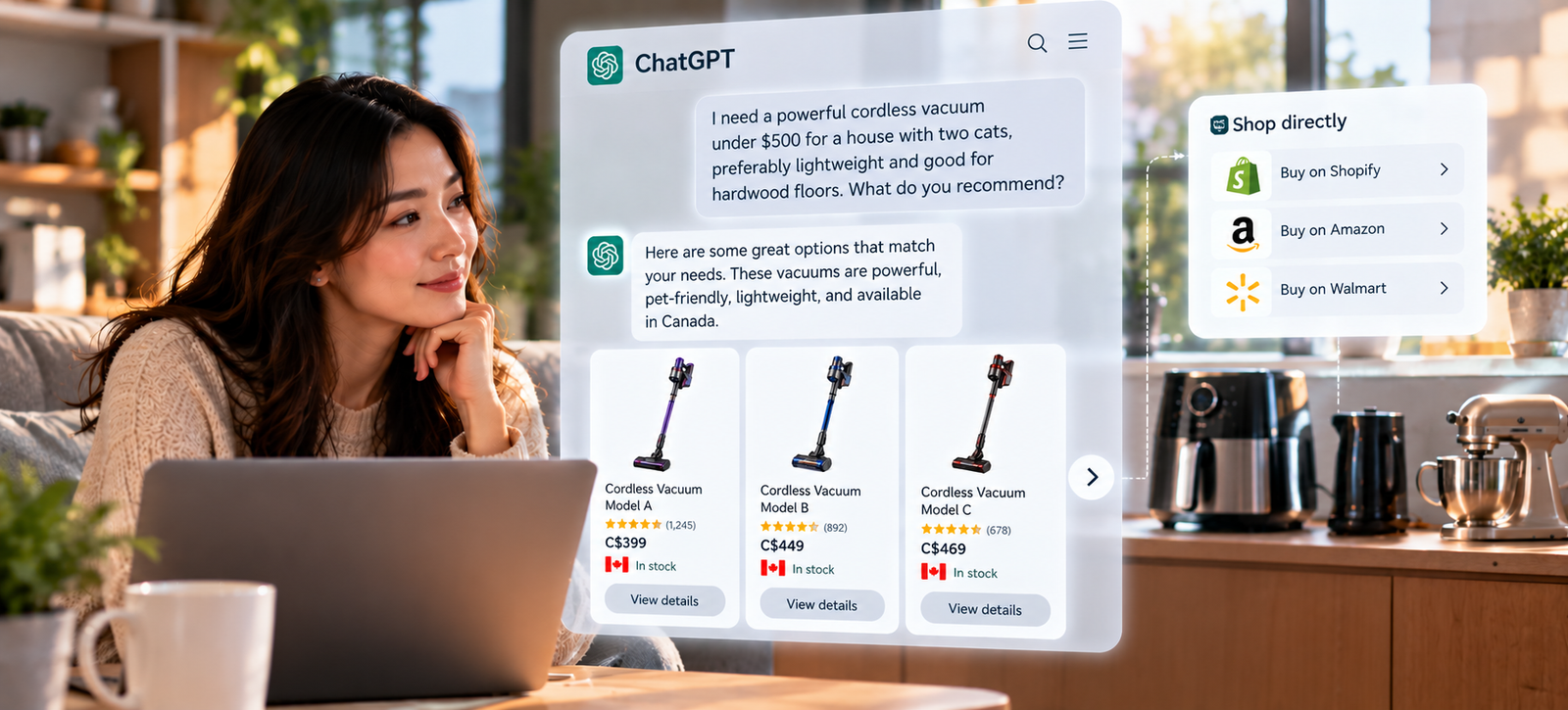
For most of e-commerce history, the website has been the centre of the customer journey. A shopper sees an ad, searches Google, clicks a link, lands on your website, browses products, compares options and eventually checks out.
But that journey is starting to change.
Now a customer can open an AI assistant and simply say, “I need a cordless vacuum under $500. I have hardwood floors, two cats, and stairs, and I want something lightweight with good filtration.” The AI does the research, narrows the field, compares the options, and explains its pick. In a growing number of cases, the shopper never browses your store at all before buying.
That raises a real question for anyone running an online business: What happens to marketing when the customer doesn’t visit your website first?
The Website Isn’t Disappearing
First, this doesn’t mean websites are becoming irrelevant. Your website remains an important source of product information, brand authority, customer support, content and, in many cases, the transaction itself.
What’s changing is the website’s role as the mandatory front door.
Shopify now describes AI as a new commerce entry point. Its Agentic Storefronts can expose products through AI channels including ChatGPT, Google AI Mode and Gemini, Microsoft Copilot and Meta. Shopify says eligible merchants can manage these channels centrally while their product information is distributed through Shopify Catalog.
The behavioural change is already measurable. Shopify reported that in Q1 2026, AI-referred sessions to its stores grew more than eightfold year over year, while orders attributed to AI-powered searches grew nearly thirteenfold.
Meanwhile, OpenAI’s product discovery announcement describes shopping experiences where consumers can explore products, compare options and get current product information directly within ChatGPT.
So we’re not talking simply about putting a chatbot on your website.
We’re talking about the possibility that the chatbot becomes the shopping environment.
The Traditional Funnel Is Being Compressed
Think about how compressed the journey has become. The old path went something like ad, search, website, category page, product page, reviews, comparison, cart, checkout. The AI version often looks like this instead: the customer explains what they need, the AI identifies the requirements, searches available products, compares the candidates, recommends a few, and the customer picks one. Several steps just collapsed into a single conversation.
Google is pushing in the same direction. Its Universal Cart is designed to work across retailers and surfaces such as Search and Gemini, while the Universal Commerce Protocol (UCP) provides infrastructure for agents to obtain product information and support transactions.
This changes what marketers need to optimize.
Your New Audience Isn’t Only Human
Traditional product copy leans on persuasion, something like “experience powerful performance for the modern home.” That line means little to an AI assistant trying to answer a specific question like which countertop oven under $250 fits an 18 inch space, has convection cooking, and holds a 12 inch pizza.
The AI needs facts, not feeling: exact price, exact width, cooking type, capacity, accessories, warranty, and availability. That doesn’t mean ditching good copywriting. It means your product pages now need two layers working together, one built for emotion and brand story, and one built for specifications an AI can actually verify.
Marketing May Shift From “Get the Click” to “Win the Recommendation”
This could become one of the biggest conceptual changes for e-commerce marketers.
Traditional digital marketing asks: How do we get the customer to click our result?
AI commerce adds another question: How do we become one of the products the AI considers worth recommending?
Imagine five retailers sell comparable coffee machines. One has excellent advertising but incomplete product data. Another clearly publishes: dimensions, drink types, grinder settings, milk system , cleaning requirements, warranty, accessories, price and availability.
When someone asks: “What’s a good espresso machine under $700 for a beginner who mostly drinks cappuccinos and doesn’t want complicated cleaning?”
the second retailer has given an AI system much more information with which to evaluate product suitability.
The battle isn’t simply for ranking position anymore. It is increasingly a battle for recommendation eligibility.
Your Product Feed Is Becoming a Marketing Asset
Historically, many businesses treated product feeds as technical necessities: “That’s the file we send to Google Shopping.”
That mindset needs to change.
In agentic commerce, structured catalog information becomes part of the communication layer between your business and AI shopping systems. Shopify Catalog, for example, structures merchant information including titles, descriptions, images, pricing, inventory and shipping for connected AI channels. Google’s UCP similarly supports agents retrieving real-time information such as product pricing and inventory from retailer catalogs.
Your product feed therefore isn’t merely IT infrastructure.
It is becoming part of marketing.
Your merchandising team, marketing team and technical team increasingly need to think about the catalog together.
So What Should E-Commerce Businesses Do Now?
You don’t need to rebuild your entire operation for AI tomorrow. Start with five practical changes:
1. Audit Your Best-Selling Products
Take your top 10–20 SKUs and ask: Could an AI understand exactly what this product is, who it’s for and what requirements it satisfies?
Look for missing dimensions, materials, compatibility, capacity, use cases, warranty, shipping and other purchase-critical information.
2. Test Real Customer Questions
Open several AI assistants and ask realistic questions without mentioning your brand.
Instead of: “Is Brand X air fryer good?”
ask: “I need an air fryer for four people under $200 with dishwasher-safe parts. What should I consider?”
Record which brands appear, then investigate why those products were easier to recommend.
3. Improve Structured Product Data
Make sure product information is consistent across Website, Shopify, Google Merchant Center, Marketplace listings, Product feeds and Structured data
E.g. If one source says 1,500W, another says 1,700W and another omits wattage entirely, you’re creating uncertainty.
4. Answer Purchase Questions, Not Just Keywords
SEO isn’t disappearing. But instead of producing ten articles designed around slightly different keyword variations, build content that genuinely helps customers make decisions:
Which size do I need?
Will this fit?
What’s the difference between these models?
Who is this product best for?
What isn’t it suitable for?
What accessories do I need?
That information can serve humans, search engines and AI systems simultaneously.
5. Measure AI Visibility
Add a new column to your marketing dashboard. Alongside Organic Traffic, Conversion Rate, ROAS and Marketplace Sales, start monitoring AI Recommendation Visibility and Test important buying prompts monthly.
Record:
Were we recommended?
Which product?
Which competitors appeared?
What sources were referenced?
Which attributes influenced the answer?
What information were we missing?
This turns AI visibility from hype into something you can actually investigate.
But What About Branding?
This is where the story becomes more interesting.
If customers increasingly allow AI agents to shortlist products, branding may become more important at the final decision stage. The situation could be:
After an AI says: “These three products meet your requirements.”
Now the customer asks: “Which company has the better reputation?” / “Which has the better warranty?” / “Which brand is known for reliability?” / “Which company has better customer service?”
Suddenly reviews, reputation, expert coverage, independent mentions, policies, warranty information and brand authority become part of the decision.
In other words:
Product data gets you considered.
Brand trust helps you get chosen.
Don’t Optimize for Robots and Forget Humans
There is a danger here!
Businesses may hear “AI shopping” and start creating ugly product pages containing enormous blocks of machine-oriented specifications. The more suitable approach is:
Beautiful enough for humans.
Structured enough for machines.
Detailed enough for decisions.
Trustworthy enough for recommendations.
Your website still matters enormously. But increasingly, its job may not only be to persuade someone who lands on the page. Its information may also need to help an AI system accurately represent your business before the customer ever arrives.
The New Customer Journey Starts With Intent
Traditional e-commerce was built around customers navigating stores. Agentic commerce is increasingly built around customers describing outcomes.
Not: “Show me air fryers.”
But: “I need something that can cook dinner quickly for four people, doesn’t take much counter space, is easy to clean and costs less than $200.”
Not: “Show me office chairs.”
But: “I work from home eight hours a day, I’m six feet tall and my back gets uncomfortable. What should I buy under $600?”
That changes marketing fundamentally.
The businesses best prepared for this environment won’t necessarily be those producing the most AI content. They’ll be businesses whose products, data, expertise and brand signals make it easy for AI systems to answer:
What is this?
Who is it for?
When should I recommend it?
Why should the customer trust it?
The website isn’t going away. But the era when every digital customer had to walk through your website’s front door is beginning to change. And that gives e-commerce businesses a new marketing objective:
Don’t only optimize for the visit.
Optimize to be part of the decision.