The Shift from Generation to Comprehension: Why AI Video Intelligence is the Next Frontier for E-Commerce
For the past several years, the intersection of artificial intelligence and video marketing has been dominated by a single, obsessive objective: scaling production. Marketers have continuously asked how AI can help them create more content, faster, and cheaper. The industry has been flooded with tools designed to generate automated ads, animate static product photos, conjure hyper realistic digital avatars, synthesize human-sounding voiceovers, and instantly spin one core video into dozens of formatted social media posts.
While these generative capabilities are undeniably powerful and useful for scaling operations, they represent only half of AI’s potential. The next major opportunity in digital marketing lies in the exact opposite direction. Instead of commanding AI to fabricate another new video, forward-thinking e-commerce businesses are starting to ask AI what their existing videos are already telling them.
This paradigm shift is known as AI Video Intelligence, and it is poised to become one of the most critical analytical tools for modern e-commerce brands, fundamentally changing how marketing teams understand consumer behavior.
Beyond the View Count: What is AI Video Intelligence?
Traditional marketing analytics are inherently quantitative. Dashboards are excellent at processing numbers: they can tell you that Video A amassed 80,000 views while Video B stalled at 15,000. They meticulously track watch time, likes, comments, click-through rates, and ultimately, conversions. However, while these metrics explain what happened, they fall completely short of explaining why it happened.
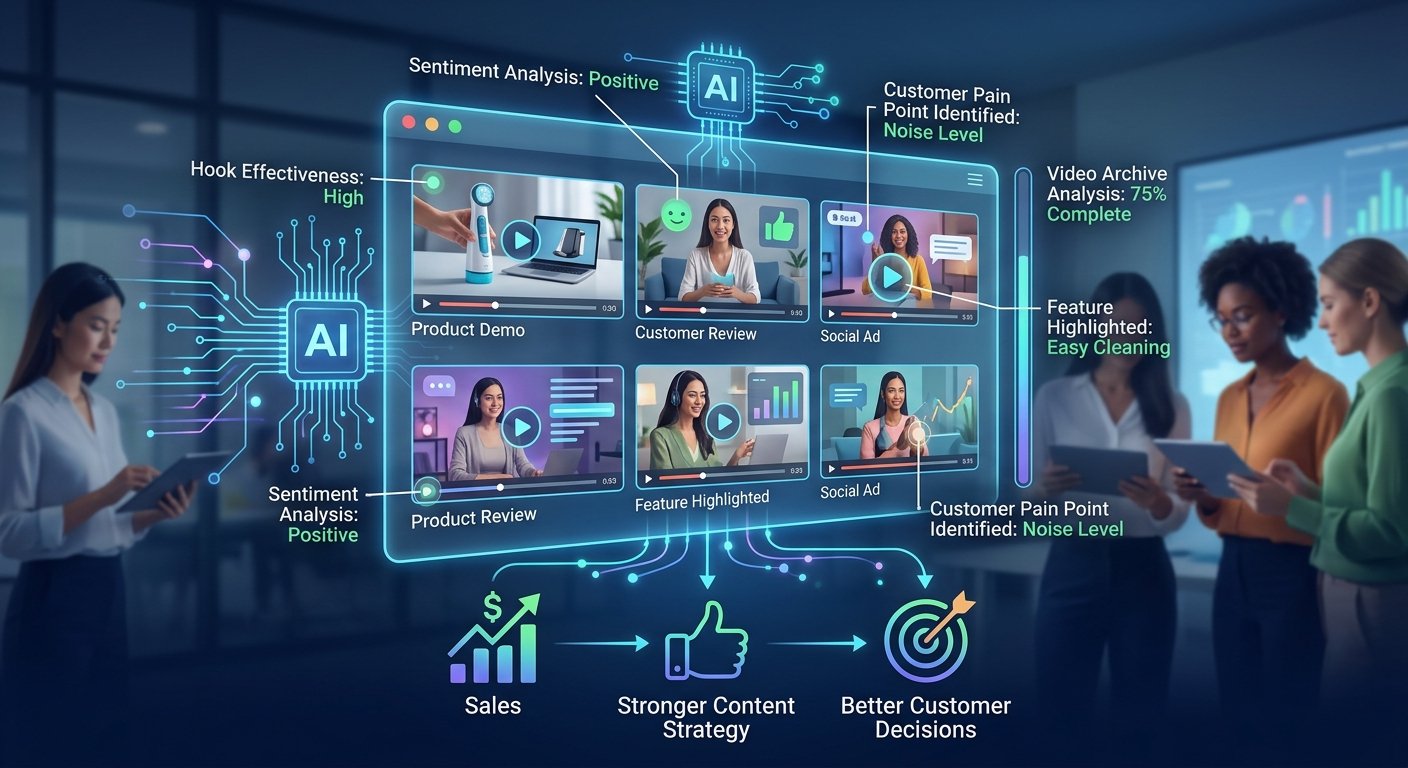
Historically, extracting the “why” required tedious human review. Today, modern multimodal AI can autonomously examine the qualitative content of the video itself. It can analyze what is visually being shown, transcribe and comprehend what is being said, identify specific actions happening at exact timestamps, and synthesize complex information across long-form content.
A prime example of this evolution is Google’s recently introduced “agentic video understanding.” This capability allows sophisticated models, like the Gemini series, to dynamically search through video frames, audio tracks, and transcripts to pinpoint relevant moments, rather than statically processing a video frame b frame. Not only does this drastically reduce the token consumption and computational costs associated with long-form video analysis, but it also vastly improves diagnostic accuracy. For marketers, this is a monumental leap forward from basic text or image analysis.
Mining Your Archives: Unlocking First Party Data
To understand the practical value of this technology, consider a hypothetical e-commerce appliance retailer. Over the past three years, this brand has published hundreds of videos across YouTube, TikTok, and Instagram Reels. Historically, learning from this archive would require a marketer to sit and watch hours of footage, taking subjective notes.
With AI video intelligence, the business can feed its entire library into a multimodal system and instruct it to classify the anatomy of each video. The AI can tag the structural elements: Opening hook → Customer problem statement → Product reveal → Feature demonstration → Benefit articulation → Promotional offer → Call to action.
By overlaying this structural data with traditional performance metrics, invisible patterns suddenly become obvious. The brand might discover that videos demonstrating how easy a blender is to clean consistently yield higher conversion rates than videos focused on motor specifications. They might find that side-by-side comparison videos generate fewer top-of-funnel views but lead to drastically higher product page visits. They might even realize that videos opening with a relatable customer frustration hold viewer retention 30% longer than videos that immediately flash the product logo.
In this scenario, the brand is no longer relying on generic generative AI prompts like, “Give me 30 new TikTok ideas.” Instead, they are asking an analytical AI, “Based on historical data, what have our customers proven they actually care about?” The latter is a far more lucrative question.
Social Listening on Steroids: Analyzing the Broader Market
The power of AI video intelligence is not limited to a brand’s own content archive; it extends outward into the broader market. Consider the massive volume of public product reviews, competitor demonstrations, and user generated unboxing videos.
Customers and independent creators constantly broadcast their unfiltered opinions. Across dozens of review videos, a recurring theme might emerge: “I love how this looks, but cleaning the filter is incredibly annoying,” or “I wish I had realized how much counter space this takes up before I bought it.”
Traditional text based social listening tools often miss these nuances. A written caption might just say, “Reviewing my new coffee maker!” while the true sentiment, a sigh of frustration when attaching a part, or the audible loudness of the machine, exists entirely within the video and audio layers. Video intelligence vendors are already deploying AI to ingest massive collections of competitor and review content, identifying these recurring pain points, extracting exact customer phrasing, and turning qualitative video into actionable market research.
The Omnichannel Impact
The insights extracted from video intelligence shouldn’t simply dictate the script for the next video; they should inform the entire e-commerce ecosystem.
If AI analysis reveals that customers are universally focused on how loud an appliance is, whether it fits under standard kitchen cabinets, and what accessories are included in the box, that intelligence becomes a blueprint for overall business optimization. Those exact answers should be pushed to the top of the product landing page. They should be integrated into the Amazon marketplace listing, added to the website FAQ, formatted into comparison charts, baked into customer service response scripts, and highlighted in email drip campaigns.
As the purchasing journey becomes more complex, customers are researching products across multiple formats. Furthermore, as Adobe reported in early 2026, AI originated traffic to U.S. retail sites is rising sharply and converting at higher rates than non-AI traffic. By optimizing your wider digital footprint based on deep video insights, you are not only helping human customers make purchasing decisions, but you are also feeding structured, relevant data to the AI search engines that are increasingly guiding those customers.
The Golden Rule: Augment, Don’t Replace, Human Judgment
Despite its power, video intelligence has a critical limitation that marketers must respect: AI is phenomenal at identifying correlations, but it cannot inherently prove causation.
If an AI dashboard reports that videos featuring product demonstrations receive twice as many views, it is tempting to declare demonstrations as the ultimate driver of success. But human context is required. Perhaps those specific videos also featured more charismatic creators, utilized better thumbnail designs, or were backed by a larger paid media budget.
Therefore, the workflow should never be:
AI analyzes → AI dictates strategy → Business blindly follows.
Instead, Hootsuite and other industry leaders advise a more integrated approach:
Content → AI Analysis → Pattern Identification → Human Interpretation → A/B Testing → Measurement.
AI surfaces the hypothesis, but human marketers must still validate it through rigorous testing.
From Content Generation to Content Intelligence
To begin leveraging this, e-commerce brands do not need a multimillion dollar enterprise AI integration. Teams can start with a simple pilot experiment. Export the performance data for your last 50 videos into a spreadsheet. Use accessible multimodal AI tools to help classify the hooks, features, and topics present in each video. Manually review the findings, map them against your highest converting posts, and let those evidence based insights dictate your content strategy for the next quarter.
We are currently witnessing a vital evolution in how businesses utilize artificial intelligence. Phase one was all about output: “AI, create more content.” Phase two is about comprehension: “AI, help us understand our content.” Ultimately, we are moving toward the final, most valuable phase: “AI, help us understand what our customers are telling us.”
In the near future, competitive advantage will no longer belong to the brand that can generate the most AI videos in the shortest amount of time. When every competitor has the tools to instantly produce a 30-second ad, sheer volume loses its edge. The true advantage will belong to the company that learns the fastest. By treating videos not just as promotional assets, but as dense datasets, e-commerce businesses can finally stop guessing what to create next, and start scaling what they already know works.