AI Can Create Your Content. But It Shouldn’t Create Your Point of View
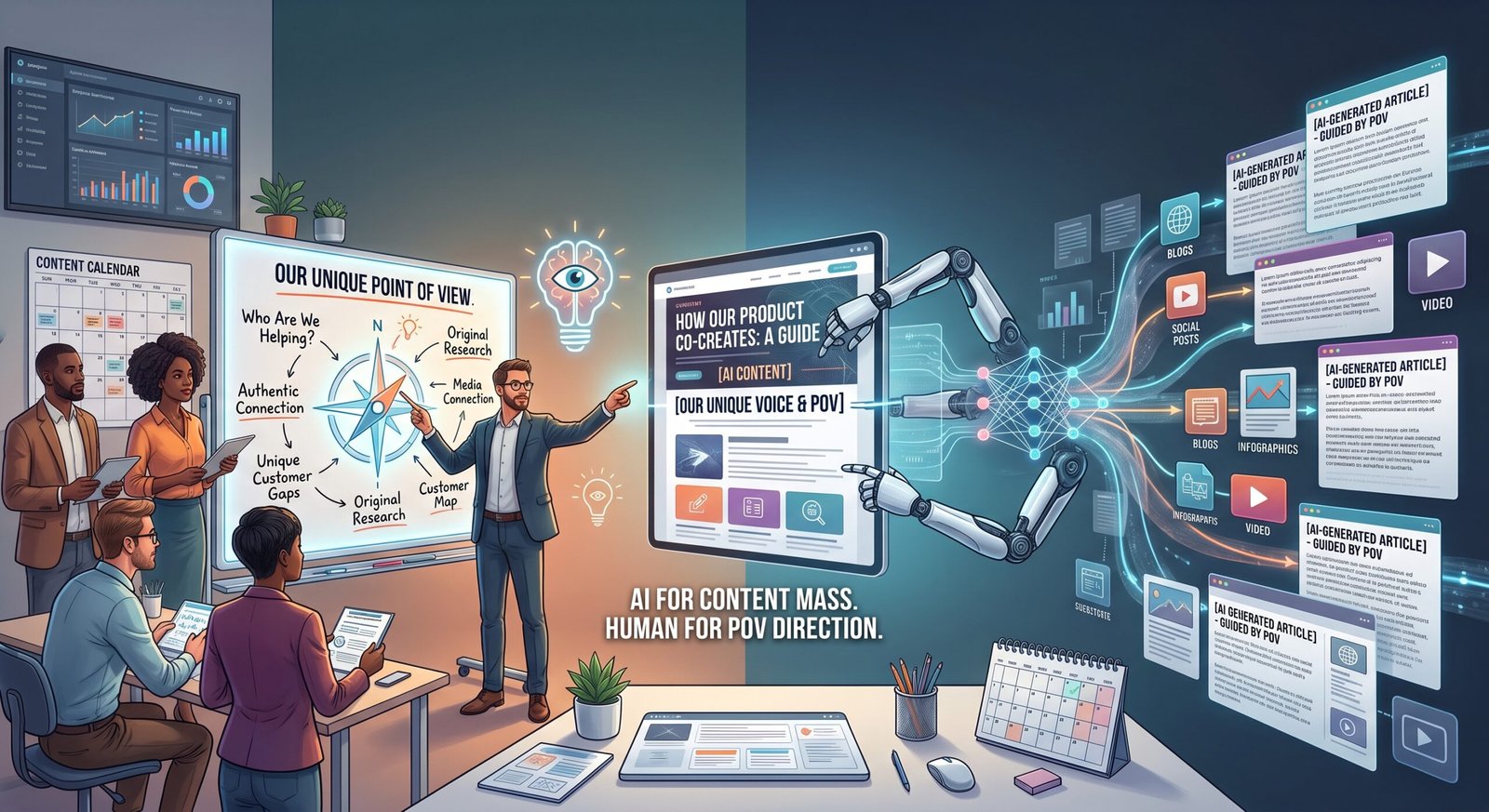
There are tons of social media posts (especially YouTube videos) teach you how to create 10, 20, 100… posts/videos/images, etc. in seconds. Or, you have already figured it out on your own (or even have already been doing so).
AI has completely changed content marketing.
A business can now generate a month’s worth of social posts in an afternoon.
Blog articles can be drafted in minutes. Product descriptions can be rewritten instantly. Videos can be scripted, images generated and newsletters summarized without a marketing team spending days on production.
That sounds like a huge competitive advantage.
But there’s a problem.
Everyone else can do exactly the same thing.
And that means the real marketing advantage is shifting from who can produce the most content to who has something worth saying.
The internet is filling with perfectly acceptable content
You’ve probably seen articles that begin like this:
“In today’s rapidly evolving digital landscape, artificial intelligence is transforming the way businesses operate…”
There’s nothing technically wrong with that sentence.
And that’s exactly the problem.
It could have been written by almost anyone, for almost any company, about almost any industry.
AI has made it incredibly easy to create content that is grammatically correct, professionally structured and completely forgettable.
LinkedIn now openly refers to some of this as “AI slop”: low-effort content that may appear polished but lacks a clear point of view, substance or unique perspective. The platform says generic AI-heavy content may receive less distribution beyond a creator’s immediate network.
So the question for businesses is no longer:
“Can AI write our content?”
Of course it can.
The better question is:
“What are we contributing that AI couldn’t have invented without us?”
AI should make expertise easier to communicate
Imagine two e-commerce consultants writing about abandoned carts.
The first asks AI:
“Write a LinkedIn post about five ways to reduce shopping-cart abandonment.”
The result might suggest:
simplify checkout,
offer multiple payment options,
provide free shipping,
send abandoned-cart emails,
and optimize mobile checkout.
All reasonable advice.
But there are probably thousands of articles saying exactly the same thing.
Now imagine the second consultant says:
“I’ve noticed something interesting while reviewing smaller e-commerce stores. Businesses often spend more money bringing new visitors to the website before fixing obvious checkout problems. Here’s why I think that’s backwards.”
Then AI helps organize that observation, find supporting research, improve the explanation and turn it into an article.
That’s fundamentally different.
AI created the first article.
AI helped communicate the second person’s idea.
That’s the distinction businesses need to understand.
A simple test: remove your company name
Take one of your recent articles and remove the author’s name and company logo.
Could the exact same article have appeared on 500 other websites?
If the answer is yes, the content probably needs something else.
That “something” could be:
your experience,
a test you performed,
an unusual observation,
a framework you developed,
a mistake you learned from,
real data,
a customer question you repeatedly encounter,
or an opinion you can actually defend.
LinkedIn’s own current guidance makes essentially the same distinction: AI-assisted content is acceptable, but it should still represent the member’s voice, perspective and experience.
Businesses shouldn’t stop using AI
The answer is definitely not to go back to writing everything manually.
That would throw away one of the biggest productivity improvements marketing teams have received in years.
Instead, divide the work differently.
Let AI do the heavy lifting
AI is excellent for:
research,
brainstorming,
organizing ideas,
finding counterarguments,
creating outlines,
drafting,
editing,
fact-checking,
rewriting,
creating headline alternatives,
turning an article into social posts,
and adapting content for different platforms.
Those tasks consume enormous amounts of marketing time.
Use AI aggressively there.
Keep the point of view human
Humans should remain responsible for questions like:
What have we noticed?
What do we believe?
What surprised us?
What have we tested?
What do customers misunderstand?
Where do we disagree with conventional advice?
What would we actually recommend someone do?
That is where expertise lives.
Consider an e-commerce example
A generic AI article might be titled:
“5 Ways AI Is Transforming E-Commerce.”
It will probably discuss personalization, customer service, inventory management, predictive analytics and automation.
Useful?
Perhaps.
Memorable?
Probably not.
Now compare that with:
“Your Product Page Has a New Customer: AI.”
That article starts with a specific observation: product pages are no longer being interpreted only by human shoppers and traditional search engines. AI recommendation systems increasingly need to understand who a product is for, what problem it solves and when it should be recommended.
That creates an argument.
And arguments create authority.
Your mistakes can actually become valuable content
Businesses naturally want marketing to make them look knowledgeable.
But one of the strongest sources of useful content is:
“We tried this. It didn’t work. Here’s what we learned.”
Imagine a company builds an AI customer-service agent and discovers that giving it too much autonomy creates problems.
That experience could produce an article:
“We Gave an AI Agent Too Much Control. Here Are the Five Permissions We Should Have Defined First.”
That is far more interesting than:
“5 Benefits of AI Customer Service.”
The second can be generated from general knowledge.
The first contains experience.
As AI-generated content becomes abundant, experience becomes scarce content.
This also matters for trust
There is another reason not to remove the human layer.
Research published in 2026 has found that perceived authenticity can decline when audiences believe brand or influencer communication has been generated by AI, particularly when people feel less human effort or relational investment went into the interaction.
That doesn’t mean customers automatically reject AI.
It means businesses need to be careful about replacing human connection with synthetic volume.
A customer may appreciate AI instantly finding an order number.
They may be less impressed by an obviously automated response to a serious complaint.
The same principle applies to content.
Efficiency is useful.
Authenticity still matters.
A better AI content workflow
Instead of:
Topic → AI → Publish
try:
Business observation → Human point of view → AI research → AI draft → Human challenge → Fact-check → Human edit → Publish
The difference may look small.
It’s enormous.
AI is still doing perhaps 60–80% of the production work.
But the reason the article exists came from a person who actually understands the business.
And there is an additional benefit: well-structured educational content can support discovery beyond social feeds. LinkedIn itself now recommends pairing timely posts with deeper articles and structuring useful content clearly enough for both people and AI systems to understand.
The competitive advantage has moved
Five years ago, publishing a polished 1,000-word article required meaningful effort.
Today, almost any business can produce one in minutes.
So production itself is no longer the advantage.
The advantage is increasingly:
original observation + real expertise + useful evidence + clear point of view + AI-powered execution.
The businesses that understand this won’t use less AI.
They may actually use more AI than everyone else.
But they’ll use it differently.
They’ll automate the parts of content creation that don’t require human judgment while investing more attention in the parts that do.
Because in a world where machines can produce unlimited content, the scarce resource isn’t another article.
It’s having something worth saying.