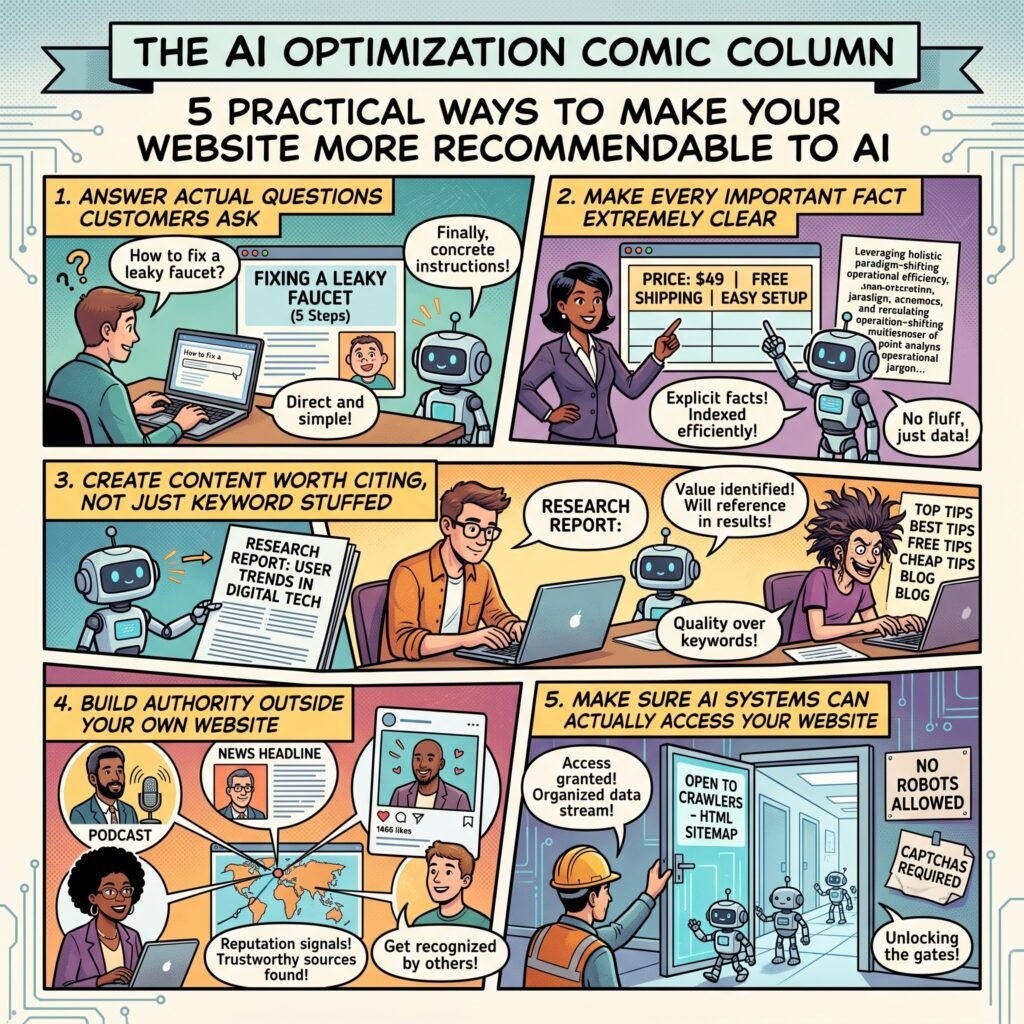
5 Practical Ways to Make Your Website More Recommendable to AI
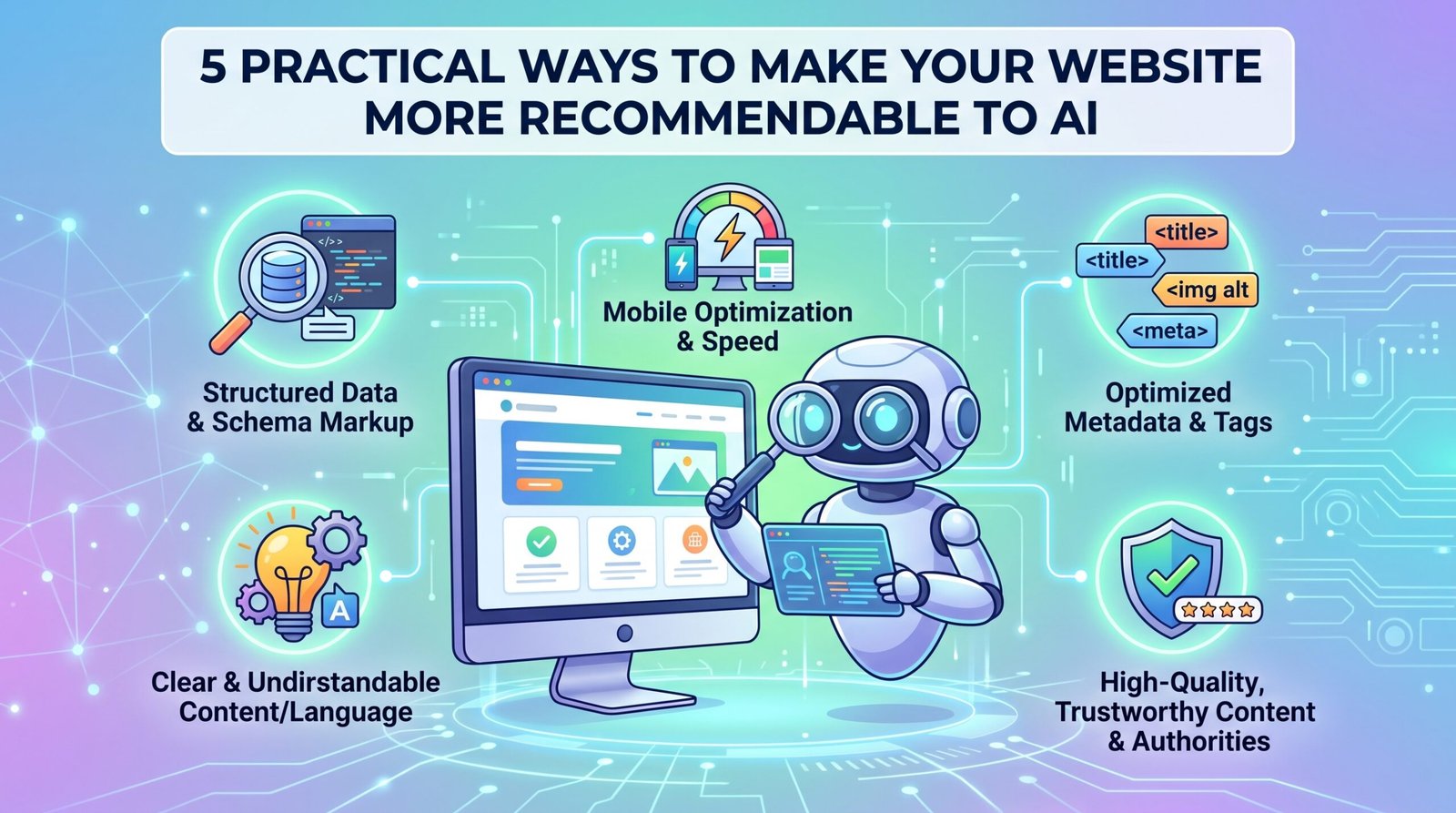
Getting found on Google is no longer the whole game.
Increasingly, customers are asking ChatGPT, Gemini, Copilot and other AI systems questions such as:
“What is the best option for my situation?”
“Which company should I use?”
“What product would you recommend?”
So how can you increase the chances that AI systems understand, cite and potentially recommend your website?
Here are 5 practical things businesses can work on right now.
1. Answer the actual questions customers ask
Don’t build content only around keywords like:
“best cordless vacuum Canada”
Create pages that clearly answer questions such as:
“Which cordless vacuum is best for pet hair and hardwood floors?”
“What size range hood do I need for a 30-inch gas stove?”
“What should a small e-commerce business automate with AI first?”
AI systems are answering questions. Give them clear, useful answers to retrieve.
A good exercise is to create a list of 50 real questions customers ask before purchasing and check whether your website answers them.
2. Make every important fact extremely clear
Don’t make AI guess.
For a product, clearly state:
- What it is
- Who it is for
- Key specifications
- Price and availability
- Compatibility
- Important limitations
- Shipping and returns
- Warranty
- Real-world use cases
- How it differs from alternatives
For a service business, clearly explain what you do, who you help, where you operate and what problems you solve.
Structured product data can reinforce this machine-readable understanding. Google, for example, uses Product structured data for information including price, availability, ratings and offers.
3. Create content worth citing, not just content stuffed with keywords
This may be one of the biggest opportunities.
Instead of publishing another generic article called:
“10 Benefits of AI for E-Commerce”
publish something genuinely useful:
“We Audited 500 Product Listings: The 7 Product-Data Problems That Appeared Most Often.”
Include original observations, comparison tables, methodology, examples, statistics, testing and expert explanations.
Microsoft now explicitly advises publishers seeking AI visibility to strengthen expertise, improve structure and support claims with evidence.
The goal changes from:
“How do I rank this article?”
to:
“Why would an AI choose my article as evidence for its answer?”
4. Build authority outside your own website
You can say you’re the best company in your industry 100 times.
That’s still you talking about yourself.
AI recommendation systems can draw information from across the web, so strengthen the external evidence surrounding your brand:
customer reviews, reputable directories, marketplace profiles, industry publications, interviews, YouTube, professional associations, expert contributions and relevant third-party mentions.
Make your business identity consistent across those sources.
Think of this as building an AI-readable reputation, not merely an AI-readable website.
5. Make sure AI systems can actually access your website
This sounds obvious, but it is easy to overlook.
Your content can be excellent and still have limited value if important pages aren’t crawlable or discoverable.
Check robots.txt, indexing, canonical URLs, sitemaps, structured data, page accessibility and whether security/CDN settings are unintentionally blocking crawlers.
For ChatGPT specifically, OpenAI says websites should allow OAI-SearchBot if they want their content to be discoverable and eligible to be surfaced and cited in ChatGPT search.
Microsoft now provides AI Performance in Bing Webmaster Tools, showing which pages are being cited across Copilot and other supported AI experiences.
And then comes the step most businesses will skip:
Measure it.
Ask 30–50 commercially important questions across several AI platforms.
Record:
Does your brand appear?
Are you merely mentioned or actually recommended?
Which competitors appear instead?
Which websites does the AI cite?
What does the AI think your company is good at?
Then improve the gaps and test again.
That’s where AI visibility becomes a business process rather than another SEO buzzword.
The objective isn’t to “trick ChatGPT.”
It’s to make your business easier for AI systems to discover, understand, verify and confidently include in an answer.
Traditional SEO asks:
“Can people find my website?”
The next question is:
“When AI is helping my customer decide what to buy, does it have enough evidence to recommend me?”