Google Now Tells Shoppers How an Ad Was Made. Why E-Commerce Businesses Should Pay Attention
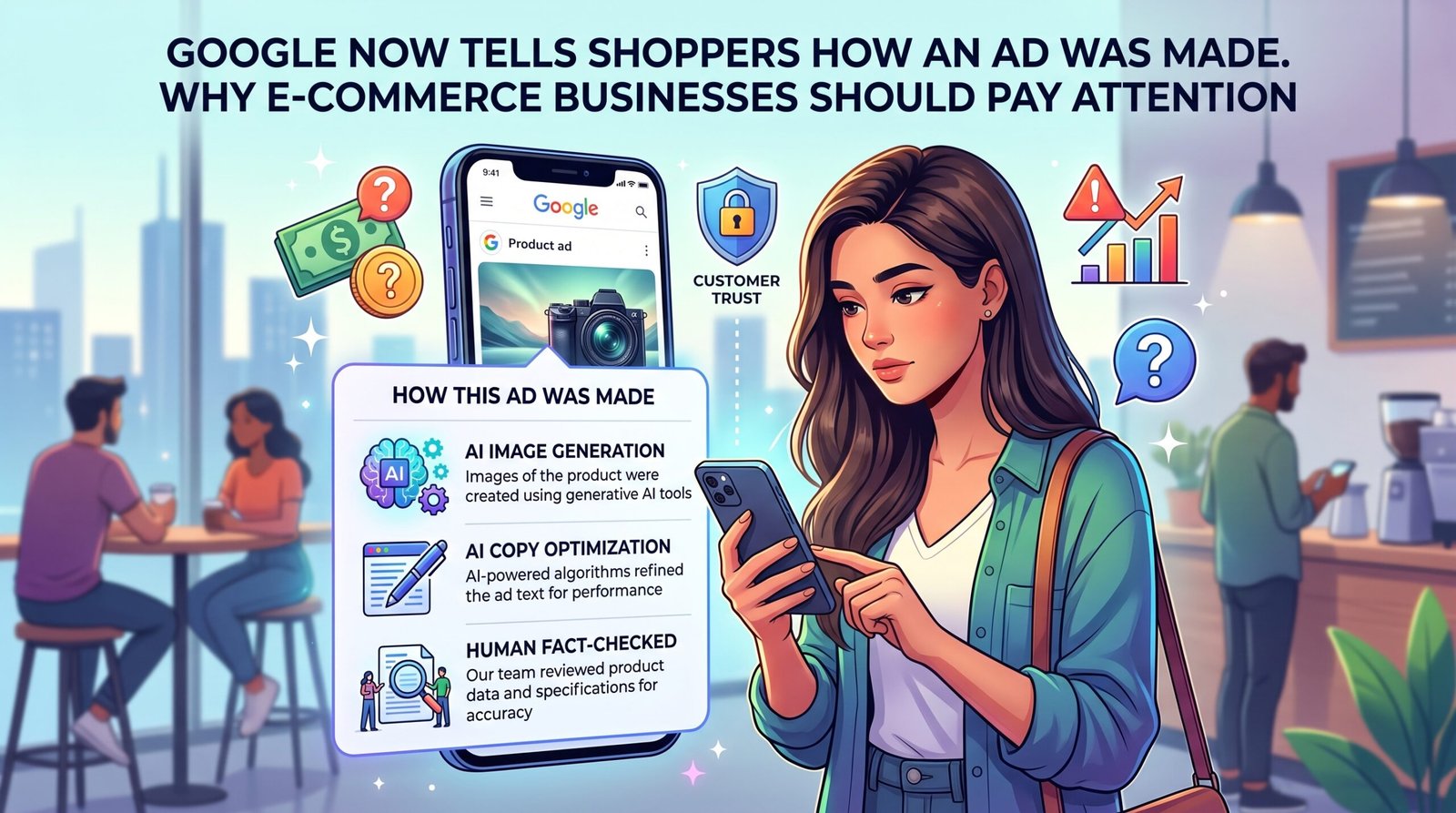
AI can help you create an ad in seconds. But your customers may now also be able to see that AI helped create it.
Google has introduced a new transparency feature called “How this ad was made,” giving users more information about whether generative AI was used to create or edit advertising content.
For business owners, this might sound like a small Google Ads update.
It isn’t.
It represents a much bigger shift: AI-generated marketing content is becoming normal, but so is AI transparency.
And for e-commerce businesses increasingly using AI to generate product images, advertising creatives, videos and marketing content, that is something worth understanding.
What Is “How This Ad Was Made”?
Google is adding a “How this ad was made” section to My Ad Center. Users can access it through the three-dot menu or information icon on ads appearing across Google Search, YouTube and Discover.
If generative AI was involved in creating or editing an ad, this section can provide information about that use.
When advertisers use Google’s own generative AI advertising tools, Google can automatically add the disclosure. Advertisers using AI tools outside Google can also identify relevant assets as AI-created or AI-edited.
Depending on the region, AI disclosures may also appear more visibly on the advertisement itself.
Google is therefore making something increasingly clear:
Using AI in advertising is acceptable. But transparency around how AI is used is becoming part of the advertising ecosystem.
Why Should E-Commerce Businesses Care?
E-commerce is one of the industries where generative AI can have enormous practical value.
Instead of organizing an expensive photoshoot for every advertising concept, a business might use AI to create lifestyle backgrounds.
One product photograph could potentially become multiple creative concepts.
A simple product image might be transformed into seasonal advertising for Thanksgiving, Black Friday, Christmas or Mother’s Day.
AI can also help create video, advertising copy and campaign variations much faster than traditional production methods.
That can dramatically reduce creative costs and make testing more accessible to smaller businesses.
But there’s an important distinction businesses need to understand:
AI should help present the product. It should not misrepresent the product.
Imagine an AI-generated advertisement showing a product performing something it cannot actually do.
Or AI adds accessories that aren’t included.
Perhaps it changes the product’s dimensions, colour, controls or physical features.
The advertisement may look fantastic.
But it could also create an expectation the real product cannot meet.
For e-commerce, that isn’t simply a creative problem.
It can become a customer trust, return-rate and brand-reputation problem.
AI Transparency Changes the Creative Strategy
Some businesses may worry that an AI disclosure automatically makes an advertisement less trustworthy.
That isn’t necessarily the right conclusion.
Consumers are becoming increasingly familiar with AI-generated content.
The more important question is:
Was AI used responsibly?
There’s a major difference between using AI to place an accurate product image inside a beautiful kitchen setting and using AI to create a fictional version of the product.
Similarly, using AI to generate ten advertising concepts for testing is very different from creating a fake testimonial or an unrealistic demonstration.
The competitive advantage therefore won’t simply belong to businesses that use the most AI.
It may belong to businesses that use AI quickly, creatively and responsibly.
Business Owners Need an AI Advertising Policy
This is where companies should start becoming more organized.
Until recently, an employee or marketing agency might simply create an image with an AI tool and upload it into a campaign.
Going forward, businesses should know which marketing assets were created or materially edited using AI.
A simple internal policy can help.
For example:
Keep the actual product accurate.
AI-generated backgrounds and environments can be useful, but important physical product characteristics shouldn’t accidentally change.
Verify every factual claim.
AI-generated advertising copy should never be assumed to be correct simply because it sounds convincing.
Track AI-generated assets.
Businesses should know which images, videos and advertising creatives involved generative AI.
Review disclosure requirements before publishing.
Google provides AI-label controls, while regulatory requirements can vary depending on where advertising is shown.
Keep humans responsible for final approval.
AI can produce creative options. Someone still needs to decide whether those options accurately represent the product and brand.
This Is Bigger Than Google Ads
The most important lesson isn’t the location of a new button inside Google Ads.
It’s the direction advertising is moving.
AI will allow businesses to create more advertising, more variations and more personalized creative at dramatically greater speed.
At the same time, platforms, regulators and consumers will increasingly expect businesses to be transparent about how that content was produced.
For e-commerce businesses, the opportunity remains enormous.
AI can help turn one product photo into multiple campaign concepts. It can accelerate seasonal creative production, produce advertising variations for testing and help smaller brands compete with companies that have much larger creative budgets.
But speed shouldn’t replace accuracy.
The question business owners should ask is no longer:
“Should we use AI to create our advertising?”
A better question is:
“How can we use AI to create advertising faster without compromising product accuracy, customer trust or our brand?”
Because AI-generated advertising isn’t going away.
The businesses that benefit most may be the ones that learn how to use it responsibly before everyone else does.