SEO or Paid Ads? The Smarter Growth Channel Depends on What Your E-commerce Business Needs First
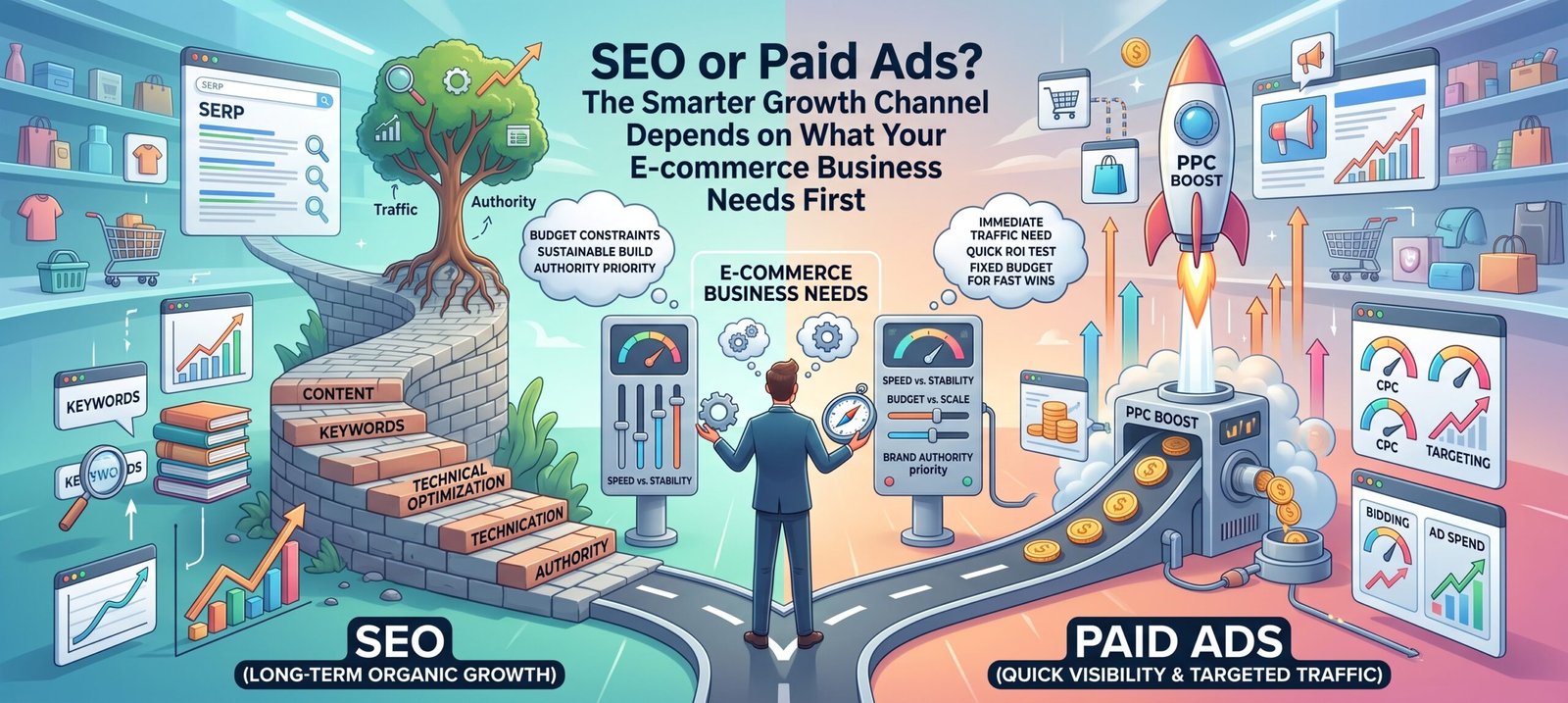
Paid ads can bring traffic tomorrow, but SEO can keep bringing customers long after the campaign ends.
For e-commerce businesses, one of the most common growth questions is:
Should we invest in SEO or paid ads?
It is a fair question. Most businesses do not have unlimited budget, time, or internal resources. They need to know whether to spend money on Google Ads, marketplace ads, social ads, influencer campaigns, search optimization, product-page content, blog articles, buying guides, or technical website improvements.
Both SEO and paid ads can help e-commerce growth.
But they do very different jobs.
Paid ads are better for speed, testing, promotions, and immediate visibility.
SEO is better for long-term discovery, trust, organic traffic, and reducing dependence on paid traffic over time.
The right choice depends on what problem the business needs to solve first.
Paid Ads: Best When You Need Traffic Now
Paid ads are useful because they create visibility quickly.
If you launch a new product, run a seasonal campaign, test a new offer, promote a sale, or need traffic to a product page immediately, ads can help you move faster than SEO.
With paid ads, you can test:
- which products attract clicks
- which audience responds
- which offer converts
- which creative works
- which keywords have buying intent
- which landing pages need improvement
That speed is valuable.
For example, if a business is preparing a holiday promotion, it may not have six months to wait for organic rankings. Paid ads can put the product in front of potential customers right away.
Paid ads are also useful for marketplace sellers. Sponsored listings on platforms such as Amazon, Walmart, Etsy, or other marketplaces can help products gain visibility in competitive categories where organic ranking is difficult.
But paid ads have a clear weakness.
When the budget stops, the traffic often stops.
That means paid ads can become expensive if the business depends on them too heavily.
SEO: Best When You Want Long-Term Visibility
SEO is slower, but it can become a long-term asset.
Good SEO helps customers find your products, categories, guides, comparison pages, and answers when they are already searching for information.
For e-commerce, SEO is not only about blog posts. It includes:
- product-page optimization
- category-page structure
- internal linking
- buying guides
- comparison articles
- FAQ content
- technical site health
- page speed
- image optimization
- product schema
- clear product data
- helpful content around buyer decisions
SEO works best when the business wants to build sustainable traffic and reduce total dependence on paid campaigns.
A strong SEO article or category page can continue attracting visitors over time. A helpful comparison page can support customers who are deciding between two options. A well-structured product page can help both search engines and customers understand what the product is, who it is for, and why someone should buy it.
The downside is that SEO takes time.
It usually does not create immediate sales tomorrow. It requires consistent effort, clear strategy, strong content, technical quality, and patience.
SEO is an investment, not a quick switch.
The Real Difference: Speed vs Sustainability
The simplest comparison is this:
Paid ads create faster traffic.
SEO creates more sustainable visibility.
Paid ads are like renting attention.
SEO is like building an asset.
Both can be valuable. But they affect the business differently.
Paid ads are useful when you need fast feedback. You can run a campaign, test a message, review the numbers, and adjust.
SEO is useful when you want your website to become more discoverable over time. You build product content, category depth, buying guides, and decision-support pages that can keep helping customers after the first publish date.
The mistake is expecting one channel to do the other channel’s job.
Do not expect SEO to replace urgent promotional traffic overnight.
Do not expect paid ads to build long-term organic visibility by themselves.
When Paid Ads Should Come First
Paid ads should usually come first when the business needs immediate data or immediate demand.
This is often true when:
- the product is new
- the business needs fast traffic
- a promotion has a deadline
- the store has very little visibility
- the business needs to test product-market fit
- there is a seasonal sales window
- marketplace ranking needs support
- the offer needs quick validation
Paid ads can help answer important questions quickly.
Are people interested?
Do they click?
Do they buy?
Which message works?
Which product deserves more investment?
But there is one warning.
Do not send paid traffic to a weak product page.
If the page is unclear, images are poor, shipping is confusing, trust is low, or the offer is weak, ads will not fix the issue. They will simply make the problem more expensive.
When SEO Should Come First
SEO should usually come first when the business needs a stronger foundation.
This is often true when:
- product pages are thin or unclear
- category pages are weak
- customers ask the same questions repeatedly
- the business depends too much on ads
- product information is inconsistent
- similar products need comparison content
- the brand wants to build authority
- the website has long-term growth potential
SEO is especially useful for products that require education.
If customers need to understand size, compatibility, features, materials, usage, installation, care, or comparison, SEO content can help them make better decisions.
This is where buying guides and comparison articles become powerful.
For example:
“Which size should you choose?”
“Basic vs premium model”
“Product A vs Product B”
“Is this upgrade worth it?”
“What should you check before buying?”
This kind of content helps SEO, but it also improves conversion.
The Strongest Strategy Uses Both
For most e-commerce businesses, the answer is not SEO or paid ads.
The answer is using both with clear roles.
Paid ads can bring traffic and test demand.
SEO can improve the foundation and build long-term visibility.
A smart growth sequence may look like this:
First, improve the product pages so visitors understand the offer.
Second, use paid ads to test which products, audiences, and messages perform.
Third, use the ad data to guide SEO content.
Fourth, build SEO pages around proven customer questions, objections, and buying decisions.
Fifth, use SEO content to support future ads, email, marketplace listings, and sales conversations.
This creates a stronger system.
Paid ads teach you what people respond to.
SEO turns those lessons into long-term assets.
Do Not Judge Either Channel Without Profit
There is one more important point.
Neither SEO nor paid ads should be judged by traffic alone.
Traffic is not the goal. Revenue is not even the full goal.
The goal is profitable growth.
A paid campaign with strong ROAS may still be weak after product cost, shipping, fees, returns, and discounts.
An SEO page with lower traffic may still be valuable if it brings high-intent visitors who convert well.
The better question is:
Which channel helps this product grow profitably?
That means tracking contribution, not just clicks.
Key Takeaways
SEO and paid ads both help e-commerce growth, but they help in different ways.
Paid ads are best for speed, testing, promotions, and immediate visibility.
SEO is best for long-term discovery, trust, decision support, and reducing dependence on paid traffic over time.
A business that only runs ads may become trapped in rising acquisition costs.
A business that only waits for SEO may grow too slowly.
The strongest e-commerce strategy usually combines both.
Use paid ads to learn faster.
Use SEO to build stronger.
Then connect both to product data, conversion quality, and profit.
Because the real question is not:
“Should we choose SEO or paid ads?”
The real question is:
“Which channel helps us attract the right customers, convert them better, and grow profitably?”
That is the number that matters.