ROAS Looks Good. Profit Tells the Truth.
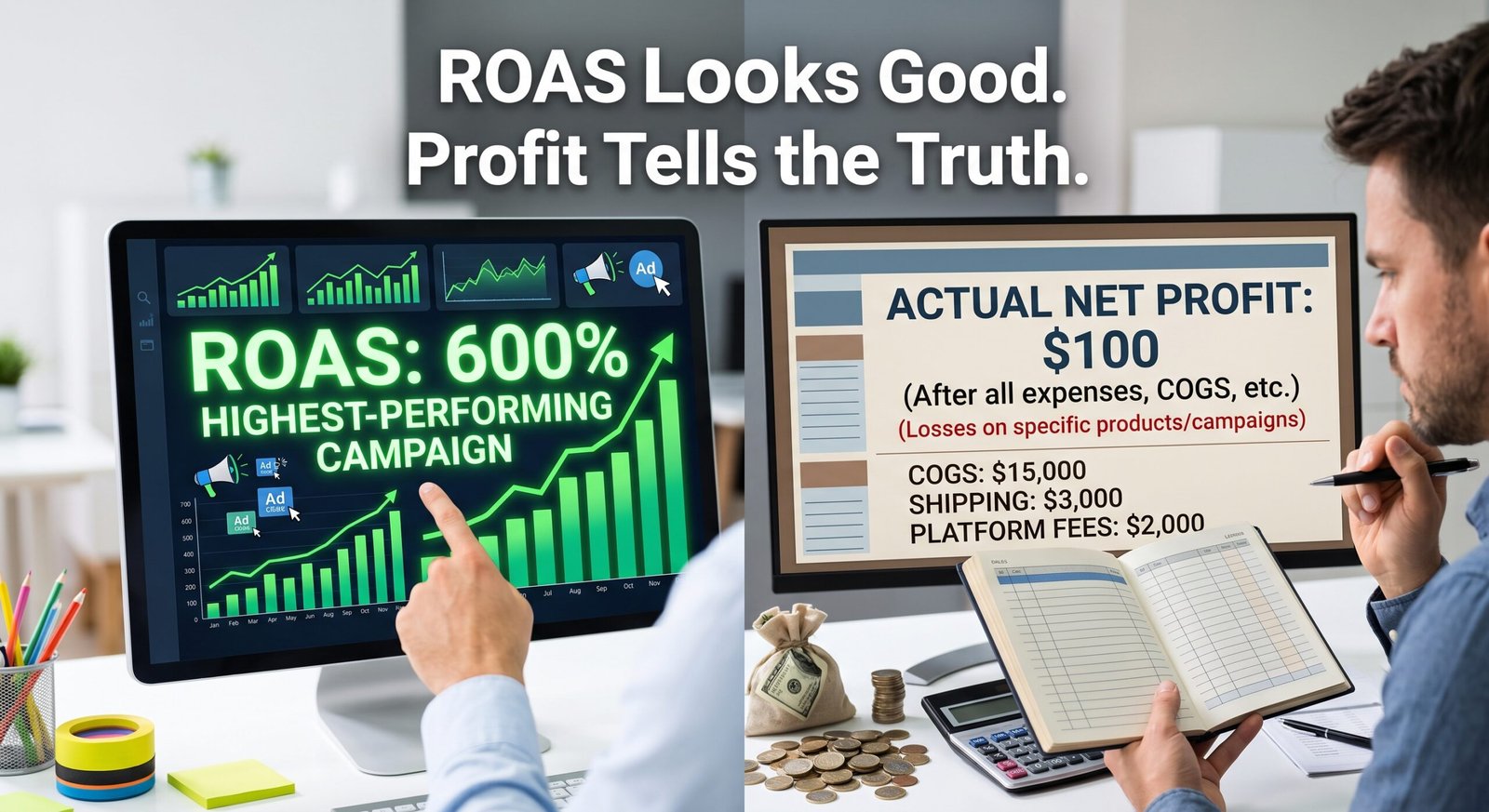
A campaign can look successful in your ad dashboard and still be quietly weakening your business.
That is one of the most common traps in e-commerce reporting.
The ad platform says your campaign has a 5× ROAS. The report looks impressive. The revenue number is going up. The product is selling. Everyone feels like the campaign is working.
But then you look at the bank account, inventory, returns, fulfilment costs, and margins… and the story becomes less exciting.
This is why every e-commerce business needs to understand the difference between ROAS and profit.
ROAS is useful. But profit tells the truth.
What ROAS Actually Measures
ROAS stands for return on ad spend.
The formula is simple:
Revenue attributed to ads ÷ advertising spend = ROAS
If you spend $1,000 on ads and the campaign generates $5,000 in attributed revenue, your ROAS is 5×.
That means every $1 spent on ads created $5 in tracked sales revenue.
That is helpful information. It tells you whether advertising is creating revenue activity.
But ROAS does not tell you whether the campaign is actually profitable.
It does not automatically include product cost, marketplace commission, payment fees, fulfilment, shipping, storage, discounts, returns, damaged items, customer-service time, or overhead.
In other words, ROAS tells you:
“How much revenue did the ad help generate?”
Profit asks:
“After all costs, how much money did we actually keep?”
Those are very different questions.
Why a High ROAS Can Still Be a Problem
A high ROAS feels good because it suggests efficiency. But it can become misleading when the underlying product economics are weak.
Imagine two products.
Product A has a 5× ROAS.
Product B has a 3× ROAS.
At first glance, Product A looks like the better advertising opportunity.
But what if Product A has low margin, expensive shipping, and frequent returns? What if Product B has a stronger margin, lower fulfilment cost, and fewer customer issues?
Product A may generate more revenue per ad dollar, but Product B may leave the business with more actual profit.
This is why ROAS should never be evaluated alone.
A campaign does not become healthy just because the revenue-to-ad-spend ratio looks strong. The product still needs to make financial sense after the sale.
The Hidden Costs Behind Every Order
E-commerce revenue is not the same as money kept.
Every order may include costs such as:
- product cost
- packaging
- payment processing
- marketplace commission
- fulfilment
- shipping
- storage
- advertising
- discounts
- refunds
- returns
- customer support
- damaged inventory
These costs vary by product, channel, and customer behaviour.
A lightweight accessory and a bulky product may have very different fulfilment economics. A high-return category may need a much higher ROAS to remain profitable. A product sold through a marketplace may carry fees that do not exist on your own website. A discounted product may convert well but leave very little margin.
This is why the same ROAS can mean different things for different products.
A 3× ROAS might be excellent for one product.
A 6× ROAS might still be weak for another.
The number only makes sense when you know the margin structure behind it.
Discounts Can Make ROAS Look Better While Profit Gets Worse
Discounts often improve conversion.
When a product goes on sale, more people may click, buy, and respond to the offer. The ad campaign may suddenly look stronger. ROAS may increase.
But if the discount cuts too deeply into margin, the business may be selling more while keeping less.
That is the dangerous part.
The dashboard may show:
More revenue
Higher conversion
Better ROAS
But the business may experience:
Lower profit per order
Faster inventory depletion
More fulfilment pressure
Less cash retained
This does not mean discounts are bad. Discounts can be useful when they are planned properly.
But a promotion should be judged by contribution, not only conversion.
The right question is:
Did the discount create profitable incremental sales, or did it simply make the revenue number look better?
Marketplace ROAS Can Be Especially Misleading
ROAS can be even more dangerous on marketplaces because the platform often shows ad performance separately from the full cost of selling.
A marketplace campaign may report strong attributed sales. But after referral fees, fulfilment charges, shipping, storage, returns, and promotional discounts, the real contribution may be much lower.
This is why sellers should avoid celebrating marketplace ROAS without calculating the full economics.
A better view is:
Attributed revenue
minus advertising cost
minus marketplace fees
minus fulfilment
minus product cost
minus expected returns
= estimated contribution
That contribution number is far more useful than ROAS alone.
It tells you whether the campaign is creating business value, not just platform revenue.
Profit Also Depends on Inventory
There is another issue ROAS does not show clearly: inventory risk.
A campaign may have excellent ROAS because customers love the product. But if the product has only two weeks of inventory left and the supplier lead time is six weeks, scaling the campaign may create a stockout.
That can hurt future sales, marketplace ranking, customer trust, and advertising momentum.
In that case, a strong ROAS does not automatically mean:
increase ad spend.
It may mean:
protect inventory, confirm replenishment, then decide whether to scale.
This is why ad decisions should connect with inventory data.
A profitable campaign is not only about today’s return. It is also about whether the business can fulfil demand without creating future problems.
The Better Metric: Contribution After Ads
Instead of looking only at ROAS, e-commerce businesses should track contribution after ads.
This does not need to be complicated at the beginning.
A simple version is:
Revenue
minus product cost
minus platform fees
minus fulfilment
minus shipping
minus discounts
minus returns allowance
minus ad spend
= contribution after ads
This gives a much clearer picture of whether a campaign is worth scaling.
Once you understand contribution, you can make better decisions:
- which products deserve more ad spend
- which products should not be promoted
- which campaigns look good but are weak
- which marketplace is actually profitable
- which products need better margins
- which listings need improvement before more traffic is sent to them
- which promotions should be replaced with bundles or value-added offers
ROAS helps marketing teams understand efficiency.
Contribution helps business owners understand reality.
When ROAS Still Matters
This does not mean ROAS is useless.
ROAS is still a helpful metric. It can show whether advertising is generating demand. It can help compare campaign efficiency. It can reveal which audiences, keywords, products, or creatives are producing sales.
The problem is not ROAS itself.
The problem is treating ROAS as the final answer.
ROAS should be the beginning of the analysis, not the end.
A strong reporting process should ask:
Is ROAS improving?
Is margin still healthy?
Are returns under control?
Is inventory available?
Are discounts too deep?
Is the campaign bringing profitable customers?
Should we scale, pause, or optimize?
That is how ROAS becomes useful instead of misleading.
Key Takeaways
ROAS looks good on a dashboard.
Profit tells you whether the campaign is actually helping the business.
A 5× ROAS is not automatically a win. A 3× ROAS is not automatically a failure. The right answer depends on product cost, margin, fees, fulfilment, shipping, discounts, returns, inventory, and customer value.
E-commerce businesses should not ask only:
“What is our ROAS?”
They should ask:
“After all costs, what did we actually keep?”
That is the number that decides whether a campaign deserves more budget.
Because the goal of advertising is not just to generate revenue.
The goal is to grow profitably.