E-commerce Is Changing: Your Product Doesn’t Just Need to Be Searchable, It Needs to Be Understandable
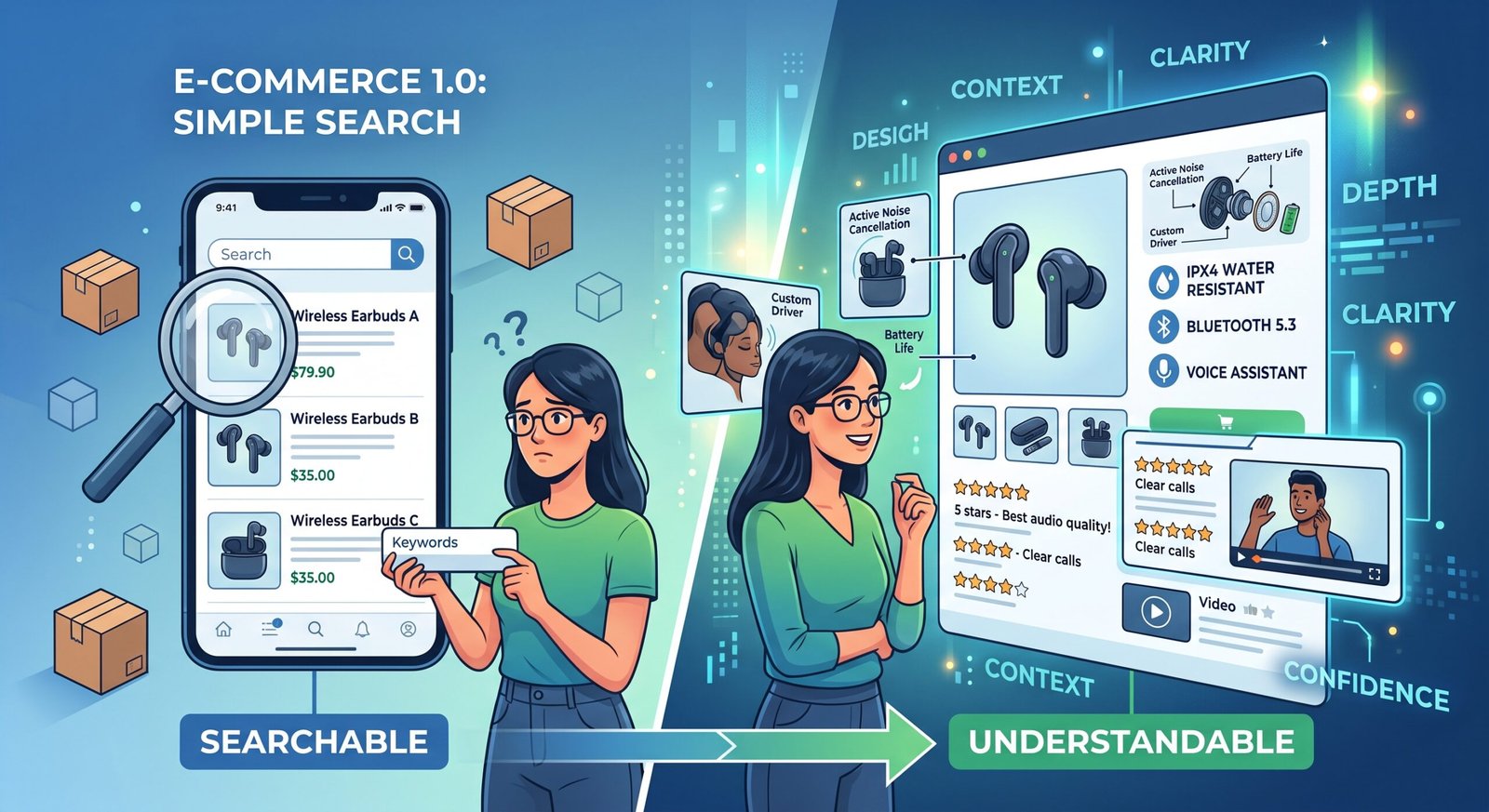
For years, e-commerce businesses have been told to make their products searchable.
Use the right keywords. Optimize the title. Fill in the tags. Improve the product feed. Rank higher in search results. Appear in more marketplace queries.
That advice still matters.
But it is no longer enough.
The next stage of e-commerce is not only about helping shoppers find your product. It is about helping customers, marketplaces, search engines, ad platforms, and AI shopping assistants understand your product well enough to recommend it, compare it, explain it, and help someone buy it with confidence.
In other words, e-commerce is moving from:
“Can people search for this product?”
to:
“Can people and systems understand why this product is the right choice?”
That shift changes how businesses should think about product pages, marketplace listings, product data, and content strategy.
Searchable Is Not the Same as Understandable
A product can be searchable but still confusing.
It may contain the right keywords, appear in the correct category, and show up in search results. But when a shopper clicks, they may still be unsure.
What size should they choose?
Is it compatible with what they already have?
Who is it best for?
What is included?
How is it different from the other model?
Is it beginner-friendly?
Does it solve their specific problem?
Is the higher price worth it?
If the product page does not answer those questions clearly, visibility alone will not create the sale.
Searchability gets the product in front of the customer.
Understandability helps the customer decide.
That is the difference.
Why This Matters More Now
Online shopping is becoming more conversational and comparison-driven.
Customers are not only typing short keywords anymore. They are asking questions. They are comparing options. They are reading reviews, watching videos, checking delivery expectations, browsing marketplaces, and increasingly using AI-powered tools to help narrow decisions.
A shopper may not search:
“compact kitchen product”
They may ask:
“What should I buy for a small apartment kitchen if I want something easy to use and easy to clean?”
That is a different kind of buying journey.
To appear in that context, the product needs more than basic keyword matching. It needs meaningful information that explains the product’s purpose, use case, strengths, limitations, and fit.
This is where many product pages fall short.
They describe the product, but they do not help the customer make a decision.
Product Pages Need to Become Decision Pages
A traditional product page often includes:
- product name
- price
- images
- basic description
- specifications
- add-to-cart button
That is the minimum.
A stronger modern product page should also answer:
- Who is this best for?
- What problem does it solve?
- What situation is it not ideal for?
- What should the customer check before buying?
- What is included in the box?
- What are the most important specifications?
- How does it compare to similar options?
- What are common customer questions?
- What are the shipping, return, and warranty expectations?
This transforms the product page from a simple listing into a buying guide.
That matters because customers do not always need more options. Often, they need more clarity.
When a product page helps shoppers understand which option is right for them, it reduces hesitation and builds confidence.
Marketplaces Are Also Moving Toward Better Understanding
Marketplaces are no longer simple digital shelves.
They use structured product data, attributes, reviews, fulfilment information, pricing, and customer behaviour to decide which products to show and how to present them.
A vague product listing is weaker in this environment.
For example, a listing that only says:
“Premium high-quality product”
does not give the platform much useful information.
A stronger listing explains:
what the product is
what size it is
what material it uses
who it is best for
what problem it solves
what makes it different
what is included
what the customer should know before buying
That helps both the customer and the platform understand the product.
Better product data can support marketplace search, filters, recommendations, advertising, and conversion.
It also reduces customer confusion, which can help lower returns and support questions.
AI Shopping Makes Product Clarity Even More Important
AI shopping assistants are changing the way product information may be used.
Instead of showing customers a long list of results, AI tools may summarize options, compare products, answer questions, or suggest what fits a customer’s situation.
That means your product information may become the source material for an AI-generated recommendation.
If your product data is incomplete, vague, or inconsistent, the AI may not understand the product correctly.
It may not know when to recommend it. It may not explain it accurately. It may favour competitors with clearer information.
This does not mean businesses should chase shortcuts or try to “game” AI systems.
The better strategy is much more practical:
Make your product information accurate, complete, structured, and useful.
That helps humans. It helps marketplaces. It helps search engines. It helps ads. And it helps AI tools understand what you sell.
The New Product Content Framework
A more understandable product page can be built around a simple structure:
1. Product identity
Clearly state what the product is.
Avoid vague names that sound impressive but do not explain the item.
2. Customer use case
Explain who the product is best for and when someone should choose it.
3. Key benefits
Connect features to outcomes.
Do not only say what the product has. Explain why it matters.
4. Complete specifications
Include the details customers need to compare and confirm fit.
5. Comparison points
Explain how this product differs from other models, sizes, versions, or alternatives.
6. Buyer questions
Add FAQs based on real pre-purchase concerns.
7. Purchase confidence
Clarify shipping, returns, warranty, support, and what is included.
This structure makes the product easier to understand and easier to buy.
Product Data Should Be Consistent Everywhere
Another important part of being understandable is consistency.
The same product should not have one name on your website, another name on a marketplace, different specifications in a product feed, and outdated information in an ad.
That creates confusion.
It also makes reporting and automation harder.
A business should aim to maintain one reliable product-data source that can support:
- website product pages
- marketplace listings
- Google Shopping
- social ads
- customer service
- inventory management
- comparison pages
- email campaigns
- AI workflows
When the product data is consistent, every channel becomes stronger.
When the product data is scattered, every channel becomes harder to manage.
This Is Not Only an SEO Issue
Many businesses still treat product content as an SEO task.
But product understandability affects much more than search rankings.
It affects:
- conversion rate
- ad performance
- marketplace listing quality
- return rate
- customer-service workload
- product comparison
- bundling
- cross-selling
- reporting
- AI discovery
- customer trust
A clearer product page can help a shopper make a decision faster.
A better FAQ can reduce support questions.
More accurate specifications can prevent returns.
A stronger comparison section can help customers choose the right model instead of leaving to research somewhere else.
This is why product content should be viewed as part of the revenue system, not just marketing copy.
What E-commerce Businesses Should Do Now
Start with your most important products.
Do not try to fix the whole catalogue at once. Prioritize:
- bestsellers
- high-margin products
- products used in ads
- products with high traffic but low conversion
- products with frequent customer questions
- products with high return rates
- products sold across multiple channels
Then ask:
Could a customer understand this product without contacting us?
And:
Could an AI assistant explain who this product is for without guessing?
If the answer is no, improve the product data.
Add clearer specifications. Rewrite vague descriptions. Add real use cases. Include comparison points. Answer buyer questions. Clarify shipping and returns. Make product names consistent. Improve images. Connect features to outcomes.
This is not just cleanup work.
It is growth work.
Key Takeaways
E-commerce is changing.
Being searchable is still important, but it is no longer the full job.
Your product also needs to be understandable.
Customers need to understand it. Marketplaces need to categorize it. Search engines need to interpret it. Ad platforms need to match it. AI shopping assistants need to explain it.
The businesses that win will not simply be the ones that add the most keywords.
They will be the ones that make their products easiest to understand, compare, trust, and buy.
The future of e-commerce content is not keyword stuffing.
It is decision support.
And the businesses that build clearer product information today will be better prepared for the next phase of online shopping.