AI Shopping Is Coming For Your Product Pages, So, Are They Ready?
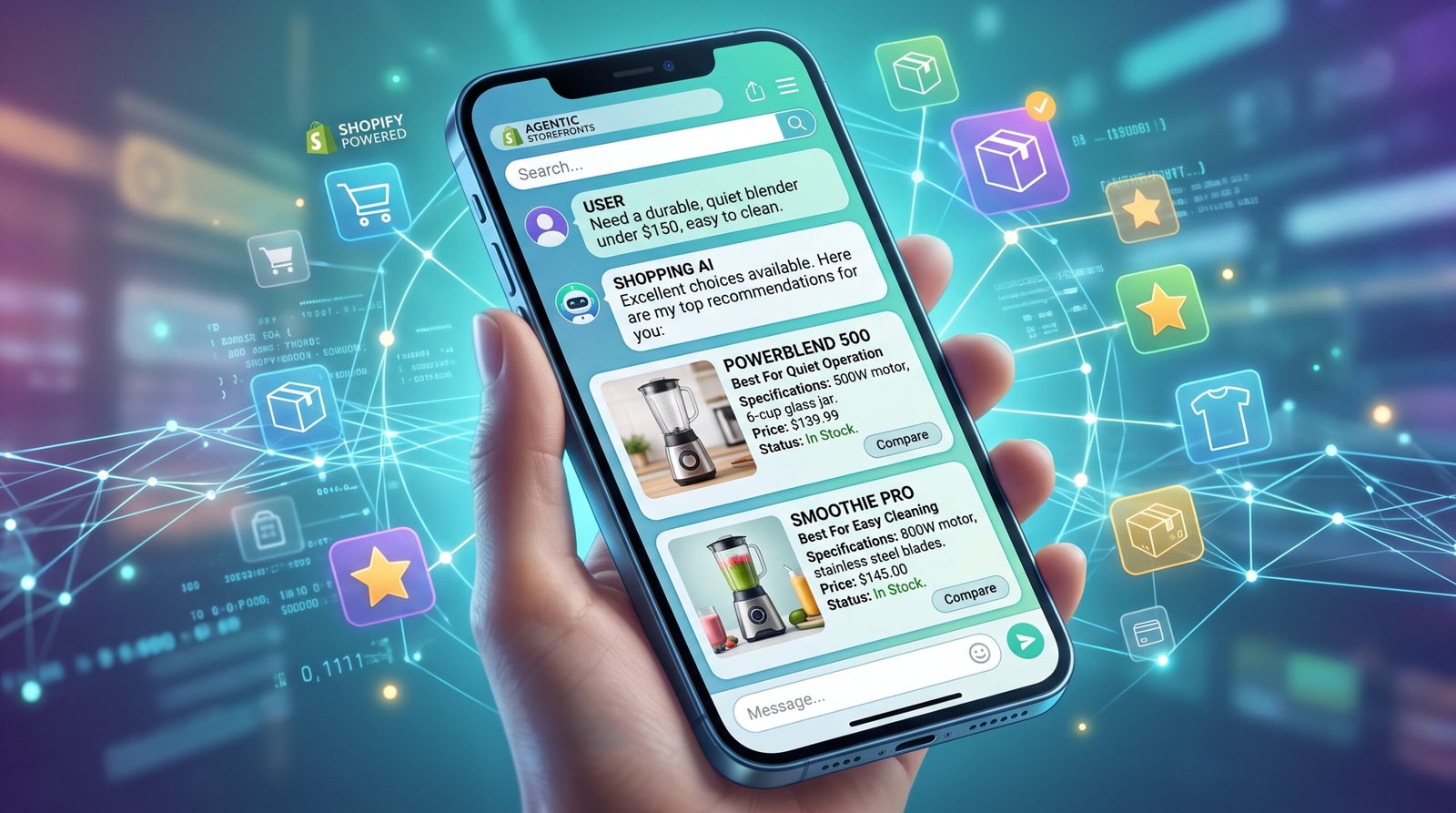
Your next customer may not begin their shopping journey on your website, Google, or a marketplace search bar. They may begin by asking an AI assistant what to buy.
That change sounds futuristic, but it is already becoming part of modern e-commerce. Shopify has been moving clearly in this direction with Agentic Storefronts, Shopify Catalog, and the Universal Commerce Protocol. In simple terms, Shopify is building infrastructure that allows eligible merchants’ products to be discovered through AI-shopping channels and, in some cases, purchased directly within those experiences.
For sellers, this raises an important question:
If an AI assistant looks at your product information, will it understand your product well enough to recommend it?
That is the practical issue.
AI commerce is not only about adding another sales channel. It changes how product information is read, compared, and used in the buying journey.
The Customer Journey Is Changing
In traditional e-commerce, the journey often looks like this:
A shopper searches a keyword, clicks a product listing, reads the page, compares a few options, and checks out.
But AI shopping creates a different pattern.
A customer may ask:
“What is a good gift for someone who just moved into a new apartment?”
“Which product is better for a small kitchen?”
“What should I buy if I want something easy to clean and under $200?”
“Compare these two options and tell me which one makes more sense.”
Instead of browsing many pages manually, the customer expects the AI assistant to narrow the options.
That means the AI needs to understand more than your product name. It needs to understand the product’s use case, size, price, benefits, specifications, limitations, availability, and why it fits a specific customer situation.
A vague product page will struggle in that environment.
Shopify Is Making Product Data More Important
Shopify says Shopify Catalog automatically structures product data so AI can find and surface products, and Agentic Storefronts can connect eligible products to AI-shopping platforms such as ChatGPT, Microsoft Copilot, Google AI Mode, and Gemini.
Shopify’s Help Center also explains that AI channels may access product data such as titles, descriptions, images, pricing, and availability through agentic storefronts. For channels that offer direct checkout, order details may also pass through the AI channel during the transaction flow.
This matters because product data is no longer just something customers read after landing on your site.
It may become the information layer that AI systems use before the customer even reaches your website.
Shopify also notes that Shopify Catalog supplies product data to AI channels, but each channel controls the final ranking, wording, and shopping experience.
That means sellers cannot fully control how every AI assistant presents their product. But they can control the quality, accuracy, and completeness of the product information available.
The New Product Page Test
In the past, many sellers asked:
“Does this product page include the right keywords?”
That still matters, but it is no longer enough.
A better modern test is:
“Could a human or AI assistant confidently explain this product to the right customer?”
If the answer is no, the product content needs work.
A strong product page should answer:
- What is this product?
- Who is it best for?
- What problem does it solve?
- What size, material, version, or specification matters?
- What is included?
- What should the buyer check before purchasing?
- How does it compare with similar options?
- What are the common questions before purchase?
- Is it available?
- What are the shipping, return, and warranty expectations?
This type of content helps AI shopping systems, but it also helps normal customers. Clear product information reduces hesitation and improves conversion.
AI Shopping Can Affect Sellers in Several Ways
First, discovery may become more conversational.
A shopper may no longer search only for exact product names. They may ask for recommendations based on lifestyle, problem, budget, size, or use case. Sellers who explain those contexts clearly have a better chance of being understood.
Second, product comparison becomes more important.
AI assistants are often used to compare options. If your product page does not clearly explain what makes the product different, the AI may not have enough useful information to represent it well.
Third, checkout may happen outside the traditional website experience.
Shopify says the Universal Commerce Protocol is designed to support agentic commerce from discovery to checkout, while preserving merchant checkout rules, discounts, and customizations.
This means a customer may potentially make a purchase inside an AI-powered experience rather than browsing your full website first. That makes accurate pricing, inventory, policies, and product data even more important.
Fourth, weak product data becomes a bigger disadvantage.
If your website has missing specifications, unclear descriptions, poor images, inconsistent product names, or outdated availability, that weakness can carry into AI discovery.
In other words, AI does not make messy product data less important. It makes it more visible.
What Sellers Should Do Now
The first step is not chasing “AI ranking tricks.”
The first step is building better commerce fundamentals.
Start with your most important products:
- bestsellers
- high-margin products
- products used in ads
- products with high traffic but weak conversion
- products with frequent customer questions
- products sold across multiple channels
Then improve the product record.
Make sure each product has a clear title, complete specifications, strong images, accurate price, current inventory, useful description, buyer-focused benefits, FAQs, comparison points, shipping details, return information, and warranty details.
Next, add more decision content.
Sections like these are becoming increasingly useful:
Best for
Choose this if
Not ideal for
Compare with
Before you buy
Frequently asked questions
What is included
These sections help shoppers decide. They also help AI systems understand the product in real buying contexts.
Clean Product Data Is Becoming a Growth Asset
Shopify says AI-driven traffic to Shopify stores grew 8× year over year in Q1 2026, while orders from AI-powered searches increased nearly 13×. Shopify also says AI searches using structured Catalog data converted at twice the rate of searches based on scraped data. These are Shopify-reported figures, so they should be treated as directional platform signals, not guaranteed results for every merchant.
Still, the implication is important.
As AI shopping grows, clean product data becomes a competitive advantage.
Your product information should be consistent across:
- Shopify
- marketplace listings
- Google Shopping
- ads
- product feeds
- customer-service documents
- internal reports
If each channel tells a slightly different story, customers and AI systems may become confused.
One reliable product-data source helps every channel perform better.
Key Takeaways
AI commerce does not mean every seller needs to build an AI tool.
It means every seller needs to make their products easier for AI systems and humans to understand.
The future product page is not just a description. It is a decision-support asset.
It should answer buyer questions, explain use cases, clarify specifications, support comparison, reduce uncertainty, and provide trustworthy information for every channel where the product may appear.
Customers are beginning to discover and evaluate products through AI conversations.
That means e-commerce businesses should stop thinking of product data as a back-office task.
It is now part of marketing, conversion, search, marketplace performance, and future AI discovery.
The sellers who prepare early will not be the ones chasing AI shortcuts.
They will be the ones with clearer product information, better structured data, stronger buying guidance, and a checkout experience ready for wherever the customer chooses to transact.