Customers Are Asking AI What to Buy. Can It Understand Your Products?
For years, e-commerce businesses have optimized product pages around one main idea:
What keywords are shoppers typing?
That still matters. But the way people shop online is changing.
Customers are no longer only typing short keywords into a search bar. They are asking questions. They are comparing options. They are using AI shopping assistants to narrow choices, understand products, check differences, and decide what to buy.
That shift matters for every business selling online.
Because the next big e-commerce question is not only:
Can shoppers find your product?
It is also:
Can AI understand your product well enough to recommend it?
Amazon Is Becoming a Shopping Decision Engine
Amazon is one of the clearest examples of this change.
Amazon says more than 250 million customers have used its AI shopping assistant this year. Monthly users are up 140% year over year, interactions are up 210%, and customers who use the assistant during a shopping journey are 60%+ more likely to convert. Amazon also says its Buy for Me agentic-shopping selection has grown from 65,000 products at launch to more than half a million products.
These are Amazon-reported figures, so businesses should treat them as a platform signal rather than a guaranteed result for every seller. But the direction is clear: AI-assisted shopping is no longer a small experiment.
Amazon’s AI shopping assistant is designed to help customers research products, compare options, understand what to look for, and make buying decisions. Amazon has also described its shopping assistant as using product catalog information, customer reviews, community Q&A, and information from across the web to answer shopper questions and provide recommendations based on conversational context.
That means product content is being interpreted in a more conversational way.
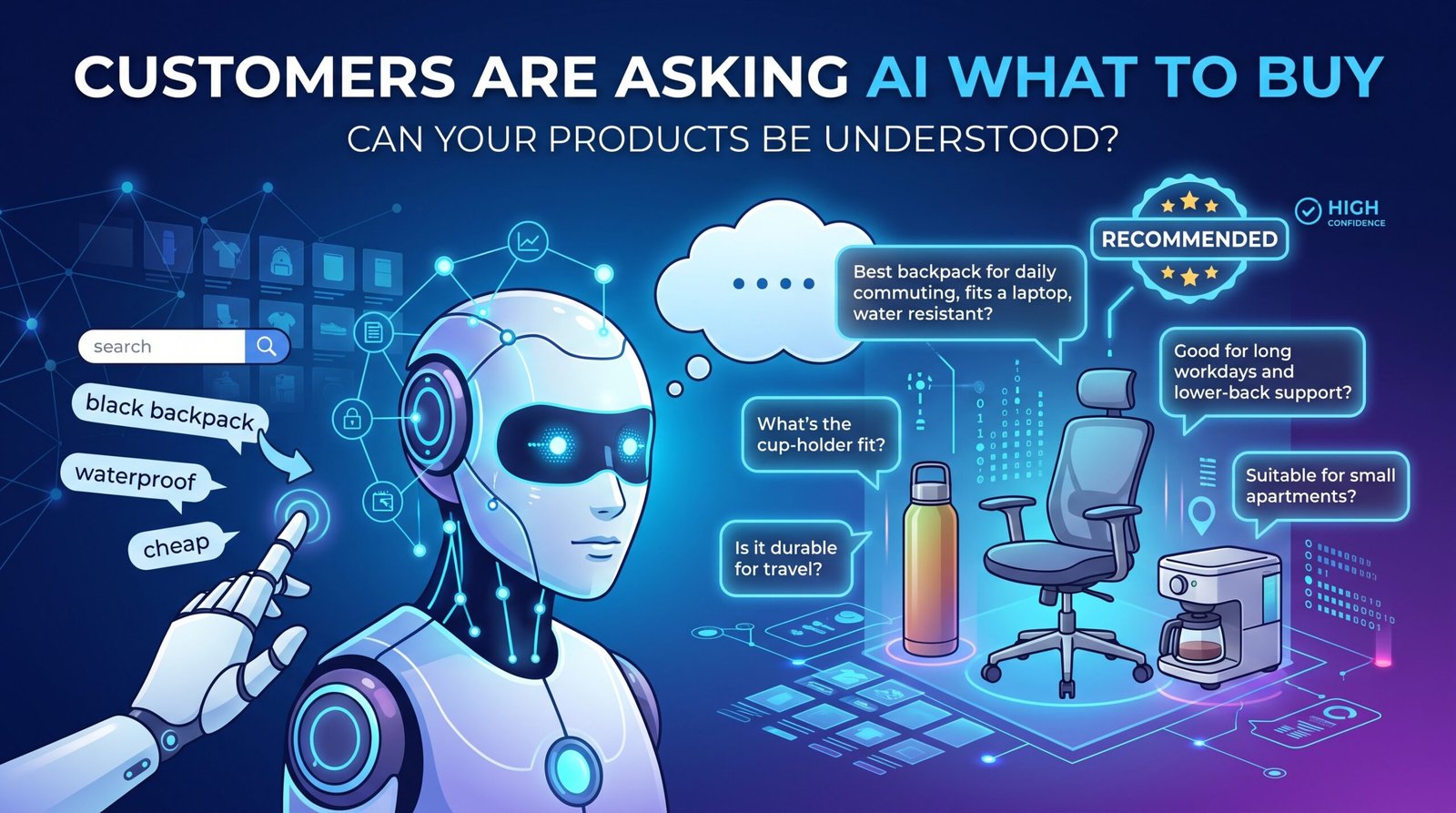
A traditional shopper might type:
“black backpack”
An AI-assisted shopper might ask:
“What backpack is good for daily commuting, fits a laptop, is water resistant, and does not look too bulky?”
Those are very different shopping behaviours.
Why This Matters for Your E-commerce Business
Many businesses still treat product pages as basic listings.
They include:
- product name
- price
- a few photos
- basic description
- maybe some specifications
That may not be enough anymore.
AI shopping systems need context. They need to understand what the product is, who it is for, what problem it solves, how it compares, what details matter, and when it is the right choice.
A product page that only says:
“High-quality modern product with premium features”
does not give a human shopper or an AI assistant enough useful information.
A stronger product page answers real buying questions:
- Who is this product best for?
- What problem does it solve?
- What size or version should the customer choose?
- What is included?
- What should the customer check before buying?
- How is it different from similar products?
- What materials, dimensions, features, or limitations matter?
- Is it suitable for beginners, small spaces, heavy use, gifting, travel, families, or professional use?
- What are the common mistakes customers should avoid?
The better your product content answers those questions, the easier it becomes for humans, search engines, marketplaces, and AI assistants to understand the product.
The Shift: Write Listings for Questions, Not Only Keywords
Keyword optimization is not disappearing. But it is becoming only one layer of product-content strategy.
A keyword-focused listing asks:
What words should we include so the product appears in search?
A question-ready listing asks:
What does the shopper need to know before they feel confident buying?
That is a much stronger approach.
For example, instead of only writing:
“stainless steel insulated bottle”
a stronger product page may explain:
best for commuting, gym, school, travel, hot drinks, cold drinks, leak resistance, cup-holder fit, cleaning, capacity, and material safety.
Instead of only writing:
“ergonomic office chair”
a stronger page may answer:
best for long workdays, small home offices, lower-back support, height range, floor type, assembly time, and comparison with similar models.
Instead of only writing:
“compact kitchen appliance”
a stronger page may explain:
best for small apartments, meal prep, easy cleaning, beginner use, family portions, storage, and what accessories are included.
This kind of content does more than improve AI readiness. It also improves conversion because it answers the questions customers already have.
Shop Direct Makes Website Product Data More Important
Amazon is also expanding Shop Direct, which lets products from external merchant websites appear in Amazon search and AI shopping experiences. Amazon says Shop Direct includes over 100 million products from more than 400,000 merchants, and merchants can use product feeds through providers including Feedonomics, Salsify, and CEDCommerce to sync catalog, pricing, and inventory with Shop Direct.
This is important because it shows a larger direction in e-commerce:
Product discovery may happen in places outside your own website, even when the transaction connects back to your website.
For Shopify and independent e-commerce businesses, this makes structured product data more valuable.
Your own website cannot be treated as an isolated store anymore. It may become a product-data source for:
- search engines
- marketplaces
- shopping feeds
- AI assistants
- comparison tools
- advertising platforms
- external discovery systems
If your product data is incomplete, inconsistent, or outdated, those systems may misunderstand what you sell.
That can hurt visibility, conversion, and customer trust.
Product Data Is Becoming a Sales Asset
This is why product data should no longer be treated as a back-office task.
Strong product data helps your business answer:
- What exactly is this product?
- Which category does it belong in?
- Which attributes matter?
- Who should buy it?
- What problem does it solve?
- What makes it different?
- What products is it compatible with?
- What is the correct price and availability?
- What questions should be answered before purchase?
Clean product data supports product pages, Google Shopping, marketplace listings, ads, customer service, reporting, and AI-assisted discovery.
Messy product data creates friction everywhere.
A product may have one title on the website, a slightly different title on a marketplace, incomplete attributes in a product feed, outdated details in an ad, and missing specifications in customer support documents.
That makes it harder for customers to trust the business and harder for platforms to understand the product.
How This Can Help Your Business Sell More
The benefit of AI-shopping readiness is not abstract.
It can help your e-commerce business in practical ways.
First, it can improve conversion. Clear product information reduces hesitation and helps shoppers make decisions faster.
Second, it can improve marketplace performance. Complete titles, attributes, images, and FAQs make listings stronger.
Third, it can improve product-feed quality. Clean structured data helps shopping platforms understand what you sell.
Fourth, it can reduce returns. Customers are less likely to buy the wrong item when expectations are clear.
Fifth, it can support future AI discovery. As platforms use AI to answer product questions, your content needs to be understandable enough to appear in the right context.
The goal is not to chase every AI trend.
The goal is to make your product catalog clear enough that every sales channel can use it properly.
What Businesses Should Do Now
Start with your top products.
Do not try to fix the entire catalog at once. Choose the products that matter most:
- bestsellers
- high-margin products
- products used in ads
- products sold across multiple channels
- products with high traffic but weak conversion
- products with frequent customer questions
- products with high return rates
Then review each product page and listing through a simple question:
Could a person or AI assistant confidently explain who this product is for and why someone should buy it?
If the answer is no, improve the content.
Add clearer specifications. Add use cases. Add FAQs. Add comparison points. Add what is included. Add size, material, compatibility, care, warranty, shipping, and return details where relevant.
Also make sure the same core product data is consistent across your website, marketplace listings, product feeds, ads, and internal reports.
Key Takeaways
Amazon’s AI-shopping growth is not something e-commerce businesses should ignore.
It signals a larger change in how customers discover and evaluate products online. Shoppers are moving from simple keyword searches toward conversational shopping, product comparisons, and AI-assisted recommendations.
That means product content needs to evolve.
The businesses that win will not only be the ones with the most keywords. They will be the ones whose products are easiest to understand, compare, trust, and recommend.
Your product listings should not only say what the product is.
They should answer the questions customers are already asking.
Because in the future of e-commerce, the winning product may not simply be the one that appears in search.
It may be the one that AI can understand well enough to recommend.