Automation Does Not Mean AI Everywhere
AI is everywhere right now.
Businesses are talking about AI agents, AI chatbots, AI dashboards, AI customer service, AI reporting, AI content creation, and AI-powered operations. It is exciting, and in many cases, genuinely useful.
But there is one misunderstanding that can lead businesses in the wrong direction:
Automation does not mean AI everywhere.
Not every workflow needs an AI agent. Not every repeated task needs a language model. Not every business problem should be handed to a chatbot. Sometimes the smartest solution is not more AI. It is a clear rule, a clean process, a better spreadsheet, a simple integration, or a workflow that runs consistently in the background.
The goal is not to make everything “AI-powered.”
The goal is to make the business work better.
Automation and AI Are Not the Same Thing
Automation means a task happens automatically based on a defined process.
AI means software can interpret, generate, summarize, classify, or reason through information in a more flexible way.
They can work together, but they are not the same.
A simple example:
If an order has not shipped after three days, the system can automatically flag it.
That does not require AI. It is a rule.
But if the business wants to understand why late shipments are increasing, which products are affected, whether the issue is warehouse-related, carrier-related, supplier-related, or caused by a promotion, AI may help summarize the pattern.
The first task is automation.
The second task benefits from AI.
Confusing the two can make systems more expensive, more complicated, and less reliable than necessary.
Use Rules When the Rules Are Clear
Many business tasks are repetitive and predictable.
They do not need creativity. They do not need interpretation. They simply need to happen accurately every time.
For example:
- Send an alert when inventory drops below a set level.
- Tag an order when shipping is delayed.
- Add a customer to an email segment after purchase.
- Update a dashboard when new data is uploaded.
- Flag a product listing when required fields are missing.
- Send a reminder when a promotion is about to expire.
- Generate a weekly sales report from fixed data sources.
These are rule-based workflows.
A business does not need AI to decide that inventory below ten units should be reviewed. The threshold is already known. The system simply needs to check the number and trigger the next step.
This kind of automation is powerful because it is consistent, predictable, and easy to audit.
When a rule is clear, use a rule.
Use AI When Interpretation Is Needed
AI becomes useful when the situation is less straightforward.
For example, a system can automatically detect that sales dropped 20%. But AI can help investigate possible reasons:
- Did traffic decline?
- Did conversion rate change?
- Did a promotion end?
- Did a product go out of stock?
- Did a marketplace listing lose visibility?
- Did a competitor lower their price?
- Did returns increase?
- Did ad spend change?
AI can summarize the pattern and suggest what a human should review next.
That is a better use of AI than asking it to run every basic step.
In e-commerce, AI is especially useful for:
- summarizing performance changes
- identifying unusual patterns
- reviewing product-page weaknesses
- drafting listing improvements
- analyzing customer feedback
- explaining why a campaign may not be profitable
- comparing product performance across channels
- turning messy notes into structured recommendations
AI is strongest when the work involves judgment, language, context, and analysis.
Use Humans When Responsibility Is Involved
Some actions should not be fully automated, even if they technically could be.
For example:
- changing prices
- approving large purchase orders
- issuing refunds
- changing advertising budgets
- sending sensitive customer messages
- making warranty exceptions
- publishing major website updates
- removing important products from sale
These actions affect money, customers, brand trust, or operational risk.
AI can support the decision, but a human should approve the action.
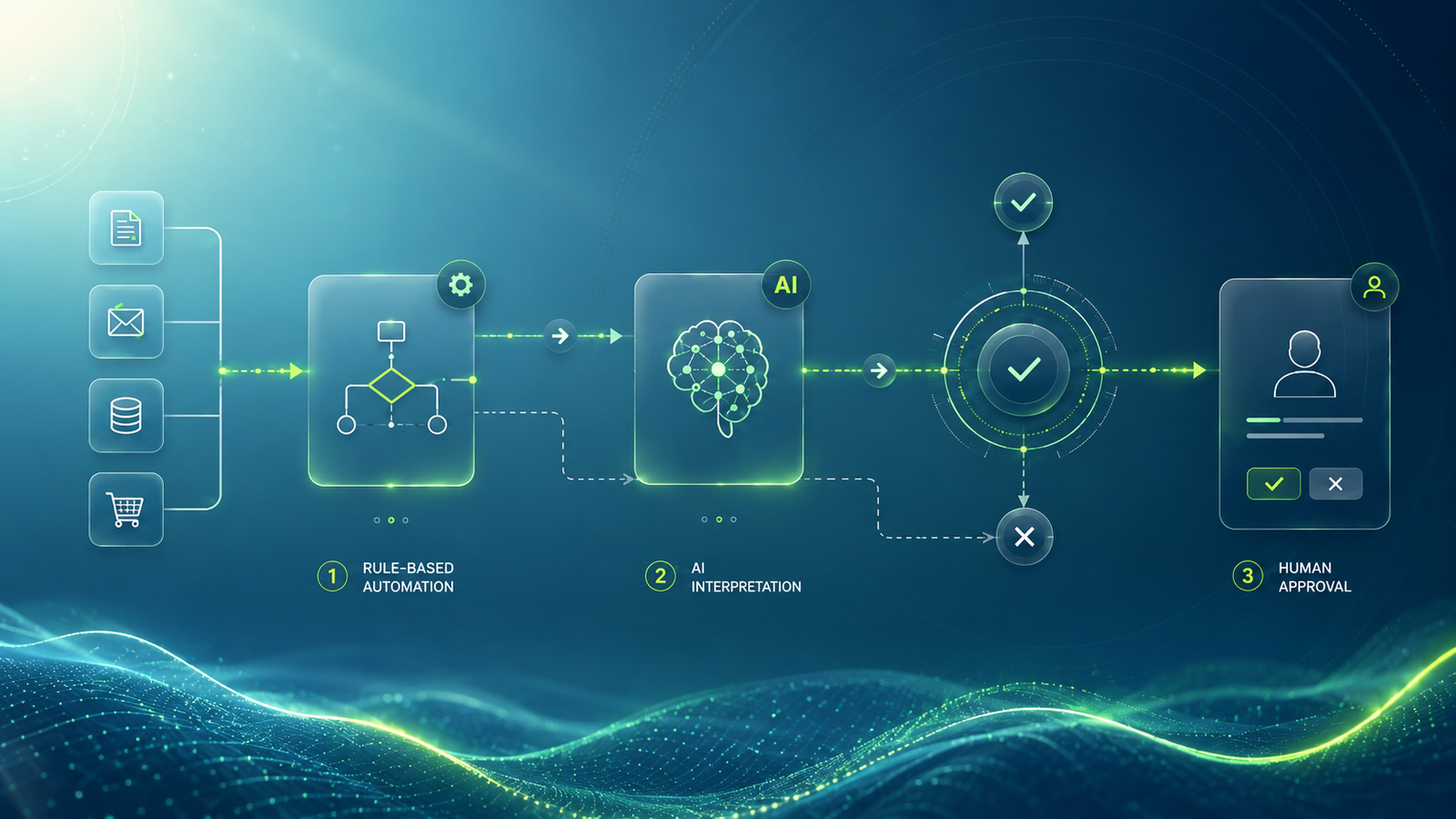
A strong workflow might look like this:
Rule detects a low-stock product.
AI analyzes sales velocity, margin, supplier lead time, and current ad campaigns.
Human approves whether to reorder, pause ads, or adjust promotion.
That is a responsible system.
A risky system says:
AI noticed low inventory and automatically reordered $20,000 of stock.
The difference is not technical ability. The difference is business judgment.
The Best Systems Combine Rules, AI, and Human Approval
The most effective business automation is usually not one giant AI agent doing everything.
It is a layered system.
First, clean data enters the workflow.
Then rules handle the predictable steps.
Then AI interprets the situations that need judgment.
Then humans approve the decisions that carry risk.
For example, an e-commerce performance workflow could work like this:
Step 1: Data collection
Sales, inventory, ad spend, product cost, returns, and marketplace data are pulled into one report.
Step 2: Rule-based checks
The system flags low inventory, high return rates, declining conversion, expiring promotions, or products spending too much on ads.
Step 3: AI interpretation
AI reviews the flagged issues and summarizes which ones matter most.
Step 4: Human decision
The business owner or manager decides whether to reorder, pause ads, update listings, change pricing, or launch a promotion.
That system is much stronger than simply asking AI:
“What should I do this week?”
Good automation gives AI better information to work with. Good AI helps humans focus on the right decisions.
AI Everywhere Can Become Expensive and Fragile
Using AI for every task may sound advanced, but it can create problems.
AI costs money every time it runs. It can misinterpret data. It may produce inconsistent answers. It may require monitoring, testing, permission controls, and human review. If the task is simple and rule-based, AI may add complexity without adding value.
For example, you do not need AI to calculate whether a product has fewer than ten units in stock.
A basic formula can do that.
You may need AI to explain whether that low-stock product should be prioritized based on sales trend, profit margin, seasonality, and active campaigns.
This distinction matters.
The best question is not:
“How can we add AI?”
The better question is:
“Where does AI actually improve the workflow?”
Sometimes the answer is one small part of the process, not the whole process.
Process Cleanup Comes Before Automation
Many businesses want automation before their process is ready.
They have inconsistent product data, unclear responsibilities, outdated spreadsheets, disconnected sales channels, missing cost information, and no clear rules for what should happen next.
Adding AI on top of that mess does not fix the operation.
It may simply make confusion faster.
Before automating, businesses should ask:
- Is the data reliable?
- Is there one source of truth?
- Are SKUs consistent?
- Are product costs updated?
- Are inventory numbers accurate?
- Are return reasons categorized?
- Are promotion dates tracked?
- Are team responsibilities clear?
- Do we know what should happen when an issue is flagged?
Automation works best when the process underneath it is clear.
AI works best when the information underneath it is trustworthy.
A Practical Rule: Automate the Repetition, Use AI for the Reasoning
A simple way to decide where AI belongs is this:
Automate the repetition. Use AI for the reasoning.
If a task follows the same steps every time, automate it with rules.
If a task requires judgment, comparison, summarization, or explanation, consider AI.
If a task carries financial, legal, customer, or brand risk, keep a human approval step.
This approach prevents businesses from overcomplicating simple work and under-controlling important decisions.
It also makes automation easier to maintain.
When something breaks, the team can see whether the issue came from the data, the rule, the AI interpretation, or the human approval step.
That is much easier to troubleshoot than a black-box AI system doing everything.
What This Means for Growing Businesses
For growing e-commerce and service businesses, automation should start with practical problems:
- reporting takes too long
- product data is inconsistent
- orders need manual checking
- promotions are hard to track
- inventory issues are discovered too late
- customer questions repeat often
- marketplace listings need regular review
- ad performance is disconnected from profit
Some of these problems need automation.
Some need AI.
Some need better internal process first.
A mature business does not chase AI for its own sake. It designs systems that are useful, measurable, and responsible.
The Bottom Line
Automation does not mean AI everywhere.
That is actually good news.
It means businesses do not need to rebuild everything with complicated AI agents to become more efficient. They can start by cleaning their data, clarifying their processes, automating repetitive tasks, and using AI only where interpretation adds real value.
Use rules where the answer is clear.
Use AI where the situation needs analysis.
Use humans where responsibility matters.
That is how businesses build automation that is not only impressive, but practical.
Because the goal is not to say, “We use AI.”
The goal is to make better decisions, reduce manual work, avoid preventable mistakes, and create a business system that actually works.