NorthPilot
Digital growth, clearly navigated
AI is changing how social media advertisements reach customers. But the biggest opportunity isn’t creating more ads, it’s discovering which messages actually motivate people to take action.
Imagine spending $1,000 on social media advertising. You create one beautiful advertisement, select your target audience, launch the campaign, and wait for results. A week later, the advertisement has generated thousands of impressions but very few customers. Was the audience wrong? Was the image ineffective? Was the message unconvincing? Without testing different creative approaches, you simply don’t know.
In the AI advertising era, successful marketing is becoming less about finding one perfect advertisement and more about systematically discovering what resonates with different customers.
For small businesses, this changes how advertising budgets should be planned and measured.
1. AI Is Changing How Social Advertising Works
Advertising platforms increasingly use artificial intelligence to determine which advertisements to show, where to display them, and which audiences are most likely to respond. Automated advertising tools can optimize campaign delivery, adjust placements, and help advertisers generate creative variations.
In 2026, major advertising platforms expanded their AI-powered creative capabilities, including image generation, text variations, and tools for producing different advertising formats. However, automation does not eliminate the need for marketing strategy. AI can optimize advertisements using the information and creative assets available to it. It cannot automatically understand every customer’s concerns, your business’s competitive advantages, or which promises your company can genuinely deliver.
Those decisions still require human understanding.
2. Creative Diversity Is More Important Than Creative Quantity
Many businesses misunderstand creative testing. They produce five advertisements using the same photograph, changing only the headline or background colour. Technically, these are five advertisements. Strategically, they may communicate exactly the same message. Meaningful creative diversity involves testing different reasons why customers might buy. Consider an online business selling everyday lifestyle products:
Creative A — Convenience
“Make your daily routine simpler with products designed for everyday living.”
Creative B — Quality
“Discover the details that make a well-designed product worth choosing.”
Creative C — Value
“Looking for something practical? Here’s what to consider before buying.”
These advertisements approach the same product category from three different customer motivations. Recent advertising training from Meta emphasizes varying creative formats, visuals, and messages rather than producing nearly identical advertisements.
The objective is not to create more content for the sake of volume. It is to test genuinely different marketing hypotheses.
3. Start With Three Customer Motivations
Before creating advertisements, identify three reasons customers might be interested in your product or service. For an online retailer, those motivations could be convenience, quality, and affordability. For a service business, they might be saving time, solving a recurring problem, or gaining professional expertise. Then create one advertisement for each motivation.
For example, a small business offering professional services might test:
Ad A — Time Savings
“Spending too much time managing everyday business tasks? Discover a simpler approach.”
Ad B — Problem Solving
“Struggling with repetitive work? See how a more organized process can help.”
Ad C — Expert Guidance
“Not sure where to start? Get practical guidance tailored to your business needs.”
Each advertisement should lead to a relevant landing page offering useful information. This approach helps identify which customer problems deserve further marketing investment.
4. How to Run a CAD $500 Creative Test
Small businesses don’t need enormous advertising budgets to begin learning. Consider an illustrative CAD $500 creative test:
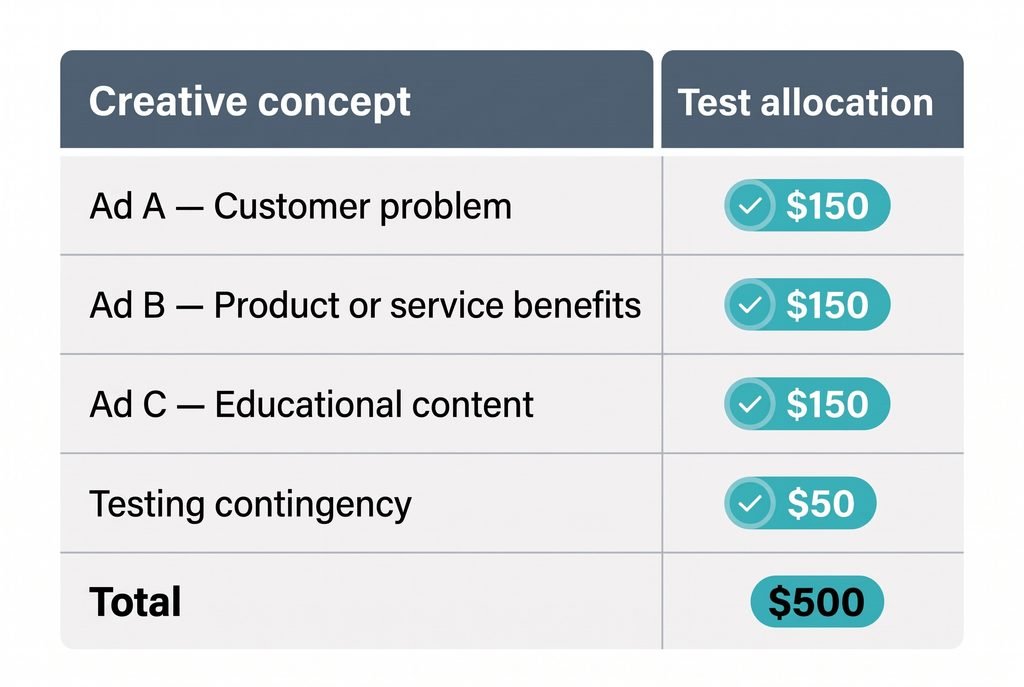
These allocations represent a planning example, not guaranteed platform spending. Where supported, use a controlled A/B testing tool to compare creative concepts. Keep the campaign objective, landing-page experience, and other major variables consistent. Avoid making frequent changes while the advertising system is learning. At this budget, the results may provide useful directional evidence, but they are unlikely to establish small performance differences with statistical confidence.
The goal is to identify promising messages for further testing, not declare a permanent winner after a few days.
5. Measure Business Results, Not Just Engagement
A common advertising mistake is choosing the advertisement with the most likes or cheapest clicks. Those metrics can be useful, but they do not necessarily indicate business success.
Imagine two hypothetical advertisements:
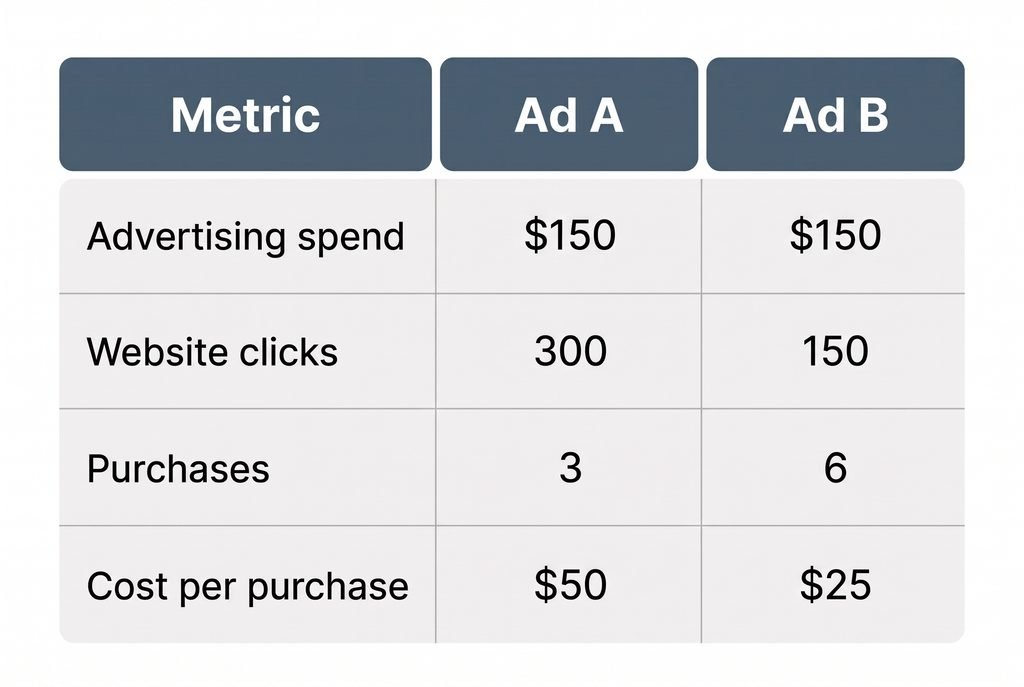
Ad A generated twice as many clicks. However, Ad B generated twice as many purchases at half the acquisition cost. If both advertisements promoted the same product at the same margin, Ad B would likely be more commercially attractive.
For e-commerce businesses, evaluate contribution profit after product costs, advertising, fulfillment, and expected returns. For service businesses, track qualified inquiries, appointments, and actual customer acquisition, not merely form submissions.
The best advertisement isn’t necessarily the one that attracts the most attention. It’s the one that produces the most valuable business outcome.
6. Where AI Creative Tools Actually Help
AI can make creative experimentation faster and more affordable. Businesses can use AI-assisted tools to brainstorm different hooks, adapt images for various placements, draft script variations, and generate initial creative concepts. Modern advertising platforms increasingly provide these capabilities directly within their campaign-management systems.
For example, AI-assisted creative tools can help turn an existing product image into several visual concepts or adapt one message for different advertising formats. However, generated content still needs human review. Check product specifications, pricing, testimonials, visual accuracy, brand consistency, and advertising-policy compliance. Businesses should also ensure that advertising claims are truthful and supported by evidence.
AI should accelerate creative production, not replace factual accuracy or professional judgment.
7. Build a Continuous Creative Testing System
Creative testing should not be a one-time campaign exercise. A practical monthly process might look like this:
Week 1: Review customer questions, sales feedback, and previous campaign performance.
Week 2: Develop three distinct creative concepts and launch an appropriately structured test.
Week 3: Review early results, check tracking accuracy, and avoid unnecessary campaign changes.
Week 4: Evaluate meaningful business outcomes, document lessons, and plan the next experiment.
Keep a simple creative testing log showing the hypothesis, message, format, audience, budget, and results. Over time, this creates a valuable record of what customers respond to. Instead of repeatedly guessing what might work, the business builds its own marketing knowledge.
The Future of Advertising Isn’t One Perfect Ad
AI is making advertising delivery increasingly automated, but that doesn’t mean marketing strategy is becoming irrelevant. It means businesses need stronger customer insights, more distinctive creative ideas, accurate conversion measurement, and a disciplined testing process. The competitive advantage isn’t producing dozens of AI-generated advertisements.
It’s knowing which customer problems to address, which messages to test, and which results justify further investment.
Before increasing your advertising budget, make sure you’re learning from the budget you already have.